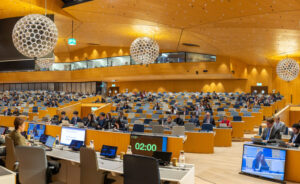
At the most recent meeting of the Standing Committee on Copyright and Related Rights of the World Intellectual Property Organization (SCCR/47), four documents were presented that could serve as a starting point for text-based work at the next meeting in May 2026 (SCCR/48) in accordance with the Work Program on Exceptions and Limitations (SCCR/43/8 Rev.) adopted by the Committee in 2023:
- The African Group ”Proposal on Limitations and Exceptions” (SCCR/47/5), published on October 7, 2025.
- The United States documents: “Objectives and Principles for Exceptions and Limitations for Libraries and Archives” (SCCR/47/10) and “Objectives and Principles for Exceptions and Limitations for Educational, Teaching, and Research Institutions” (SCCR/47/9);
- The Chair’s Text of November 10, 2025, prepared by the chair and vice chair of the SCCR and entitled “Text Proposed in the Framework of Work Towards an Appropriate International Legal Instrument or Instruments on Limitations and Exceptions” (SCCR/47/8).
Below is a table that compares these proposals. The two proposals from the United States are combined in a single column; and the African Group Proposal and the Chair’s text each have their own columns.
The table demonstrates that there are significant areas of commonality among all four documents; and even more between the Chair’s text and the African Group Proposal. This suggests that further text-based work in the Committee towards an international legal instrument or instruments concerning exceptions and limitations can start with these documents.
| Expand a section below to compare: | |||
|---|---|---|---|
| African Group | Chair's Text | US Proposals | |
| Proposal on L&Es Prepared by the African Group (SCCR/47/5) | Proposals in the Framework of Work Towards an Appropriate International Legal Instrument or Instruments on L&Es. Proposal by SCCR Chair and Vice-Chair (SCCR/47/8) | U.S. Objectives and Principles on L&Es for Educational, Research, and Teaching Institutions (SCCR/47/9) and Libraries and Archives (SCCR/47/10) | Full Name of Document |
| Contracting Parties shall take all appropriate measures to respect, protect and fulfill the right to receive education and conduct research through appropriate exceptions and limitations in their national laws, consistent with their international obligations, maintaining the balance between the rights of authors and the larger public interest. (p. 15). Member States shall provide an appropriate balance in their copyright and related rights system through limitations and exceptions for the public interest, including for education; research; freedom of expression uses such as for quotation, comment, criticism, review, caricature, parody and pastiche; access to information and news reporting; preservation of cultural heritage; and to facilitate access for persons with disabilities. (p. 15). Contracting Parties shall update, carry forward and appropriately extend into the digital environment limitations and exceptions in their national laws which have been considered acceptable under the Berne Convention, especially under article 10(1) and 10(2), and devise new exceptions and limitations that are appropriate in the digital environment to protect educational and research activities. (p. 15). | Limitations and exceptions are an integral part of a balanced copyright system and should contribute to quality preservation, access, education and research, as well as to expand opportunities for all persons with disabilities to fully participate in the cultural life of the community, to enjoy the arts, and to benefit from scientific progress. (p. 6) Promote cooperation among institutions at national, regional and international levels. (p. 6). | Encourage Member States to adopt well-focused exceptions and limitations in their national laws that are consistent with their international obligations, including the three-step test, facilitate the public service role of libraries and archives, and maintain the balance between the rights of authors, artists and publishers, and the public interest, particularly in research, education, preservation, and access to information. (L&A, p. 2) Encourage Member States, when adopting or revising exceptions and limitations for libraries and archives, to consider adding museums and other non-profit institutions that provide similar public service functions as libraries and archives, including carrying responsibility for the preservation and stewardship of the cultural knowledge and heritage. Therefore, it is likewise important to support their mission of curating, studying, and sharing information, knowledge, and cultural heritage with the public and to promote the adaptation of exceptions and limitations to ensure that laws at the national level enable the preservation activities of libraries and archives, or possibly museums and other non-profit institutions that provide similar public service functions as a libraries and archives. (L&A, p. 2) Encourage Member States to adopt well-focused exceptions and limitations in their national laws, consistent with their international obligations, including the three-step test, that allow certain uses of copyrighted works for nonprofit educational purposes, maintaining the balance between the rights of authors and the larger public interest, particularly education, research, and accessto information. (ERT, p. 2) | National Exceptions |
| It shall be permissible to use a work or other subject matter for educational or research purposes to the extent justified by the purpose and provided such utilization is compatible with fair practice. (p. 19) Uses in the course of teaching activities, such as: i. making private copies, including in preparation of a course of instruction; ii. performing or communicating by way of illustration, or for comment, criticism, or review, in the course of instruction, including in online education; iii. making and distributing copies or excerpts for use in a course of instruction; and iv. making and administering examinations, including the drafting of questions and communicating the questions to students. (pp. 19-21) Uses in the course of learning activities, such as: i. making private copies for purposes of study; ii. including works of visual arts, short works and other subject matter, and excerpts of longer works or other subject matter in assignments and in responses to examinations; iii. translating or otherwise adapting for use in assignments and examinations; and performing or otherwise communicating in an educational context, including by wire or wireless means. iv. performing or otherwise communicating in an educational context, including by wire or wireless means; (pp. 21-23) | Facilitate access to works for cultural, educational and research purposes, including through digital and online tools, and across borders. (p. 5) Enable cultural heritage institutions as well as educational and research institutions to provide copies and enable access to works to researchers, teachers, students and the public, under appropriate conditions. (p. 5) Educational and research institutions: schools, universities, and other entities of a similar nature furthering educational or research purposes. (p. 4) | Encourage Member States to enable libraries and archives to carry out their public service role of advancing research and knowledge by adopting exceptions and limitations for purposes of research and scholarship, and to consider adding museums and other non-profit institutions that provide similar functions as libraries or archives, as eligible entities. (L&A, p. 4) Exceptions and limitations for education and research support the core functions of nonprofit educational institutions at all levels, by advancing knowledge by preserving the world’s cultural, artistic, and scientific heritage and facilitating access to and dissemination of knowledge for teaching and learning. (ERT, p. 2) Exceptions and limitations for education and research also further societal goals by helping individuals to achieve their potential and to participate meaningfully in public life. (ERT, p. 2) Support exceptions and limitations, consistent with international obligations, such as the three-step test, that recognize the importance of copyright while continuing to foster and allow certain uses in technologically evolving learning environments. (ERT, p. 4) Exceptions and limitations that support technologically evolving learning environments, such as online and blended learning, are an important way to keep pace with new technology and methods of learning and can enhance and encourage broader dissemination of learning tools. (ERT, p. 4) Specific national exceptions and limitations in the online environment that permit the nonprofit use of reasonable and limited portions of works in connection with online teaching and learning and other technology-supported learning approaches may enable a wide variety of learners who lack physical access to educational facilities the opportunity to learn. (ERT, p. 2) | Research and Education |
| Contracting Parties shall provide for a limitation or exception to the right of reproduction in order to allow cultural heritage institutions to make copies of any works or other subject matter that are permanently in their collections, in any format or medium, for the purposes of preservation of such works or other subject matter and to the extent necessary for such preservation. (p. 29) For purposes of this Instrument, “cultural heritage institution” means a publicly accessible library or museum, an archive, or a film or audio heritage institution. (p. 31) | Support the preservation of cultural heritage by libraries, archives and museums and other not-for-profit entities performing equivalent functions. (p. 4) Enable cultural heritage institutions to make copies of works, whether published or unpublished, for the purposes of preservation or replacement, including highly ephemeral materials. Such copies may be made in analogy or digital formats, and during technological migration, provided they are necessary and incidental to a specific preservation purpose. (p. 4) Enable the preservation of and remote digital access to works, including cross-border, under secure conditions and promote the respect of adequate and effective digital security measures. (p. 5) Enable libraries, archives, and museums to fulfill their public service mission of preserving the cumulative knowledge and heritage of nations and people. (p. 6) Allow cultural heritage institutions to proactively preserve materials at risk of deterioration, obsolescence and damage, as reasonably necessary for the purpose of preservation. (p. 6) Apply exceptions and limitations for libraries, archives, and museums solely to non-commercial activities, and not to activities undertaken for direct or indirect commercial advantage. (p. 6) Enable the preservation and migration of content, including from obsolete formats to new ones. Permit the making of copies of works for preservation and replacement, under certain appropriate circumstances, including digital conversion and format shifting. (p. 6) Cultural heritage institutions: libraries, archives, museums and other not-for-profit entities performing equivalent functions. (p. 4) Preservation: activities aimed at maintaining, stabilizing, restoring or migrating works, whether published or unpublished, to prevent their loss or deterioration, including the conversion of analog to digital formats and migration to stable technological formats. (p. 4). | Encourage Member States to enable libraries and archives to carry out their public service role of preserving works by adopting exceptions and limitations for their preservation activities, and to consider adding museums and other non-profit institutions that provide similar functions as libraries or archives, as eligible entities. (L&A, p. 3) Exceptions and limitations can and should enable libraries, archives, and museums to carry out their public service role of preserving works that comprise the cumulative knowledge, heritage, and culture of the world’s nations and peoples. (L&A, p. 4) Exceptions and limitations can and should enable libraries, archives, and museums to make copies of published and unpublished works, including highly ephemeral materials, for purposes of preservation and replacement, under certain appropriate circumstances. Those circumstances may include preservation and replacement in both analogy and digital formats, or migration of content from obsolete storage formats to more stable formats on an ongoing basis, as reasonably necessary and as incidental to technology for a specific, limited preservation purpose. (L&A, p. 4) | Preservation |
| Contracting Parties shall provide for a limitation or exception to the right of reproduction, the right of distribution, and the right of making available in order to allow cultural heritage institutions to provide access to preserved works and other subject matter in their collections as follows: a. Cultural heritage institutions shall be permitted to provide on the premises access to copies in any format or medium. b. Cultural heritage institutions shall be permitted to provide copies in any format or medium to persons for the purpose of private study, scholarship, or research. c. Cultural heritage institutions shall be permitted to reproduce and make available to the public any work or other subject matter which is out of commerce, where no suitable licences covering the needs and specificities of cultural heritage institutions are easily available on the market. (p. 29) | Facilitate access to works for cultural, educational and research purposes, including through digital and online tools, and across borders. (p. 5) Enable cultural heritage institutions as well as educational and research institutions to provide copies and enable access to works to researchers, teachers, students and the public, under appropriate conditions. (p. 5) Enable the preservation of and remote digital access to works, including cross-border, under secure conditions and promote the respect of adequate and effective digital security measures. (p. 5) Access: on-site or remote availability to use works for the purposes of private study, cultural enjoyment, and education or research. (p. 4) | Reasonable exceptions and limitations can and should establish the framework enabling libraries, archives, and museums to supply copies of certain materials to researchers, scholars, and other users, directly or through eligible intermediary institutions, and accessible either on premises or, with effective digital security measures, remotely, under certain appropriate circumstances. Those circumstances may include access by a single user at a time, for a limited time. (L&A, p. 4) Encourage Member States to enable libraries and archives to carry out their public service role in the digital environment by adopting exceptions and limitations for providing public access to their digital collections, and to consider adding museums and other non-profit institutions that provide similar public services functions as libraries or archives, as eligible entities. (L&A, p. 4) Limitations and exceptions should appropriately ensure that libraries, archives, and museums can preserve and provide access to information and materials developed and/or disseminated in digital form and through networked technologies, while implementing reasonable and effective digital security measures that protect rights holders and ensure that the limitations and exceptions are meeting international obligations, such as the three-step test. (L&A, p. 4) | Access |
| It shall be permissible to produce, distribute, and make available accessible format copies of works for the benefit of people with any disability that requires such format to enjoy the work on an equitable basis with others. (p. 33) [M]aking and providing accessible format copies of works to teachers, students, or researchers with disabilities, including by import and export. (p. 25). | Facilitate access to published works in accessible formats for persons with disabilities other than those covered by the Marrakesh Treaty (p. 5) Facilitate access to published works in accessible formats for persons with disabilities other than those covered by the Marrakesh Treaty, under appropriate conditions that may include: use solely for the purpose of producing material in accessible formats (p. 5) the respect of adequate and effective digital security measures (p. 7) Interoperability of systems should be encouraged to facilitate i. access to works for persons with disabilities and ii. controlled cross-border uses (p. 7) Persons with disabilities: includes those who have long-term physical, mental, intellectual, or sensory impairments which, in interaction with various barriers, may hinder their full and effective participation in society on an equal basis with others. (p. 4) | Acknowledge that Member States are permitted to provide exceptions and limitations beyond those provided by the WIPO Marrakesh Treaty to Facilitate Access to Published Works for Persons Who are Blind, Visually Impaired, or otherwise Print Disabled, as long as they are consistent with the three-step test, applied solely to noncommercial activities by non-profit institutions, and do not apply to those activities undertaken for direct or indirect commercial advantage. (L&A, p. 3) Acknowledge that the WIPO Marrakesh Treaty to Facilitate Access to Published Works for Persons Who are Blind, Visually Impaired, or otherwise Print Disabled (Marrakesh Treaty) does not apply to people with other disabilities. (L&A, p. 3) Noting that any exceptions or limitations for people with disabilities not covered by the Marrakesh Treaty should be restricted to accessible format copies of works for the benefit of people with the disabilities specifically identified in the exception or limitation and are consistent with the three-step test, applied solely to non-commercial activities, and do not apply to those activities undertaken for direct or indirect commercial advantage. (L&A, p. 3) | People With Other Disabilities |
| Limitations and exceptions adopted pursuant to this Instrument shall permit cross-border uses. (p. 35) Contracting Parties shall provide that if a copy is lawfully made under a limitation or exception, that copy may be distributed or made available to or from another Contracting Party for the same purposes for which the copy was lawfully made. (p. 35) | Facilitate access to works for cultural, educational and research purposes, including through digital and online tools, and across borders (p. 5) Enable the preservation of and remote digital access to works, including cross-border, under secure conditions and promote the respect of adequate and effective digital security measures (p. 5) Promote cooperation among institutions at national, regional and international levels. (p. 6) Digital and cross-border uses should become normal and standard, subject to conditions ensuring respect for rights and digital security. (p. 7) Interoperability of systems should be encouraged to facilitate (i) access to works for persons with disabilities and (ii) controlled cross-border uses. (p. 7) Cross-border: the provision or distribution, communication, or making available of a copy of a work or other protected subject matter, in physical or digital form, from one country to users located in another country. (p. 4) | --- | Cross-Border Uses |
| Contracting Parties shall ensure that legal remedies against the circumvention of effective technological protection measures do not prohibit or prevent the uses enabled by the limitations and exceptions provided by the Contracting Parties consistent with this Instrument. (p. 41) | Ensure that appropriate measures provide adequate legal protection and effective remedies against the circumvention of technological protection measures, while such protection does not prevent beneficiaries from enjoying the limitations and exceptions provided. (p. 5) | --- | Technological Protection Measures |
| Any person using a work or other subject matter for a purpose promoted by this Instrument shall be protected from claims for damages and from criminal liability when the action is performed in good faith in the belief, and where there are reasonable grounds for believing, that the use is permitted by law or by an applicable license. (p. 43) When a Contracting Party provides for secondary liability regimes, educational, research, and cultural heritage institutions shall be exempt from liability for the actions of their users. (p. 43) | The relevance of good faith should be considered when assessing liability for the application of limitations and exceptions by institutional beneficiaries. (p. 7) Alternative dispute resolution mechanisms should be implemented as an option to resolve disputes concerning the use of works under limitations and exceptions. (p. 7) | When appropriate, Member States should recognize limitations on the liability of certain types of damages applicable to libraries, archives, and museums, and their employees and agents authorized to act on behalf of the institution within the scope of their employment, that act in good faith, believing or having reasonable grounds to believe that they have acted in accordance with the copyright law. (L&A, p. 5) Member States should, consistent with their international obligations, recognize appropriate limitations on certain types of monetary damages applicable to non-profit educational, teaching, and research institutions, and their employees and agents, when they prove that they acted in good faith, believing or having reasonable grounds to believe that their conduct is in accordance with copyright law. (ERT, p. 4) | Limitations on liability |
You can also view, download and print this document as a PDF below: