

Artificial Intelligence (AI), and Generative AI in particular, is transforming the way we create and challenging fundamental concepts of copyright law — including authorship, originality, and the very notion of a “protected work.” As AI tools become increasingly embedded in creative processes, they also raise concerns among creators and intellectual workers about potential job displacement and the risk that AI-generated outputs may undermine creative markets. These outputs are only possible because Generative AI systems are typically trained on human-authored works — a practice that has already prompted lawsuits in several parts of the world.
As part of research activities carried out by the Global Expert Network on Copyright User Rights, researchers from the Centre on Knowledge Governance and the Brazilian Copyright Institute (IBDAutoral) mapped all legislative proposals currently under discussion in the Brazilian National Congress that address AI, including those at the intersection of AI and copyright.
Methodology
We mapped the databases of legislative proposals from the Federal Senate and the Chamber of Deputies in search of bills addressing issues related to Artificial Intelligence. The searches were conducted between January and February 2025 on the websites of the Chamber of Deputies and the Federal Senate.
On the Chamber of Deputies website, a subject-based search was performed using the platform’s built-in tool. The first query used the term “artificial intelligence,” with “bill” selected as the proposal type and no restrictions applied to the status field — meaning all propositions were included. This returned 173 bills, some of which were incorrectly classified as AI-related, as discussed below. A second search, using the same parameters but adding the term “copyright,” returned 13 results, also with some misclassifications. After removing duplicates, the total number of bills mapped in the Chamber of Deputies came to 175.
On the Federal Senate website, the search was conducted under the “Search – Senate Portal” tab using the free-text term “artificial intelligence,” with the filters “Bills and Subject Matters – Propositions” and “PL – Bills” applied. This returned 25 records, some of which overlapped with bills already identified in the Chamber of Deputies search. No time restrictions were applied at any stage, in order to obtain the broadest possible view of AI-related legislation currently under consideration in the National Congress.
Once the bills were identified, we collected and categorized key information about each one — including bill number, date of introduction, authorship, party affiliation, affected legislation, rapporteur, and current status. In addition, a short description of each bill was prepared based on its summary and full text.
Preliminary Findings
The initial mapping, after removing duplicates, identified 200 bills related to artificial intelligence. Of these, 10 were found to be incorrectly classified as AI-related or did not feature AI as a meaningful element.
In terms of when bills were introduced, a modest increase was observed in 2019, with 10 proposals filed that year. The real surge, however, came between 2022 and 2023, when the number of bills rose from 15 to 53, and again in 2024, with 82 bills introduced. This acceleration is understood to be tied to the widespread diffusion of generative AI systems — such as ChatGPT — beginning in the second half of 2022.
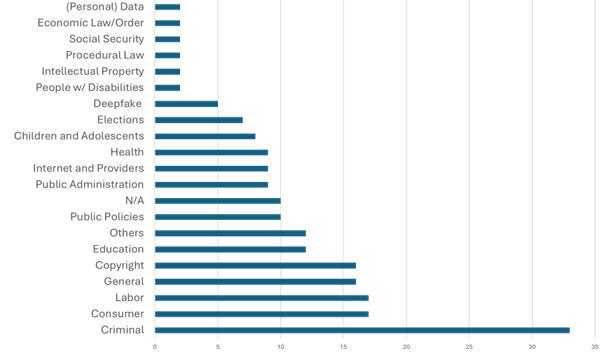
Regarding subject matter, the most prevalent theme across the mapped bills is criminal law (33 bills), followed by labor law (17) and consumer protection (17). Next come bills of a more general or principles-based nature addressing the development and use of AI (16), and then those specifically dealing with copyright (14). It is worth noting that a single bill may be classified under more than one category.
Main Themes Across AI Legislative Proposals
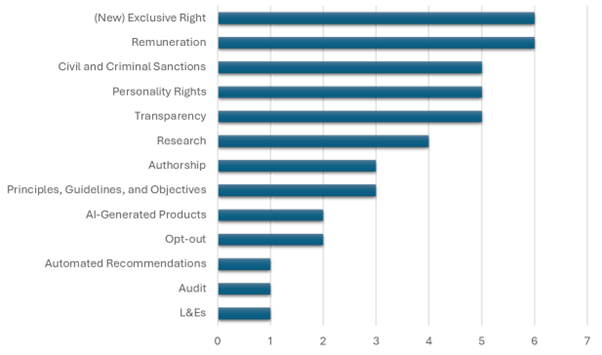
A preliminary analysis of the 14 bills addressing the intersection of generative AI and copyright reveals a strong focus on two issues: recognizing the use of protected works for AI training as an act subject to exclusive rights — or even as grounds for creating a new exclusive right (6 bills) — and establishing remuneration obligations when protected works are used for training purposes (6 bills). Other frequently addressed topics include civil and criminal sanctions for copyright infringement (5 bills) and transparency obligations imposed on AI developers and operators (5 bills).
By contrast, the equally important debate around limitations and exceptions — particularly regarding the use of works for AI training in research and educational contexts, or for certain text and data mining purposes — has received considerably less legislative attention, appearing in only 1 bill. That bill is No. 2338/23, which has already been approved by the Federal Senate and is currently under review in the Chamber of Deputies.
Most Frequent Topics in AI and Copyright Legislative Proposals
The full mapping of bills under consideration in the National Congress will be made publicly available on the website of the Observatório Nacional de Direitos Autorais, an initiative created by the Brazilian Copyright Institute in 2022. The Observatory’s main objective is to provide open access to a wide range of materials — including judicial decisions, theses and dissertations, draft laws, legislation, and international treaties — on copyright law, serving as a reference resource for researchers, legal practitioners, and anyone seeking to understand and deepen their knowledge of the subject.