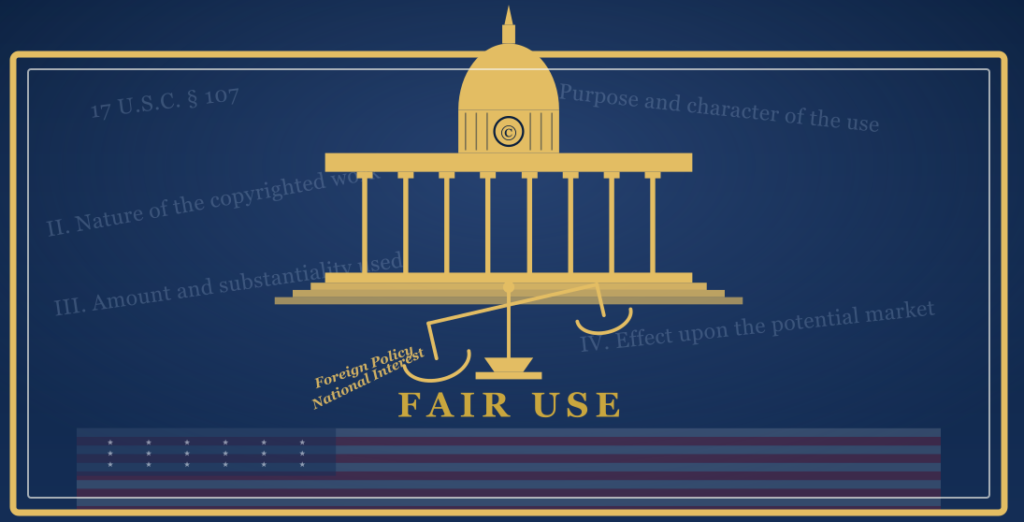
A thirty-year pattern of U.S. flip-flopping on whether fair use should travel abroad — and why the AI industry’s needs may now be tipping the balance back in its favor.
Three Decades of Contradiction
At the recently concluded G20 innovation ministerial in Chapel Hill, North Carolina, Howard Lutnick, the U.S. Secretary of Commerce, stressed the importance of balancing the interests of copyright owners and AI developers. He recognized that achieving this balance would raise “complex questions across all of our jurisdictions. We’ve got to establish doctrines and make sure we embrace fair use.” This call for the embrace of fair use outside of the United States is the latest twist in a 30-year history of inconsistent U.S. government (USG) positions on the adoption of flexible copyright exceptions overseas.
In trade negotiations since the mid-1990s, USG has consistently attempted to convince other countries to adopt IP regimes with levels of protection similar to those afforded by U.S. law in an effort to promote international trade. This advocacy for the replication of U.S. levels of protection, however, has had one major exception: the fair use right. On some occasions, USG has supported adoption of fair use principles; on other occasions, it has opposed it.
From TRIPS to the Trans-Pacific Partnership
During the negotiations of the TRIPS Agreement in 1994, the U.S. proposed language concerning exceptions even narrower than the Berne “three-step test.” It suggested that exceptions be permitted “only in clearly and carefully defined special cases which do not impair an actual or potential market for or the value of a protected work.” Professors Niva Elkin-Koren and Neil Netanel write that this language was “profoundly antagonistic to fair use.” Had it been adopted, the fair use right codified in 17 U.S.C. § 107 might have “run afoul of U.S. obligations under TRIPS.” Fortunately, the U.S. proposal was rejected and the Berne three-step test was incorporated instead.
Conversely, in 1997, when Hong Kong was debating whether to adopt a reverse engineering exception based on the EU Software Directive, USG pressured the Legislative Council to adopt a flexible fair use provision in its place.
When the George W. Bush Administration started negotiating free trade agreements in 2001, USG resisted any references to fair use. However, the Korea-U.S. Free Trade Agreement, signed in 2007, included at Korea’s insistence a footnote that permitted it to adopt an exception for fair use. Korea ultimately did so.
In 2012, during the negotiation of the Trans-Pacific Partnership (“TPP”) Agreement, USG changed direction again when it proposed the adoption of language obligating parties to seek to achieve a balance in their copyright systems. This balance was to be achieved by means of limitations and exceptions “giving due consideration to legitimate purposes such as, but not limited to, criticism, comment, news reporting, teaching, scholarship and research.” This list of legitimate purposes comes from 17 U.S.C. § 107. Moreover, in its statement supporting this language, the office of the U.S. Trade Representative (USTR) stated:
An important part of the copyright ecosystem is the limitations or exceptions placed on the exercise of exclusive rights in certain circumstances. In the United States, for example, consumers and businesses rely on a range of exceptions and limitations, such as fair use, in their businesses and daily lives.
(See here for a more detailed discussion of the TPP language.) The U.S. pulled out of TPP with the election of President Trump in 2016. The balanced copyright language, however, was retained in the agreement signed by the remaining eleven countries, the Cooperative and Progressive Agreement for Trans-Pacific Partnership.
Retreat: USMCA, Marrakesh, and South Africa
Although USG proposed the balanced copyright language in 2012, and supported the final text of the TPP agreement in 2015, it opposed inclusion of similar balanced copyright language in the U.S.-Mexico-Canada Free Trade Agreement, signed in 2018. Moreover, in 2013, during negotiation of the Marrakesh Treaty for exceptions for people with print disabilities, USG opposed a reference to fair use as one means of satisfying the Treaty’s obligations. Ultimately, the Treaty stated that a country could meet the Treaty’s obligations by “judicial, administrative or regulatory determinations for the benefit of beneficiary persons as to fair practices, dealings or uses to meet their needs,” consistent with the three-step test.
In April 2019, the International Intellectual Property Alliance (“IIPA”) filed a petition with USTR claiming that if the South Africa’s Copyright Amendment Bill (CAB) went into force, South Africa would deny adequate and effective protection for intellectual property, a requirement for eligibility for trade preferences under the African Growth and Opportunity Act (“AGOA”). A central complaint of the petition was CAB’s flexible fair use provision modeled on 17 U.S.C. § 107. In October 2019, based on the petition, USTR initiated a review of South Africa’s eligibility for AGOA, even though President Ramaphosa had not yet signed the CAB into law. As part of its review, USTR requested submissions from interested parties, held a hearing, met in Washington with South African government officials, and sent staff members to South Africa on a fact-finding trip. The CAB’s fair use provision was frequently referenced at the hearing and on the fact-finding trip.
Before USTR reached a final decision on IIPA’s petition, South African President Ramaphosa referred the CAB back to Parliament. This action almost certainly was motivated at least in part by USTR’s concerns about the CAB’s inclusion of a fair use right. To be sure, USTR never publicly stated that it was reviewing the CAB specifically because of the fair use provision; the IIPA petition addressed many aspects of the CAB in addition to its fair use provision. At the same time, USTR never stated that it was untroubled about fair use in the CAB; it never voiced support for South Africa’s adoption of an exception based on what the U.S. Supreme Court has recognized as an essential element of U.S. copyright law.
AI and the Return of Fair Use
This brings us to Secretary Lutnick’s call for our trading partners to embrace fair use. The same week as the G20 innovation ministerial, the U.S. Department of Justice filed a statement of interest in the copyright litigation brought by the New York Times against OpenAI. In its filing, the DOJ forcefully argued that the training of an artificial intelligence Large Language Model on copyrighted works was a fair use.
USG’s oscillation between supporting and opposing the “exportation” of fair use likely reflects conflicting impulses. On the one hand, USG at times appears to recognize that fair use is a critical feature of U.S. copyright law relied upon by creators and users alike, that foreign creators and users would benefit from a fair use right, and that fair use in other countries would help U.S. technology firms in their operations abroad. On the other hand, the U.S. copyright industry seems to have convinced elements of USG that foreign courts would construe fair use so broadly, arbitrarily, and inconsistently as to cause creators significant harm. The position USG takes on the exportation of fair use in any specific situation depends on which of these conflicting impulses happens to prevail. With USG’s current interest in promoting the success of U.S. AI firms, the pro-fair use impulse is likely to triumph in the near-future.
In any event, there is no evidence to support the belief that foreign courts would construe fair use broadly, arbitrarily, and inconsistently. (See here for the text of the fair use of fair dealing provisions that have been enacted in more than 40 countries with over a third of the world’s population.) To the contrary, Professors Elkin-Koren and Netanel’s thorough review of fair use cases in Israel (which adopted fair use in 2007 over U.S. copyright industry opposition) shows that Israeli courts apply fair use more stringently than U.S. courts. Israeli courts reject the fair use defense in 70% of cases, while U.S. courts’ rejection rate is only 40%. Further, although the statutory language of the Israeli fair use exception is almost identical to 17 U.S.C. § 107, Israeli courts impose an additional requirement on defendants: providing attribution to the original material. Thus, Professors Elkin-Koren and Netanel conclude that “far from being a license to unauthorized copying, fair use offers a conceptual framework for a sophisticated legal analysis weighing the conflicting values and considerations promoted by copyright law.” Hopefully USG will hear this message and not prevent other countries from adopting fair use, even after AI loses its luster.