
Introduction
The strongest message emerging from the AI for Good Global Summit 2026 was clear: the future of artificial intelligence (AI) will depend less on creating new international laws and more on developing inclusive governance frameworks that balance innovation, creativity, intellectual property and the public interest.
Held in Geneva from 7 to 10 July 2026, the AI for Good Global Summit brought together governments, international organizations, industry leaders, researchers, creators and civil society to examine how AI can advance sustainable development while addressing the legal, ethical and economic challenges it creates.
Convened annually since 2017 by the International Telecommunication Union (ITU) in partnership with more than 50 United Nations agencies and co-convened with the Government of Switzerland, the Summit has become the UN’s leading global forum on AI. This year’s discussions demonstrated that governance—not technology alone—is becoming the defining challenge of the AI era.
Among the many themes explored, debates on creativity, intellectual property and knowledge governance revealed a common conclusion: AI policy must be developed collaboratively across governments, industry, creators, researchers and users rather than by any single institution.
Innovation and Copyright Are Not Opposing Goals
Perhaps the most significant discussions focused on whether AI can promote creativity while respecting the rights of creators.
During The Sound of Intelligence: John Legend and the Leaders Shaping the AI Music Revolution, Grammy Award-winning artist John Legend joined Michael Nash (Universal Music Group) and Richard Kerris (NVIDIA) to explore how AI is transforming music creation, production and artistic expression.
Rather than portraying AI as either a threat or a solution, the panel acknowledged the complexity of balancing technological innovation with copyright protection. Participants examined how artists can be fairly remunerated while encouraging innovation and whether AI can expand, rather than replace, human creativity.
The same questions resurfaced during the high-level session AI, Creativity and Ownership: The New Value Equation, where leaders from WIPO, TIME, Warner Brothes Discovery and The Atlantic discussed how AI is reshaping journalism, music and other creative industries.
Although participants expressed differing perspectives, the discussions revealed broad agreement on one point: AI governance must accommodate diverse creative sectors rather than rely on one-size-fits-all solutions.
The World Is Not Yet Ready for an AI Treaty
One of the Summit’s clearest policy messages was that there is currently no international consensus to negotiate a global treaty on AI and intellectual property.
Ken-Ichiro Natsume, Assistant Director General of WIPO, explained that although WIPO would naturally support international cooperation where appropriate, its Member States have not yet reached agreement to begin treaty negotiations.
Instead, discussions centred on three foundations for responsible AI development:
- high-quality data;
- technological innovation; and
- effective regulation.
Participants also examined one of today’s most contentious issues: remuneration for copyrighted works used to train AI systems.
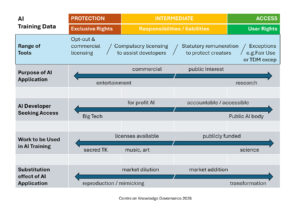
Rather than advocating a single global solution, panellists recognised that different creative sectors will require different licensing and remuneration models.
On copyright enforcement, speakers observed that private licensing agreements between AI developers and rights holders are proliferating more rapidly than legislation. At the same time, they argued that additional judicial decisions across jurisdictions will be essential to provide legal certainty and may gradually contribute to international convergence.
The discussion therefore suggested that practical experience—including licensing practices and court decisions—may shape future international norms before governments negotiate new treaties.
Intellectual Property Must Support AI Innovation, Not Constrain It
The Summit also highlighted that intellectual property should be viewed as a strategic business tool rather than an automatic objective.
During From Idea to Impact: IP Strategies for AI Entrepreneurs, WIPO launched Learning Machines: An Introduction to AI and IP for Small and Medium-Sized Enterprises, a practical guide to help AI start-ups understand and use intellectual property effectively.
The publication outlines several policy approaches currently under discussion internationally, including recognising joint inventorship between humans and AI, requiring disclosure of AI involvement while maintaining human inventorship, and even developing entirely new IP frameworks for AI-generated inventions.
These debates closely reflect discussions taking place within WIPO’s Standing Committee on Copyright and Related Rights (SCCR).
Importantly, the session demonstrated that questions surrounding AI and intellectual property extend far beyond legal experts. Effective knowledge governance requires sustained dialogue among governments, innovators, creators, researchers, industry and civil society.
Health Innovation Demonstrates the Value of Institutional Collaboration
Healthcare provided perhaps the strongest example of why AI governance depends on institutional cooperation.
The session AI for Health: Scaling Impact through Standards, Investment and Intellectual Property demonstrated that successful AI innovation requires technical standards, responsible data governance, investment and intellectual property to work together throughout the innovation lifecycle.
The discussion highlighted the joint ITU-WHO-WIPO publication AI-enabled Health Innovation and Intellectual Property: From Idea to Impact, which illustrates how these complementary areas can support responsible AI deployment.
As Alain Labrique of WHO observed, each institution contributes distinct expertise: ITU develops technical standards, WHO provides leadership on health and data governance, and WIPO focuses on innovation and intellectual property.
Participants also cautioned against assuming that stronger IP protection is always desirable. Whether formal IP rights benefit an AI business depends on its commercial strategy, size, sector and innovation model.
Similarly, discussions on health data emphasised that technical standards should promote interoperability while protecting rights and ensuring equitable access. Arijit Patra of UCB Biopharma argued that global health data standards should reward contributors without discouraging collaboration, particularly in low-resource settings. The ultimate objective should be an open, trustworthy global data ecosystem that accelerates innovation while ensuring fairness and accountability.
Conclusion
The AI for Good Global Summit 2026 demonstrated that the central challenge facing artificial intelligence is not technological capability but governance.
Across discussions on creativity, intellectual property, entrepreneurship and healthcare, participants consistently rejected simplistic solutions. Rather than calling for immediate international regulation, they emphasized the need for flexible governance frameworks that evolve alongside technology and reflect the diversity of industries, creators and users affected by AI.
Equally significant was the recognition that AI governance can no longer be shaped by governments or international organizations acting alone. As AI becomes embedded across every sector of society, effective governance will increasingly depend on sustained collaboration among policymakers, industry, researchers, creators, civil society and users.
The Summit therefore marked an important shift in the global conversation. It showed that the future of AI will be determined not only by technological breakthroughs but also by our collective ability to build governance systems that foster innovation, protect creativity and ensure that AI serves the public interest.