
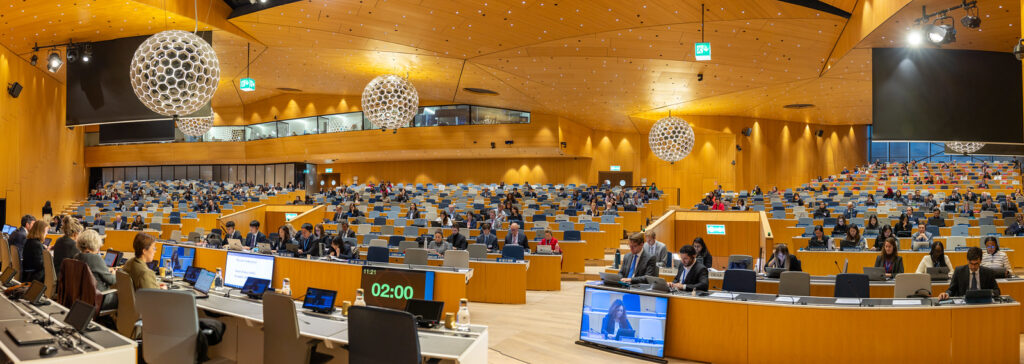
WIPO SCCR 47 Ends with Some Progress After Another Late Night
The World Intellectual Property Organization’s Standing Committee on Copyright and Related Rights negotiated its conclusions into the early morning hours of December 6 over the conclusions on a packed agenda. The meeting agreed to identify a series of specific articles of the Treaty on the Protection of Broadcast Organizations that lack consensus, to delay until next meeting the decision on how to begin text based negotiations on three proposals for work on an instrument on limitations and exceptions, and to begin work on studies of remuneration of audiovisual authors and on copyright and training of artificial intelligence tools. This note describes the major conclusions and positions of member states at the meeting. Below we also publish an edited transcript of the SCCR 47 public sessions. Treaty for the Protection of Broadcast Organizations The Chair released a new draft Treaty for the Protection of Broadcasting Organizations with minor changes from the previous draft. After many sessions of the SCCR when it appeared that a conclusion of the broadcast Treaty might be near, this round ended with conclusion that many of the draft treaty’s provisions are far from reaching consensus. The Chair’s summary, in a break with those of the recent past, contained a detailed discussion of divergences that remain: 8. Regarding the first set of articles (articles 1, 9, 12, 13, 14, 16, 17), no concerns were raised about their current wording. The second set of articles (articles 3, 4, 6, 10) received support in principle, although a few technical adjustments are still required either in the provisions or the explanatory notes. With respect to the third set of articles, further in-depth discussions are needed in order to overcome the remaining differences, particularly on the topics of (i) rights contained in articles 7, 8 and the respective definitions (article 2), (ii) exceptions and limitations (article 11) and (iii) the functioning of the national treatment and reciprocity principles (article 5 and the interlink between articles 6, 7, 8, 9 and articles 10 and 15). In plenary statements, the United States and the members of the African Group explicitly opposed moving the current Chair’s draft of the treaty to a diplomatic conference. The African Group has long supported a narrow broadcast treaty and has repeatedly expressed concerns about potential unintended effects of a broader treaty on public interest uses and on competitive markets. At this SCCR, the Group made its most specific objections to particular provisions of the draft. The African group stated its support for the conclusions of the Chair’s summary of SCCR 45, “notably that the treaty should be narrowly focused on signal piracy, should not extend to post-fixation activities, should provide Member States with flexibility to implement obligations through adequate and effective legal means and that the object of protection relates to program carrying signals linked to linear transmissions.” It criticized the current draft of the Treaty as veering outside of this zone of consensus. It specifically objected to: The Group identified several questions it requested the facilitators and proponents of the treaty to address, including: The African Group concluded that, “given the lack of consensus on numerous provisions, the African Group is of the view that the present text is not ready for a referral to a Diplomatic Conference.” It further restated its position “that the broadcasting treaty and the instrument on limitation and exceptions should progress together with a view to finalizing both instruments concurrently.” The United States largely repeated concerns about the scope of the draft treaty that it has made in previous SCCR and General Assembly meetings. It expressed disappointment that Articles 7 and 8, on fixation and post-fixation rights over stored programs, were retained in this draft despite its objections to these provisions in earlier meetings. The EU, the primary demander of the Treaty, expressed some flexibility in confining the draft to conform to concerns raised by other members and recognized that “further technical clarifications are needed” on the present draft. The EU restated its support for a “future proof” treaty in which “retransmission by computer networks of broadcasting organization should be granted meaningful protection.” But it asserted some flexibility on this matter, stating that, “in order to achieve a compromise,” it is “ready to consider” the current option in the text for countries to opt out of covering broadcasting organizations that transmit exclusively via computer networks through a reservation. The EU did not, however, signal support for the narrowing of rights to exclude coverage of stored programs opposed by the United States and the Africa Group. Some other countries, including Russia, Japan, and Canada, noted the minimal changes in the current draft and urged that it progress toward the available consensus that could support a narrower treaty. India specifically called for consideration of “the option of incorporating mandatory limitations and exceptions.” Brazil asserted that it was ready follow a consensus for the convening of a Diplomatic Conference based on the present draft, but asserted that “in case consensus is not possible by the end of this session, we propose to temporarily remove the topic from the agenda to enable consultations among interested parties, bringing it back to the Committee after sufficient convergence is identified.” Following plenary comments, the discussions of the Treaty moved into informal sessions in which, for the first time in recent memory, observers were not permitted to listen to the deliberations. Limitations and Exceptions The limitations and exceptions agenda saw the introduction of three new texts. Responding to SCCR 46’s conclusion that the Chair “will prepare a document with concrete suggestions … for the implementation of the Work Program” on limitations and exceptions, the Chair published a Framework of Work Towards an Appropriate International Legal Instrument or Instruments on Limitations and Exceptions. The African Group published a Draft Instrument on Limitations and Exceptions for Libraries, Archives, Museums, Education and Research Institutions and People with Disabilities. The United States, during the SCCR meeting, published Updated Version of the Document “Objectives and Principles for Exceptions and Limitations for Libraries And Archives” and