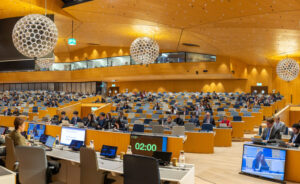

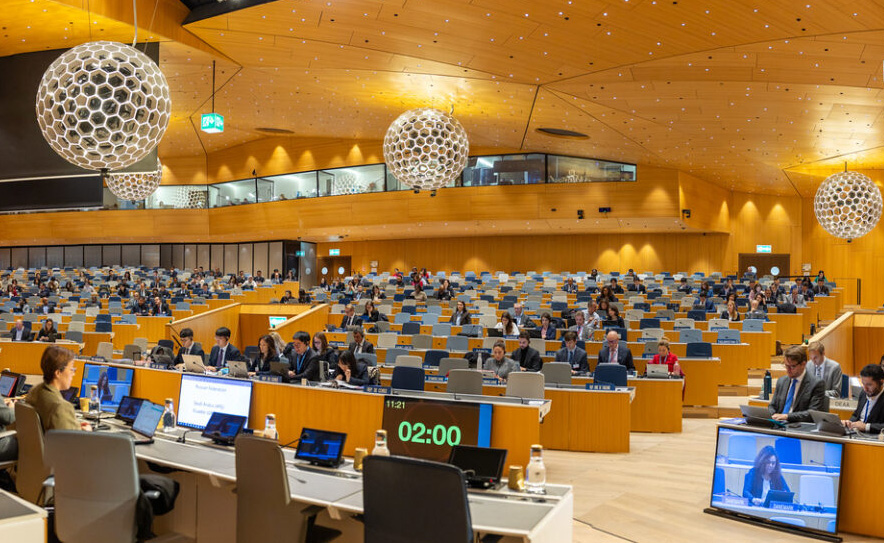
The 48th session of the World Intellectual Property Organization’s Standing Committee on Copyright and Related Rights (SCCR) reached a breakthrough in its main agenda items. Cutting through decades of gridlock, SCCR 48 embraced the first text-based work on Limitations and Exceptions (L&Es) since 2018 and agreed to draft new text on alternatives for the most controversial topics in the Broadcasting Treaty.
Advancing Text-Based Work on Limitations and Exceptions
The issue of limitations and exceptions has been a standing agenda item since 2005 1, when the Committee approved Chile’s proposal of a work plan toward “agreement on exceptions and limitations for purposes of public interest that must be envisaged as a minimum in all national legislations for the benefit of the community; especially to give access to the most vulnerable or socially prioritized sectors.” (SCCR/13/5)
The agenda item is operating under a 2012 General Assembly mandate “to work towards the adoption of an appropriate international legal instrument or instruments on exceptions and limitations” (WO/GA/41/14) for libraries, archives, museums, education and research institutions, and persons with disabilities not covered by the Marrakesh Treaty.
Statement by Ambassador Qobo, Coordinator of the African Group
At a side event on limitations and exceptions sponsored by the International Federation of Library Associations and Institutions (IFLA), Ambassador Mzukisi Qobo, Coordinator of the African Group in WIPO, summarized how the rights of libraries, educators, and researchers to access and use copyrighted materials “have long been an integral part of copyright policy in every country,” but normative work in WIPO has been left behind.
“Study after study (has shown) that developing countries often have the least permissive systems of public interest exceptions. … When African countries seek to expand public interest provisions to levels comparable to those found in the United States or the European Union, they are often met with claims that such measures undermine international intellectual property norms. That is precisely why greater clarity in the international system regarding these flexibilities is so important.
So the African Group, and indeed the broader coalition of developing countries formerly organized as the Friends of Development, have consistently argued that this body must guide and clarify not only the expansion of exclusivity, but also the expansion of inclusivity.
The African Group proposal has expressed flexibility regarding the form that such an instrument could take, and we have provided specific detail on the subjects that should be included. We hope that all countries will join us in supporting meaningful progress on this important agenda item.”
Recent Progress Toward an Instrument
There has been renewed progress toward text-based work since SCCR 43 in 2023, when the Committee adopted a Work Program to promote the 2012 mandate to draft an instrument. Previously, dating back to 2018, the Committee was only holding information sessions under the agenda item, first through a series of conferences to develop “Action Plans,” followed by a moratorium on normative work throughout WIPO during the Covid-19 Pandemic.
At SCCR 47, held in December 2025, multiple textual proposals were introduced to serve as a starting point, including two statements of principles and objectives submitted by the United States (SCCR/47/9 and SCCR/47/10); a “framework” for consideration of an instrument produced by the chair (SCCR/47/8), and a highly specific draft instrument from the African Group modeled on previous proposals in the committee from the pre-2018 period (SCCR/47/5).2
Prior to SCCR 48, there was no consensus on which text to use for negotiations. SCCR 48 succeeded in breaking this impasse.
Linking L&Es and Broadcast; Other Statements of Support
South Africa, on behalf of the African Group, said in its opening statement at the SCCR that it remains committed to linking progress on the Broadcast Treaty to the development of an L&E instrument:
“The African Group wishes to remind [delegates] that the Committee’s work continues to be guided by two General Assembly mandates. First, to conclude a signal-based treaty on the protection of traditional broadcasting organizations. Secondly, to advance work to add an international legal instrument on limitations and exceptions… it remains our firm position that this two processes should advance in tandem.”
Brazil renewed its support for text-based work on the L&E agenda with several strong statements.
“Brazil supports the continuation of work on limitations and exceptions. It is a major element of WIPO’s Development Agenda. It is an instrument inherent to the IP system available to Developing Countries in their quest to balance IP, the public interest and sustainable development objectives. We are flexible regarding the nature of an outcome document. whether in the form of a legally binding instrument or a joint recommendation.
…
[T]he General Assembly’s mandate on exception and limitations specifically mentions an international legal instrument or instruments in whatever form. For complying with the mandate before us it is necessary to start text-based negotiations which so far have not happened despite urgent calls by Member States from many different regions and social backgrounds.
Toolkits may feed important information but they do not replace nor implement the obligations approved by the General Assembly. The mandate is in fact the common ground that we have and the work of the Committee must be in line with it without undue delay. Thank you.”
Other member states and groups largely articulated their previous positions. The EU, for example, repeated opposition to “work towards legally binding instruments” but stated that “[n]evertheless, we stand ready to engage constructively… to reflect further on other possible nonbinding instruments.”
The Chair’s New Mandate on L&Es
After extended informal sessions, in which observers were not able to listen in, the Committee agreed to instruct the chair to synthesize the proposals from SCCR 47 into a single, cohesive document, signaling the start of concrete, text-based work. The Chair reported:
“In order to facilitate substantive discussions under this longstanding agenda item at SCCR 49, the Chair will prepare an informal document focusing on the following topics: First, limitations and exceptions for preservation. Second, limitations and exceptions for the benefit of people with other disabilities. And third, limitations and exceptions for education.”
To build this new text, the Chair will use the various existing documents in a complementary manner, actively combining elements from the African Group’s proposal, the United States’ proposed objectives and principles, and previous Chair texts to find convergences.
Tackling the Controversial Core of the Broadcast Treaty
Alongside the L&E breakthrough, SCCR 48 made significant procedural headway toward narrowing the Treaty for the Protection of Broadcast Organizations, an item that has been on the agenda since 1998.
The primary hurdle for the Broadcasting Treaty has been aligning the draft text with the 2006 and 2007 General Assembly mandates3, which require a strictly “signal-based approach” limited to the protection of traditional broadcasters (see WO/GA/33/10, para 107, 2006). The most intense controversies have surrounded the proposed inclusion of Article 7 (fixation) and Article 8 (stored programs) and associated limitations and exceptions, which critics argue extend beyond signal protection into post-fixation rights.4
Providing broadcasters the right to control the fixation of signals and the use of stored programs poses a significant risk to public-interest uses and to competition. These rights could allow broadcasters to prevent consumers from using third-party “catch up” services to record and play back lawfully received content, as well as force cultural institutions to seek permission to record lawfully received content for preservation, education, research and other public interest purposes. Because of these issues, public interest groups and several Member States have demanded that mandatory limitations and exceptions (Article 11) apply to all uses permitted by copyright law.
Concerns were also raised by the African Group over the proposal to allow reservations, rather than a freedom to opt-in, for coverage of purely webcast transmissions and over the use of a reciprocity principle rather than a national treatment norm in Article 5.
Failure to Incorporate Concerns into the Latest Draft of the Broadcast Treaty
Despite many countries raising concerns with these issues in recent meetings of the SCCR, the Chair’s Text for SCCR 48 (SCCR/48/3) did not contain any brackets or changes noting the controversies. Several groups and countries expressed frustration at the limited changes in the Chair’s draft in response to opposition to various provisions.
The African Group stated:
“We are deeply concerned that our discussions in this committee, including the specific objectives to particular provisions raised by our group and other Delegations are not reflected in the Chair’s draft. Our support for continuing to spend time discussing the broadcasting Treaty is contingent on those discussions being reflected in the drafts that the Chair produces.”
The United States similarly stated:
“[W]e are disappointed that the latest draft text retains the post fixation articles about which we have expressed deep concerns and have repeatedly requested their removal. We cannot support their inclusion.”
Canada took an active role in the discussion to “urge this committee to focus its efforts on issues where there is presently consensus and to set aside issues where further consensus is at least for now impossible.”
The Chair’s New Mandate on Broadcast
Acknowledging the impossibility of moving a stagnant draft to a Diplomatic Conference without addressing these fundamental disagreements, the Committee agreed to instruct the Chair to draft new text presenting direct alternatives for the specific friction points. The Chair summarized:
“Substantive discussions focused on three main areas where further in-depth discussions are needed to achieve a final agreement on the convening of a Diplomatic Conference on the broadcasting organizations treaty. First, Article 7 and 8 and how they are interlinked with Article 11 on exceptions and limitations. Second, Article 10 and its connection with Article 5 regarding national treatment and the reciprocity principle. And third, Article 3.6.”
To drive the negotiations forward, the summary confirms that “the Chair in consultation with interested Delegations will prepare a separate informal document for the next session of the SCCR presenting possible options on these three main areas.”
By officially committing to generate option-based texts for the most contentious broadcasting provisions and initiating consolidated, text-based negotiations on L&E, SCCR 48 has laid the groundwork for a more balanced and functional negotiation on these agenda items.
Copyright in the Digital Environment
A third major agenda item of the Committee, included in “Other Matters,” has involved the application of copyright in the digital environment.
For many years, the Latin American and Caribbean countries (GRULAC) have proposed adding this issue to the standing agenda and receive at least equal time as the two major agenda items subject to General Assembly mandates. In consideration of the Agenda, Brazil stated:
“The agenda of the SCCR looks unfit for the current times to the detriment of WIPO’s credibility as an agency of the UN specialized in innovation and technology for development. Today the world speaks only of the digital economy, of AI and its impact on everything including on IP, innovation and the digital divide.”
El Salvador (on behalf of GRULAC) stated :
“GRULAC has contributed to this discussion through a proposed work plan on copyright in the digital environment. This does not seek to establish binding norms but rather to structure the Committee’s work on the challenges and opportunities presented by emerging technologies including AI. As an expected outcome of this work plan we propose the development of a good practices guide on the appropriate use of works, performances, phonograms and broadcasts in the digital environment.”
There continued to be a lack of consensus on whether to add the digital agenda to the Committee’s standing agenda, with several members opposing making the addition before completing one of the other two major items. But the Committee agreed to allocate significant time to the agenda item in the future, including for “substantial discussions” on the upcoming Scoping Study on AI Training and Copyright and for information-sharing between Member States on Copyright and Generative Artificial Intelligence.
Another matter discussed under the topic “Copyright in the Digital Environment” was Indonesia’s Proposal on Royalty Governance. At the Forty-Seventh Session of the SCCR, Indonesia tabled a “Proposal for a Legally Binding Instrument on the Governance of Copyright Royalty in Digital Environment: Promoting a Fair Chance in a Globalized World”, (SCCR/47/6). At SCCR/48, the Ministry of Law of the Republic of Indonesia presented a revised document entitled “draft elements for a possible International Instrument on the Governance of Copyright Royalties in the Digital Environment” (SCCR/48/4). The document addressed multiple aspects of remuneration, including transparency, accountability, metadata accuracy, cross-border cooperation, and interoperability.
References
- On the history of the L&Es in the SCCR, see Luca Schirru, Ben Cashdan and Sean Flynn, Copyright Limitations and Exceptions in the SCCR: A Timeline (Centre on Knowledge Governance, Nov. 20, 2025), available here. ↩︎
- See, Jonathan Band, Comparison of Limitations and Exceptions texts for SCCR/48 (Update) (Centre on Knowledge Governance, Apr. 8, 2026), available here. ↩︎
- On the history of the Broadcast Treaty, see Luca Schirru and Sean Flynn, Tracing a Century of Broadcasting Rights Debates: 1928–2025 (Centre on Knowledge Governance, Nov. 20, 2025), available here ↩︎
- See Sean Flynn, Is the draft Broadcast Treaty consistent with the General Assembly mandate? (Centre on Knowledge Governance, Oct. 22, 2025), available here. ↩︎