
Artificial intelligence has become one of the principal issues facing the international intellectual property system. Over the past several years, the World Intellectual Property Organization (WIPO) has approached AI primarily as a subject for discussion, producing studies and convening conversations on its legal and policy implications. In his opening address to the 68th WIPO General Assemblies, Director General Daren Tang outlined a more structured approach, describing how the Organization intends to organize its work on AI during his second term.
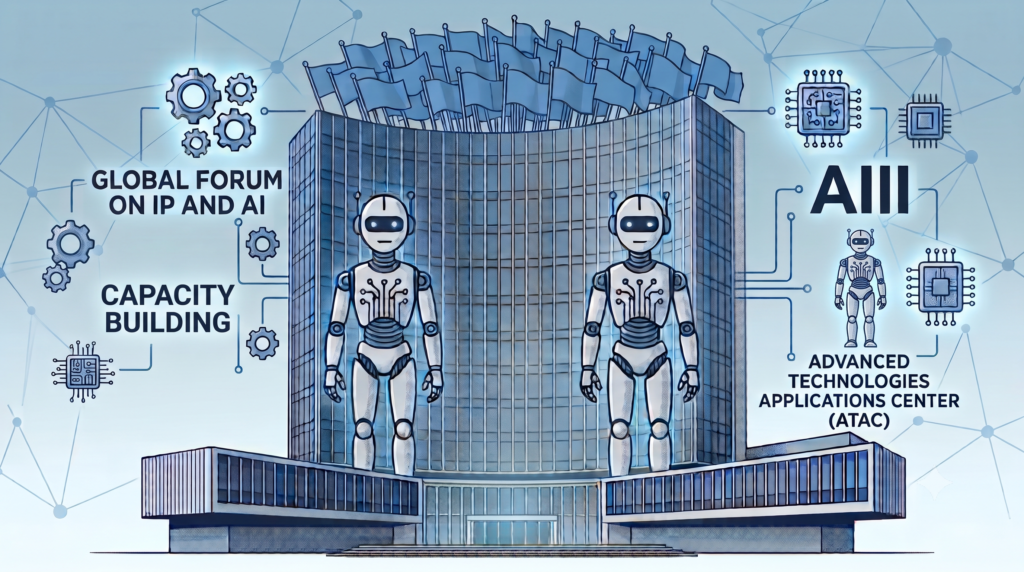
The Director General framed this objective as part of his broader goal of ensuring that the international intellectual property system is “future ready.” To explain that objective, he introduced what he described as the “four wheels of a car,” a framework that organizes WIPO’s AI agenda into four areas: intergovernmental dialogue, technical infrastructure, operational tools, and capacity building.
The first concerns intergovernmental dialogue. WIPO will convene a new Global Forum on AI and IP on 9–10 November 2026, intended to provide Member States with a dedicated forum to discuss artificial intelligence and intellectual property “holistically and strategically.” The Director General specifically invited ministers and senior policymakers to participate, as the program addresses AI-related legal and policy issues across the full spectrum of IP rights including their broader impact on IP, innovation and creativity.
The second concerns technical infrastructure. Earlier this year, WIPO launched the AI Infrastructure Interchange (AIII), a platform through which experts from different sectors will examine issues including metadata, digital identifiers, and watermarking. According to the Director General, the work carried out through AIII will be reported to Member States and incorporated into their discussions.
The third concerns administrative implementation. WIPO is developing artificial intelligence tools for intellectual property offices, beginning with trademark examination. A pilot involving selected offices is expected next year, followed by broader deployment. The Director General also invited national IP offices developing similar systems to collaborate with WIPO in their design, with the stated objective of reducing duplication and promoting cooperation.
The fourth concerns capacity building. WIPO will continue providing legislative assistance, technical advice, and training related to AI, including projects undertaken jointly with other United Nations agencies. The Director General referred to one initiative supporting AI entrepreneurs in Africa developing healthcare applications.
Stepping back to see the bigger picture with AI at WIPO
Viewed individually, these initiatives correspond to functions that WIPO has traditionally exercised: convening Member States, coordinating technical work, providing services to intellectual property offices, and supporting implementation through technical assistance. Taken together, however, they also reflect a broader institutional development. Rather than treating artificial intelligence solely as a policy issue requiring discussion, WIPO is integrating AI across the principal functions through which it shapes the international intellectual property system.
The sequencing of these initiatives is also noteworthy. The AI Infrastructure Interchange has been operating since April, AI examination tools are already under development, and capacity-building activities are underway. By contrast, the Global Forum, the principal mechanism through which Member States will collectively discuss WIPO’s broader AI agenda, will not convene until November. As a result, parts of WIPO’s AI program will already have moved from planning to implementation before Member States meet in a dedicated forum to consider its overall direction.
Viewed individually, the four initiatives address different aspects of WIPO’s work. Taken together, however, they reveal a broader institutional development. WIPO is no longer positioning itself solely as a forum where Member States discuss the implications of artificial intelligence for intellectual property. It is also becoming an institution that designs elements of the technical and administrative infrastructure through which AI governance will operate.
Governance questions to be addressed in WIPO’s AI Strategy
That evolution raises governance questions that extend beyond intellectual property doctrine. How will Member States oversee these initiatives as they move from policy discussions to implementation? What role will creators, innovators, researchers, civil society, and other stakeholders play in shaping them? To what extent will decisions concerning metadata, digital identifiers, AI-assisted examination, and other technical infrastructure influence future policy choices?
These questions arise because governance increasingly occurs not only through treaties and legislation, but also through technical standards, software, administrative practices, and digital infrastructure. As WIPO’s AI agenda develops, the relationship between these different forms of governance may become as consequential as the substantive legal rules themselves.