
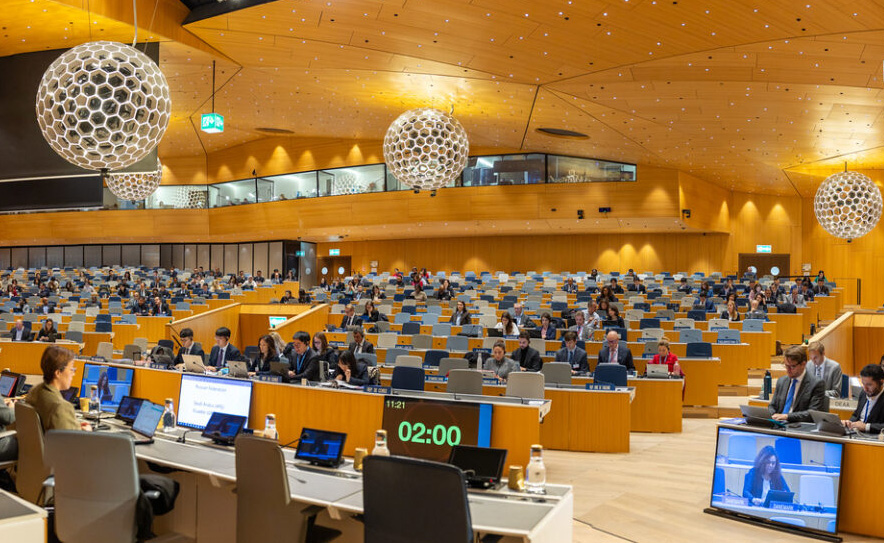
This note provides background information, links to recently published research and analysis, and descriptions of the issues in the agenda for the 48th meeting of the World Intellectual Property Organization’s Standing Committee on Copyright and Related Rights, May 18-22, 2026.
To view this document as a PDF for downloading and printing, click here.
The Standing Committee on Copyright and Related Rights (SCCR) has long focused on two long-standing agenda items: the Treaty for the Protection of Broadcast Organizations (since 1998) and Limitations and Exceptions for libraries, archives, museums, education, research, and persons with disabilities (since 2004, SCCR/12/3). The SCCR has also been considering various initiatives around copyright in the digital environment since its inception in 1998. Several other matters have been introduced to the agenda over time, including consideration of resale royalty rights for artwork, the rights of theatre directors, and “public lending rights” — which refer to charging libraries for lending public copies of copyrighted works.
I. Protection of Broadcast Organizations
II. Limitations and Exceptions
A. Copyright in the Digital Environment
C. Rights of Theatre Directors 10
I.Protection of Broadcast Organizations
A. Background
The negotiation of the rights of broadcasters was included on the SCCR’s agenda at its founding in 1998. It follows and extends a history of WIPO treaties on broadcasting dating to the Berne Convention’s protection of the rights of authors to their broadcasts in 1928 (Art 11bis), recognition of the rights of broadcast organizations to control uses of wireless broadcasts in the Rome Convention of 1961, and recognition of duties of countries to control unlawful interception of satellite signals by any means in the Brussels Convention Relating to the Distribution of Programme-Carrying Signals Transmitted by Satellite (1974).
The Broadcast Treaty is being drafted according to the GA Mandates of 2006 and 2007. The central question for the Broadcasting Treaty, in line with the 2007 General Assembly Mandate, is whether there is sufficient “agreement on objectives, specific scope and object of protection” to warrant a recommendation for a diplomatic conference. (WO/GA/34/16). The 2006 GA mandated that the Broadcasting Treaty be “confined to the protection of broadcasting and cablecasting organizations in the traditional sense” and “based on a signal-based approach” (WO/GA/33/10, para 107, 2006).
B. Current Issues
The changes in the latest draft are minimal. The SCCR 45 Chair’s Summary described the general zone of consensus on the committee on its objectives, scope, and object of protection:
“[w]ith respect to objectives, there is common understanding … that the treaty should be narrowly focused on signal piracy, should not extend to any post-fixation activities and that it should provide member states with flexibility to implement obligations through adequate and effective legal means” and “that the object of protection (subject-matter) of the treaty is related to programme-carrying signals linked to linear transmission”.
Some of the provisions in the Chair’s draft appear to extend beyond the bounds of the consensus described in SCCR 45 and in the GA mandates from 2006 and 2007. Some of the major issues include:
- Are fixation and stored programs rights “signal-based”?
The GA mandates require that the Broadcast Treaty follow a “signal based approach.” The Rome Convention uses a “rights-based” approach — i.e., giving broadcasters exclusive rights such as transmission and fixation. The Brussels Convention follows a “signal-based” approach, requiring prevention of signal theft by any regulatory means, without requiring or promoting exclusive rights.
There appears to be a consensus on the Committee that, at least in principle, the inclusion of article 10’s flexibility to use other regulatory means combined with some optional exclusive rights (arts. 6-9), in what has been called a “hybrid” approach, can meet the GA requirement that it be “signal-based.” But some countries have opposed articles 7 (fixation) and 8 (stored programs) as being beyond the GA’s mandates.
a. Fixation (Art. 7)
Extending the treaty to a right of fixation (Art. 7) essentially means that a user would have to get permission from a broadcaster to make a copy of broadcast content, even if that content was lawfully received (e.g. by a subscriber). That could enable broadcasters to charge subscribers extra for the right to record content, even for uses that copyright law normally permits. For example, a broadcaster may be enabled to demand additional license fees to use private recording devices to enjoy content at a different time or on a different device. Or broadcasters could require licenses to make recordings for any use not included in limitations and exceptions, such as recordings for educational, research, or preservation uses by cultural institutions.
b. Stored Programs (Art. 8)
Extending protections to uses of stored programs could enable broadcasters to exclude uses of third-party recording devices and thereby obtain market power for such services. The right to record broadcast material for personal time or device shifting dates to the introduction of video cassette recorders in the 1970s. There are often markets for third party digital recording devices for broadcast material, such as the TIVO device that was popular in the US for many years. Some countries may want to authorize more sophisticated third-party recording, such as the system that was held in the US to violate broadcaster rights in American Broadcasting Cos., Inc. v. Aereo, Inc., 573 U.S. 431 (2014), which ruled that Aereo’s service—which allowed subscribers to view live, over-the-air television broadcasts over the internet—violated copyright laws.
2. Should limitations and exceptions apply to all uses permitted by copyright?
Public interest groups have frequently opined that the limitations and exceptions to any broadcasting organization’s right should extend at least to all uses permitted by copyright, for example, by changing the use of “may” to “shall” throughout Article 11. Otherwise, a public interest user may have to clear broadcast rights even for a use permitted by copyright.
3. Are internet streaming companies “traditional” broadcasting?
The GA mandates require the Broadcasting Treaty to be confined to “traditional” broadcasting. The current definition of a broadcasting organization applies to any organization that “takes the initiative and has the editorial responsibility for the transmission, …; the programmes of a broadcasting organization form a linear programme-flow.” (art. 2(a)) The intent of including a “linear program flow” requirement is likely meant to exclude streaming platforms from the definition. But streaming companies like Amazon Prime and YouTube often show some scheduled programming and thus could be considered covered broadcasting organizations. The African Group has proposed that the definition of a covered broadcaster in a member state be determined by local law. This would enable countries to make the choice of who is covered through domestic policy.
4. Should all countries have the right to authorize remunerated retransmissions?
The current Article 6 gives broadcasting organizations the right to prevent retransmission by any means. This could prevent countries from allowing or requiring that cable, Internet, or other providers of content carry broadcast content in exchange for a fee. In the US, for example, there are “must carry” laws that require cable companies to carry publicly broadcast television channels and do not allow broadcasters to refuse to license such content. Article 6(2), added in the SCCR 46 draft (SCCR/46/3), permits pre-existing domestic arrangements that allow entities to retransmit programme-carrying signals through remuneration schemes. This provision could be amended to allow remuneration schemes more generally, such as based on Article 11(2) of the Beijing Treaty.[1]
5. Should the basic negotiating text include brackets?
There are a number of other areas where technical changes to the current text are warranted. If a version of the Chair’s text is to be recommended for a diplomatic conference under the rule of the last two conferences, that any change to the text would require consensus, it would be important for the text to reflect brackets reflecting any disagreements on the current language. The SCCR could, for example, move to a consolidated committee text where delegates could insert brackets into the text to clarify language that currently lacks consensus.
A summary of the positions of member states at SCCR 47 on these issues is included below:
Positions on the Broadcast Treaty
|
Country / Group |
Positions |
|---|---|
|
USA |
Opposes Art. 7 (fixation), 8 (stored programs) |
|
European Union |
Largely supports existing text; in SCCR 47 expressed openness to “further technical clarifications.” |
|
Central European and Baltic States Group (CEBS) |
Supports existing text |
|
African Group (AG) |
Opposes Art. 8 (stored programs); Supports mandatory limitations and exceptions for uses permitted by copyright; Supports the right to permit remunerated retransmissions to all countries (Art. 6.2); Supports the definition of broadcaster “as determined under national law”; Supports opt-in, instead of a reservation, for coverage of web-based broadcasting (Art. 3). |
|
Russia, Japan, Canada |
Supports narrowing the draft to achieve consensus. |
|
India |
Supports mandatory L&E (Art. 11). |
|
Brazil |
Supports diplomatic conference on the current text or to “temporarily remove the topic from the agenda to enable consultations.” |
II. Limitations and Exceptions
A. Background
The issue of limitations and exceptions has been a standing agenda item since 2005, when the Committee approved Chile’s proposal of a work plan toward “agreement on exceptions and limitations for purposes of public interest that must be envisaged as a minimum in all national legislations for the benefit of the community; especially to give access to the most vulnerable or socially prioritized sectors” (SCCR/13/5).[2]
The L&E agenda item is currently operating according to the 2012 General Assembly Mandate to “work towards the adoption of an appropriate international legal instrument or instruments on exceptions and limitations” (WO/GA/41/14) for libraries, archives, museums, education and research institutions, and persons with disabilities not covered by the Marrakesh Treaty.
In SCCR 43, the Committee adopted a Work Program that includes drafting “objectives, principles, and options” for potential instruments.
In SCCR 46, the Chair’s summary reported an agreement that “The SCCR will move forward in discussions based on the 2012 Mandate and the Work Program” and the Chair “will prepare a document with concrete suggestions … for the implementation of the Work Program,” taking into account “all relevant documents at the disposal of the Committee, along with input made by delegations during SCCR/46.”
In SCCR 47, three sets of proposals for text to begin work toward an instrument were introduced:
- the Chair and Vice-Chair’s November 10, 2025, “Text Proposed in the Framework of Work Towards an Appropriate International Legal Instrument or Instruments on Limitations and Exceptions” (SCCR/47/8)’
- the United States’ proposed “Objectives and Principles for Exceptions and Limitations for Libraries and Archives” (SCCR/47/10) and “Objectives and Principles for Exceptions and Limitations for Educational, Teaching, and Research Institutions” (SCCR/47/9);
- the African Group’s ”Proposal on Limitations and Exceptions” (SCCR/47/5).
The SCCR 47 Chair’s summary indicated that there was no agreement on which draft to begin text based work, concluding:
“15. The Committee will work toward finding convergences in line with the 2012 Mandate and the Work Program adopted by the Committee in 2023 taking into account all documents as listed in paragraph 13 at the next session.
16. The SCCR will use, in a complementary manner, all relevant documents at the disposal of the Committee, along with input made by delegations during SCCR/47.”
B. Current issues.
- General Agreement on High-Level Principles
The three documents considered in SCCR 47 display a high level of agreement on topics to be addressed in a potential instrument. All three documents include provisions on:
- Implementation of exceptions in national laws, including objectives to promote “balance” between exclusive rights and public interests;
- Promotion of exceptions for research and education, including using digital and online tools;
- Promotion of exceptions for preservation by cultural heritage institutions;
- Promotion of access to works preserved by cultural heritage institutions;
- Limitations on liability for public interest users for good faith reliance on limitations and exceptions.
The African Group and Chair’s texts address additional issues not included in the U.S. proposals, including:
- Rights of people with disabilities to make accessible copies of works;
- Cross border uses of works relying on limitations and exceptions;
- Rights to use materials for uses covered by limitations and exceptions that are restricted by technological protection measures.
The Africa Group proposal also includes a provision on a balanced interpretation of the three-step test. This provision may be especially useful to counter the idea, expressed in the recent WIPO Guide to Copyright Treaties, that general exceptions like fair use and fair dealing violate the three-step test.[3]
Some industry representatives have opposed any work on limitations and exceptions with the general argument that such provisions may take away from earnings of creators. There is empirical evidence, however, that greater access to uses of works for education, research and other public interests has a negligible effect, and can even expand, markets for such works.[4]
2. Choosing a text to use for text-based work
At SCCR 47, there were divergences in the positions of members on which of the proposals to use in text based negotiations. The positions expressed are summarized below:
Positions on starting text for L&E Agenda
|
Country/Group |
Positions |
|---|---|
|
AG |
Text based work based on AG text. |
|
GRULAC, CEBS |
Text based work based on the Chair’s document. |
|
Brazil, Argentina, Chile |
Suggested prioritizing work on preservation by cultural heritage institutions |
|
Iran, Russia |
Support work on AG proposal |
|
Pakistan, India, Algeria |
Support “binding” instrument; not identify which document. |
The main difference between the instruments is in their level of generality. The US and Chair’s texts are focused on more abstract objectives and principles with looser connection to international instrument text. The African Group’s proposal is in the form of a draft instrument (which could be soft or hard law) with specific provisions modeled on other international copyright instruments and specific proposals from member states in previous SCCR meetings.[5]
There is not currently a consensus on the committee to negotiate a binding treaty on limitations and exceptions. The African Group, India and Pakistan have often supported negotiation toward a binding instrument. The US and EU and CEBS have supported work only toward a non-binding instrument.
The US and Chair texts are clearly non-binding to the extent they focus only on objectives of an instrument, but do not take the form of an instrument. The AG text uses language (including “shall” and referring in some places to “contracting parties”) that occur more frequently in binding instruments.
WIPO’s Joint Recommendation Concerning Provisions on the Protection of Well-Known Marks[6] is a non-binding instrument that uses the word “shall.” Alternative framing for a more clearly non-binding Joint Recommendation can be found in the proposal in the Standing Committee on Trademark for a Joint Recommendation: Industrial Design Protection for Designs for Graphical User Interfaces. It uses the language “it is recommended that….”
If one document were to be used as the base for negotiations, the African Group text is by far the most specific and closest to the language of an international instrument. The Group expressed their desire to integrate comments on its language from other members. Alternatively, the Chair could be tasked to create a consolidated document combining the various proposals, which could take the form of a Chair’s chart comparing the language in topical areas, such as CKG has produced.
3. Should the goal be to move an L&E Instrument and the Broadcast Treaty Together?
The African Group and its member states have expressed their position in the last several SCCR meetings and in the most recent meeting of the General Assembly that “the discussions on the broadcasting treaty and limitations and exceptions [should] move together.” A procedural issue before the committee could be to adopt similar procedures as used for the Broadcast Treaty, including the appointment of expert facilitators to create discussion drafts for the Committee.
III. Other matters
A. Copyright in the Digital Environment
Issues concerning protection of and exceptions to copyright in the digital environment have been a constant issue for the SCCR since it was created in 1998 to, among other matters, consider “Copyright, Related Rights and Digital Technology.”
GRULAC has submitted a revised Work Program with proposals for studies and activities in this area focusing primarily on remuneration for digital uses, including through streaming platforms and, in more recent submissions, for the training of Artificial Intelligence (AI) tools. Previous proposals in the Committee on this topic have also included limitations and exceptions in the digital environment, such as updating exceptions beyond the analogue uses that are the focus of many dated copyright laws.
The GRULAC proposal includes that Copyright in the Digital Environment be added to the standing agenda. One difference between the “other matters” and the standing agenda items for Broadcast and Limitations and Exceptions is that the “other matters” lack a specific General Assembly mandate on the topic. The SCCR can, however, set its own agenda and decide without the GA’s approval to add an item to the standing agenda.
The SCCR 47 Chair’s Summary (para 20) records an agreement that the “Committee decided that of the documents SCCR/43/7, SCCR/45/4 and SCCR/47/7, only document SCCR/47/7 will be forwarded to SCCR 48.”
The main differences between SCCR/45/4 and SCCR/47/7 included the addition of discussion and proposed studies on the issue of training AI tools with copyrighted content; addition of the issue of protection for voice and image rights; and a proposal to work toward a “guide to good practice” on uses of works to train AI.
Paragraph 2 of the Work Plan clarified that, “[f]or the time being, the plan is not aimed at establishing international legislation.” But a new paper by Indonesia (SCCR/47/6) outlined a proposal for a legally binding international instrument to govern copyright royalties in the digital environment, specifically focusing on phonograms and audiovisual works.
The Chair’s Summary (para 21) noted a decision to implement the first item on the GRULAC work plan — for “the Secretariat to prepare a study on policy or regulatory approaches to the relationship between AI training and copyright.” The Committee also approved a “a Study on the Rights of Audiovisual Authors and their Payment Mechanisms for the Exploitation of their Works – Revised (document SCCR/44/7 REV.2)” proposed by the African Group (Chair Summary Para 24). A parallel study on the rights of performers was not approved, and “will be further discussed at the next session.” (Para 25).
With regard to the Indonesian Proposal for a Legally Binding Instrument on the Governance of Copyright Royalty in Digital Environment, the Committee agreed that “[d]iscussions will continue at the next session.”
The Committee also agreed (para 23) for “the Secretariat to organize a follow-up information session on copyright and artificial intelligence at SCCR/48.”
One AI-related topic that may be useful for the Committee to consider is the training of “public interest” or “public AI” systems that serve goals such as language translation into endangered languages, facilitation of academic research, or other public interest purposes.[7] There are a number of proposals worldwide for various models of remuneration and exclusivity for uses of copyrighted content in commercial AI training, including recent studies or legislative proposals in the US, EU, UK, Brazil, India, and elsewhere. While these proposals diverge on mechanisms for protecting uses of copyright works, all of them express an interest in permitting uses of works for AI tools by public non-commercial research and education institutions.
The Centre on Knowledge Governance and its partners have produced various works on this topic, including a lecture series on remuneration for AI training, and papers on remuneration options for streaming uses.[8]
B. Resale Royalty Right
Resale royalty rights require that artists (normally restricted to fine arts) receive a royalty for sales of their work after the first sale, which is intended to account for the fact that many artists sell their original works at a low price and would not otherwise benefit from the increased value of the work in future sales. The Berne Convention permits countries to provide for resale royalties. This agenda item is not focused on norm setting. The SCCR has produced two toolkits on the artists resale royalty right: Part 1 (focusing on legislation), and Part II (focusing on administration and collective management). SCCR 48 could decide whether to keep this item on the agenda or to devote its time to other matters.
C. Rights of Theatre Directors
The SCCR produced a study on the rights of theatre directors in SCCR 41 (SCCR/41/5). At SCCR 47, there was a brief update on continued work on the subject. SCCR 48 could decide whether to keep this item on the agenda or to devote its time to other matters.
D. Other Studies
Proposals for studies of on Copyright Protection of Technical Standards (document SCCR/46/4 REV.), for a Study on the Impact of the Creative Industries on the Economic Growth of Member States (document SCCR/47/11), on Types of Business Models and Economic Opportunities Created by and Through the Implementation of Technological Protection Measures (document SCCR/47/12) were presented to the Committee and will be further discussed at SCCR 48.
Notes
- See Luca Schirru and Sean Flynn, Tracing a Century of Broadcasting Rights Debates: 1928–2025 (Centre on Knowledge Governance, Nov. 20, 2025), available here
- See Sean Flynn, Is the draft Broadcast Treaty consistent with the General Assembly mandate? (Centre on Knowledge Governance, Oct. 22, 2025), available here.
-
“Contracting Parties may in a notification deposited with the Director General of WIPO declare that, instead of the right of authorization provided for in paragraph (1), they will establish a right to equitable remuneration for the direct or indirect use of performances fixed in audiovisual fixations for broadcasting or for communication to the public. Contracting Parties may also declare that they will set conditions in their legislation for the exercise of the right to equitable remuneration.” ↑
-
See Luca Schirru, Ben Cashdan and Sean Flynn, Copyright Limitations and Exceptions in the SCCR: A Timeline (Centre on Knowledge Governance, Nov. 20, 2025), available here; Aditya Gupta and Sean Flynn, Justifications for an Instrument on Copyright Limitations and Exceptions (Centre on Knowledge Governance, Oct. 22, 2025), available here ↑
-
See Jonathan Band, Comparison of Proposed Texts on Limitations and Exceptions for SCCR 48 (Centre on Knowledge Governance, April 8, 2026).
-
See Sean Flynn, New WIPO Guide Casts Doubt on Open General Exceptions (Centre on Knowledge Governance, April 1, 2026) https://knowledgegov.org/wipo-guide-on-fair-use/; Christophe Geiger, Implementing an International Instrument for Interpreting Copyright Limitations and Exceptions, International Review of Intellectual Property and Competition Law 40(6) (January 2009)
-
See Aditya Gupta, How Access Provisions Grow Readers and Book Sales (Centre on Knowledge Governance, April 1, 2026), https://knowledgegov.org/how-access-provisions-grow-readers-and-book-sales/ ↑
-
See Centre on Knowledge Governance, Comparison of African Group Proposal on Limitations and Exceptions to Prior SCCR Proposals and the Chair’s Proposal, available here. Teresa Nobre, Is the African Group Proposal on L&Es Consistent with EU Law? (Centre on Knowledge Governance, April 9, 2026), https://knowledgegov.org/?p=5935&preview=1&_ppp=1c981e9a30; Cf. Global Expert Network on Copyright User Rights, Geneva Principles on Copyright Limitations and Exceptions (Jun. 23, 2025), available here. ↑
-
See. e.g.. Art. 3(1): “A Member State shall protect a well-known mark against conflicting marks, business identifiers and domain names, at least with effect from the time when the mark has become well known in the Member State.” ↑
-
See https://publicai.network/; Centre on Knowledge Governance, Case Studies on AI for Good, https://knowledgegov.org/focus-area/tdm-case-studies/ ↑
-
See Martin Senftleben, More Money for Creators and More Support for Copyright in Society—Fair Remuneration Rights in Germany and the Netherlands, 41 (3) Columbia Journal of Law & the Arts (2018), https://journals.library.columbia.edu/index.php/lawandarts/article/view/2020. 20200611.pdf; IViR, Study on Remuneration of authors and performers for the use of their works, European Commission, 2015, available at: https://www.ivir.nl/publicaties/download/1593.pdf ↑
View this document as a PDF for downloading and printing below.