

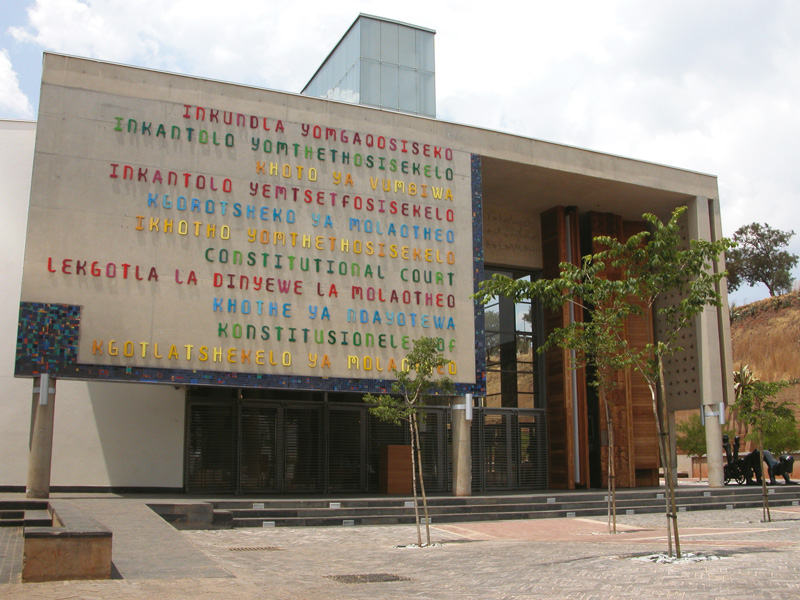
On 26 June 2026 the Constitutional Court in South Africa handed down its judgement on the constitutionality of the Copyright Amendment Bill. It found that the majority of provisions are constitutional and do not amount to an arbitrary deprivation of property. These include the provisions on fair use of copyrighted works and other exceptions for libraries, research and personal copies. On Fair Remuneration of creators it dismissed the President’s referral on procedural grounds. One specific set of exceptions for education were found to be unconstitutional however, leaving the future of the Bill unclear. Further analysis and the full judgement follows.
Details of the Referral
On 10 October 2024, the President of South Africa launched an ex parte application referring the Copyright Amendment Bill (CAB) and the Performers’ Protection Amendment Bill (PPAB) to the Constitutional Court for a decision on their constitutionality in terms of sections 79(4)(b) and 84(2)(c) of the Constitution. This followed an earlier process in June 2020, where the President referred the Bills back to Parliament due to procedural and substantive reservations. The President’s initial concerns included that certain provisions amounted to retrospective and arbitrary deprivation of property, and conflicted with international treaties such as the Berne Convention and TRIPS Agreement.
While Parliament attempted to accommodate the reservations by amending or deleting some sections, the President maintained that the revisions did not cure the substantive constitutional defects. Consequently, he requested the Court to exercise abstract judicial review over sections 6A, 7A, 8A, 12A-D, 19B, and 19C of the CAB, alongside corresponding provisions of the PPAB, arguing they unlawfully limit property rights under section 25(1) of the Constitution.
Summary of the Findings
The Constitutional Court, in a majority judgment authored by Mhlantla J, evaluated the referred sections and concluded the following:
- Sections 6A, 7A, and 8A (Equitable Remuneration/Royalties): The Court held that the referral of these sections as a whole was incompetent. The President’s initial reservations to Parliament regarding these sections were extremely narrow, specifically targeting subsections that Parliament subsequently deleted. By raising new, broader concerns before the Court that were never put to Parliament, the President failed to follow the proper procedural scope required for a referral.
- Section 12A (“Fair Use”): The introduction of a “fair use” scheme (transitioning from “fair dealing”) is constitutional. The Court found that the open-ended list of exceptions (such as research, parody, education, and news reporting) is balanced by strict fairness criteria. The provision serves a clear public benefit, is not fatally vague, and does not constitute an arbitrary deprivation of property.
- Sections 12B and 12C (Specific and Temporary Exceptions): These sections are constitutional. They allow for specific uses such as short quotations, ephemeral copies for broadcasters, and technological interoperability. The Court found they are narrowly tailored with internal safeguards (e.g., requiring fair practice and attribution) and do not arbitrarily deprive copyright owners of their property.
- Section 12D (Educational and Academic Activities):
- Subsections 12D(1)-(5) are unconstitutional. The majority ruled that they constitute an arbitrary deprivation of property. These provisions enable the wholesale copying of textbooks by educational institutions under loosely defined conditions, failing to adequately define “commercial purposes” or specify which institutions qualify. The Court held that this improperly shifted the state’s burden to fund public education onto private authors, disrupted normal market exploitation, and conflicted with international copyright law.
- Subsections 12D(6)-(9) are constitutional. These subsections are appropriately narrow, governing minor uses such as a student incorporating small portions of works into personal assignments or theses.
- Section 19B (Computer Programs): This section is constitutional. It allows for the limited reproduction of code solely to achieve software interoperability, expressly forbids commercial exploitation of the copied code, and is not arbitrary.
- Section 19C (Libraries, Archives, Museums, and Galleries): This provision is constitutional. It allows cultural institutions to use and reproduce works for preservation, knowledge, and historical purposes, explicitly prohibiting commercial use. It provides reasonable certainty and rationally balances public access with copyright protection.
- PPAB: The findings and orders made regarding the CAB apply equally to the corresponding provisions in the Performers’ Protection Amendment Bill.
Dissenting Judgment
Majiedt J penned a dissenting judgment solely regarding subsections 12D(1)-(5). He argued that these educational exceptions are constitutional and do not amount to arbitrary deprivation. Majiedt J asserted that the majority placed an impermissibly narrow focus on property law, neglecting the fundamental constitutional right to education and the state’s obligations under international human rights law. He reasoned that the provisions contain sufficient internal constraints (such as the requirement that a license be unavailable on reasonable terms) to balance the rights of authors against the dire need to remove barriers to educational materials for disadvantaged learners.
The Future of Fair Use and the Copyright Amendment Bill in South Africa
The majority judgment highlighted several valuable aspects of the fair use provisions (Section 12A), emphasizing that copyright is not an absolute right and must strike an appropriate balance between individual property rights and the public benefit. The key values of fair use identified by the Court include:
- Flexibility and Adaptability: Fair use introduces an open and adaptable approach to copyright exceptions that is better equipped to evolve alongside creative and cultural developments. The Court found this preferable to the restrictive, closed list of permitted purposes found under the previous “fair dealing” regime.
- Promoting Public Benefit and Innovation: The Court observed that overly exclusive, overregulated copyright can act as a hindrance to knowledge production, stifle secondary creative work and innovation, and undermine fundamental rights such as freedom of expression and the right to education. The fair use provision relies on a clear public benefit rationale to prevent these harms.
- Enabling Transformative Use: Fair use protects transformative use, which allows creators to utilize a limited part of an original work to create another entirely new, original work, such as in the case of parody or satire.
- Maximising Personal Use: It gives individuals the flexibility to maximise the use of a work in their personal capacity—for instance, copying a legally obtained work onto various personal devices—without threatening the creator’s potential market through third-party distribution.
- Providing a Structured Balancing Tool: Rather than permitting uncontrolled copying, fair use provides a clear framework of guidelines and fairness criteria. This acts as an intelligible balancing tool to weigh the impact on the copyright owner against the importance of the use, while also safeguarding the moral rights of authors by requiring acknowledgement.
While these arguments provide a robust defense of Fair Use, the future of the legislation in South Africa is unclear. Since the majority on the court concurred that the specific exceptions for education were unconstitutional it now falls to parliament to decide what to do next. Supporters of the reforms, including education trade unions and others will likely call on parliament to draw up a new version of the Bill with the Fair Use and Fair Royalties provisions intact for the President’s signature.
Here is the full judgement