Just AI

Artificial Intelligence

Centre announces a policy agenda on ‘Just AI’

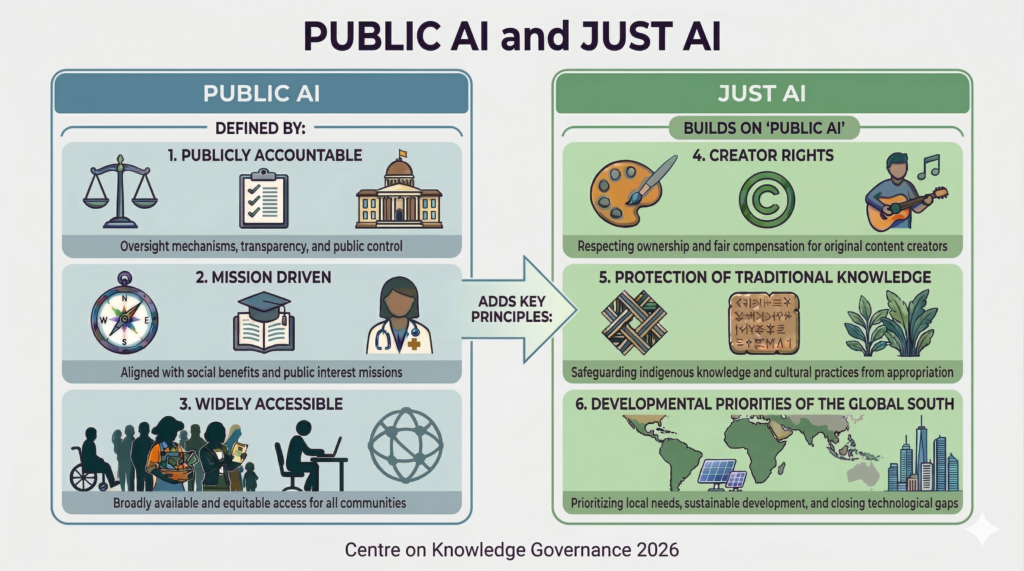
In today’s world, research in fields ranging from health, education and agriculture to economics, social sciences and humanities relies on computational methods, and in particular artificial intelligence tools.  Policy makers and public interest advocates around the world are beginning to formulate a policy agenda for the promotion of Just AI.  The concept of Just AI combines the desires for promoting public accountability and accessibility in AI infrastructure advocated by “Public AI” advocates with additional human rights concerns, including the moral and material interests of creators, the stewardship of traditional knowledge, cultural expressions, and genetic resources by communities, and the developmental priorities of the Global South.  Many of the core elements of a Just AI vision require the implementation or alteration of copyright and related knowledge governance policies (including, e.g., privacy law, data governance, competition law, etc.). These areas of law are often shaped and informed by international treaties and policies being implemented and reformed in International Geneva.    At the Centre on Knowledge Governance we are working with a network of 100 scholars in 30 countries (through the User Rights Network) and with representatives of governments in multilateral organisations in Geneva to help define a policy agenda on Copyright, the Right to Research and Just AI.  To read more about our vision for just AI, see our full concept note below. For case studies on Just AI, visit our focus area page on Just AI

Artificial Intelligence, WIPO

WIPO Launches Artificial Intelligence Infrastructure Interchange

WIPO launched its Artificial Intelligence Infrastructure Interchange (AIII) on March 17, which was described as having the goal of supporting the development of AI technology that supports the livelihoods of creators and innovators. The goal has two aspects – making AI tools available to creators to help their work, while at the same time assuring that the works used to create such tools support the moral and material rights of authors.  The key focus is on “infrastructure” that can technically identify AI creations and promote models for creators to use AI as a tool. Assistant Director General Ken Natsume explained that “the answer lies in various tools: Watermarks, metadata, digital ID, authentication tools, digital distribution frameworks.” The AIII’s launch page similarly defines the “IP infrastructure” of its focus as composed of “watermarks, authentication tools, standards, metadata, digital identifiers, rights management and content recognition systems, and digital distribution frameworks … developed by rightsholders and creators to build new business models that safeguard their rights.”  This definition of AI infrastructure is quite different than the broader sense embraced by Public AI advocates. That approach proposes “treating AI as public infrastructure, emphasising democratic governance, broad accessibility, and accountability to the communities that AI systems serve.” The concept of “Just AI” used by the Centre on Knowledge Governance and others is largely congruent with the goals of Public AI, but also raises additional human rights concerns, including the moral and material interests of creators. In this sense, the WIPO AIII focus on tools to enable remuneration and creator opt outs in AI Tools can be seen as promoting some but not all aspects of a Just AI vision.  At the launch event, participants described the goal of AIII as providing a neutral forum for creators, rights holders, developers, and experts to share information on the development and use of such tools, including tools that can be used in the creation process. Music and voice or actor simulation models are a core focus of the project. These are areas where AI tools have the potential to create content that competes with the works used to train them. In such areas, the justification for using highly licensed tools and giving creators maximum ability to opt out of their content being used in training is at its apex.    The WIPO project has created a “Technical exchange network (TEN)” where technical experts from the private sector, including academics and civil society, will share information on the development and use of content identification tools. There will also be an annual public meeting of the project and a government expert group that will share information with policy makers about such infrastructure and exchange on national developments.

Scroll to Top