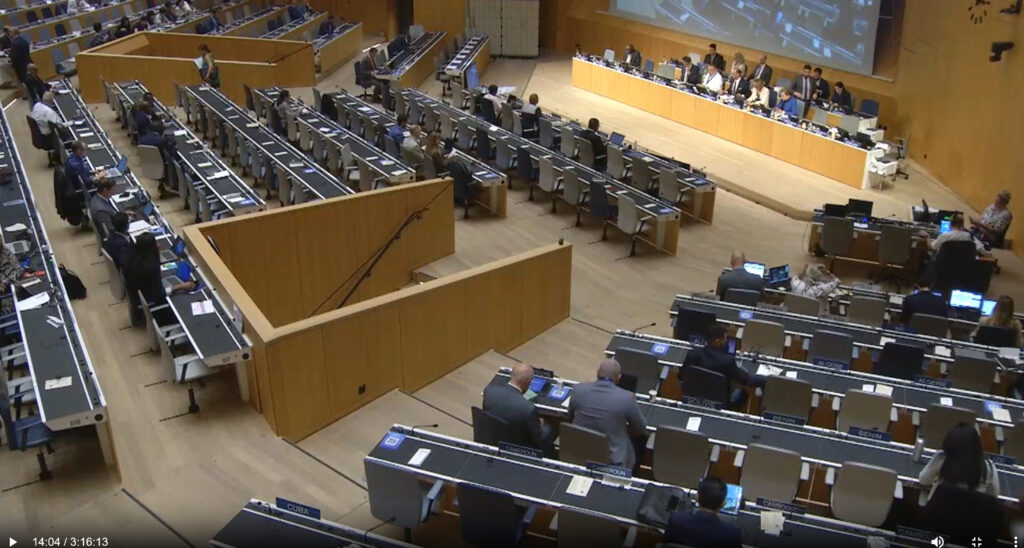
The 68th series of meetings of the Assemblies of the Member States of the World Intellectual Property Organization (WIPO) convened in Geneva from July 7 to 15, 2026. Following the decision at the previous Standing Committee on Copyright and Related Rights (SCCR) to begin text-based work on limitations and exceptions (L&Es), the latest meeting of the General Assembly provided insight into the way forward for future discussions. Member states articulated their positions on the specific type of instrument that should be the focus of the Committee’s ongoing work.
Developing Countries Renew Call for Progress
Several developing nations urged the Committee to make tangible progress on the 2012 General Assembly mandate. The Islamic Republic of Iran stated that they expect future work “to open the door to genuine text-based negotiation at the 49th session, not another cycle of general exchanges”. El Salvador, speaking for GRULAC, encouraged deliberations to “move towards practical and balanced solutions that enable tangible progress in these longstanding discussions.
Speaking specifically to the timeline on behalf of the African Group, South Africa articulated frustration over the delays, noting a “lack of political will” on the current agenda and observing that 14 years after the 2012 mandate, “the work program on L&Es remain without a conclusive implementation approach”,. To address this, South Africa proposed that the African Group draft text serve as the baseline for negotiations: “South Africa is of the firm view that the Africa Group proposal contains substantive text which could be a baseline for norm setting negotiations”. Egypt endorsed this approach, stating it is the best way of “living up to the mandate given by the Assemblies of 2012”.
The African Group proposal tabled at SCCR 47/5, whilst including proposed minimum standards for L&Es, explicitly references the 2012 WIPO mandate to work towards an “appropriate international legal instrument or instruments (whether model law, joint recommendation, treaty and/or other forms)”, leaving its final legal nature open to negotiation.
Binding vs Non-Binding
Several regional groups reiterated their opposition to the development of a binding international agreement. Speaking on behalf of the European Union, Ireland noted that while they cannot support work towards a legally binding instrument, they are open to “improving their national legislation within the existing international copyright framework, including reflection on possible nonbinding instruments”. Albania, representing the CEBS Group, articulated a similar position, noting that they “remain open to exploring nonbinding instruments and best practices tools”.
The United States articulated firm opposition to text-based negotiations for a binding treaty. The US delegation communicated that it “does not support further binding norm setting activity at the international level for exceptions and limitations and likewise opposes any text-based discussions towards a binding international legal instrument”
Progress Through a New Chair’s Document
To advance the work, member states highlighted an agreement at the last SCCR that the SCCR Chair will draft a new informal document. As noted by the Islamic Republic of Iran, this will not be a revision of a previous text, but a new document focusing specifically “on preservation, persons with other disabilities and education”. El Salvador, speaking for GRULAC, observed that “the preparation of an informal document to be developed by the Chair… would help structure a substantive debate”.
The willingness of developed nations, such as those in Group B, to consider non-binding instruments offers a path for continued substantive work, marking a shift from previous years of deadlock. While Group B, represented by Germany, maintained that work must strictly follow the previously adopted SCCR/43 work program, they stated a readiness to engage in “further constructive discussions on this issue based on the document to be prepared by the Chair”.
This agreement to utilize a new, structured framework allows the Committee to advance its technical discussions without being stalled by disagreements over the final legal nature of the instrument.
Broadcasting Organizations Treaty and Other Agenda Items
The General Assembly also reviewed the draft WIPO Broadcasting Organizations Treaty. Regional groups including the EU and CEBS expressed their readiness to continue discussions based on the document to be prepared by the Chair, aiming to advance toward a diplomatic conference. The United States maintained that the framework should follow the 2006/2007 mandate for a signal-based approach, noting that the lack of consensus on the rights to be granted and scope of protection makes clear that “much work remains“.
In addition to these topics, Member States addressed the SCCR’s work regarding copyright in the digital environment. Several delegations acknowledged the information sessions held on copyright and generative artificial intelligence, noting that further discussions and a scoping study on AI training are planned for upcoming SCCR sessions.
Outcome in the Final Summary Document
The official outcome of these discussions is recorded in the final summary document of the Assemblies (A/68/9). The document adopted a procedural decision, taking note of the report and directing the SCCR “to continue its work regarding all ongoing issues”.