
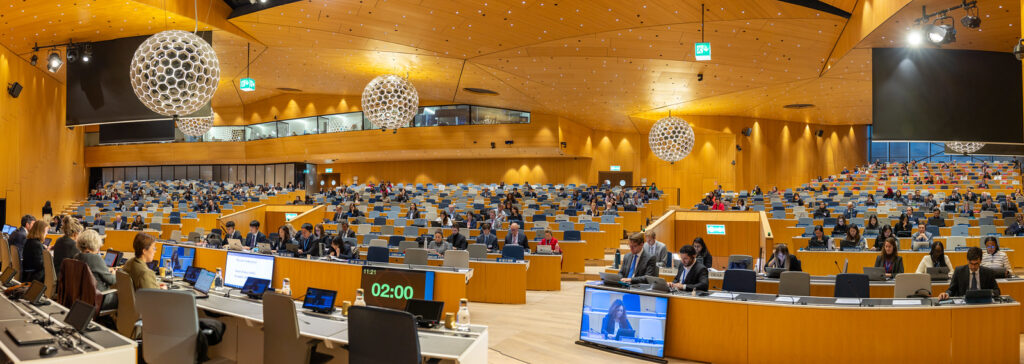
The World Intellectual Property Organization’s Standing Committee on Copyright and Related Rights negotiated its conclusions into the early morning hours of December 6 over the conclusions on a packed agenda. The meeting agreed to identify a series of specific articles of the Treaty on the Protection of Broadcast Organizations that lack consensus, to delay until next meeting the decision on how to begin text based negotiations on three proposals for work on an instrument on limitations and exceptions, and to begin work on studies of remuneration of audiovisual authors and on copyright and training of artificial intelligence tools. This note describes the major conclusions and positions of member states at the meeting. Below we also publish an edited transcript of the SCCR 47 public sessions.
Treaty for the Protection of Broadcast Organizations
The Chair released a new draft Treaty for the Protection of Broadcasting Organizations with minor changes from the previous draft. After many sessions of the SCCR when it appeared that a conclusion of the broadcast Treaty might be near, this round ended with conclusion that many of the draft treaty’s provisions are far from reaching consensus. The Chair’s summary, in a break with those of the recent past, contained a detailed discussion of divergences that remain:
8. Regarding the first set of articles (articles 1, 9, 12, 13, 14, 16, 17), no concerns were raised about their current wording. The second set of articles (articles 3, 4, 6, 10) received support in principle, although a few technical adjustments are still required either in the provisions or the explanatory notes. With respect to the third set of articles, further in-depth discussions are needed in order to overcome the remaining differences, particularly on the topics of (i) rights contained in articles 7, 8 and the respective definitions (article 2), (ii) exceptions and limitations (article 11) and (iii) the functioning of the national treatment and reciprocity principles (article 5 and the interlink between articles 6, 7, 8, 9 and articles 10 and 15).
In plenary statements, the United States and the members of the African Group explicitly opposed moving the current Chair’s draft of the treaty to a diplomatic conference.
The African Group has long supported a narrow broadcast treaty and has repeatedly expressed concerns about potential unintended effects of a broader treaty on public interest uses and on competitive markets. At this SCCR, the Group made its most specific objections to particular provisions of the draft.
The African group stated its support for the conclusions of the Chair’s summary of SCCR 45, “notably that the treaty should be narrowly focused on signal piracy, should not extend to post-fixation activities, should provide Member States with flexibility to implement obligations through adequate and effective legal means and that the object of protection relates to program carrying signals linked to linear transmissions.” It criticized the current draft of the Treaty as veering outside of this zone of consensus. It specifically objected to:
- the extension of the draft to stored programs in Article 8;
- failing to provide mandatory limitations and exemptions, “potentially allowing uses permitted by copyright law, including quotation, research, education and uses by libraries, archives and persons with disability to fall within broadcasters’ exclusive rights”;
- the restriction of the right to permit remunerated retransmissions in Article 6.2 to countries that already have such rules (“We call for this flexibility to be available to all countries”);
- the failure of the definition of a broadcaster to “be limited to traditional broadcasters as determined under national law” and to provide for an opt in, instead of a reservation, for coverage of web-based broadcasting.
The Group identified several questions it requested the facilitators and proponents of the treaty to address, including:
- whether “broadcasters could require licenses for the recording and use of content from a signal where such uses would otherwise be permitted under copyright limitations and exceptions”
- “If Article 7 and 8 remain, would only entities licensed by broadcasters be permitted to sell devices enabling consumers to record and replay traditional broadcasts?”
- Whether, under the definition of a broadcaster, would “non-traditional entities, such as online platforms that occasionally transmit live sports or other content in a linear flow, be protected?”
The African Group concluded that, “given the lack of consensus on numerous provisions, the African Group is of the view that the present text is not ready for a referral to a Diplomatic Conference.” It further restated its position “that the broadcasting treaty and the instrument on limitation and exceptions should progress together with a view to finalizing both instruments concurrently.”
The United States largely repeated concerns about the scope of the draft treaty that it has made in previous SCCR and General Assembly meetings. It expressed disappointment that Articles 7 and 8, on fixation and post-fixation rights over stored programs, were retained in this draft despite its objections to these provisions in earlier meetings.
The EU, the primary demander of the Treaty, expressed some flexibility in confining the draft to conform to concerns raised by other members and recognized that “further technical clarifications are needed” on the present draft. The EU restated its support for a “future proof” treaty in which “retransmission by computer networks of broadcasting organization should be granted meaningful protection.” But it asserted some flexibility on this matter, stating that, “in order to achieve a compromise,” it is “ready to consider” the current option in the text for countries to opt out of covering broadcasting organizations that transmit exclusively via computer networks through a reservation. The EU did not, however, signal support for the narrowing of rights to exclude coverage of stored programs opposed by the United States and the Africa Group.
Some other countries, including Russia, Japan, and Canada, noted the minimal changes in the current draft and urged that it progress toward the available consensus that could support a narrower treaty. India specifically called for consideration of “the option of incorporating mandatory limitations and exceptions.”
Brazil asserted that it was ready follow a consensus for the convening of a Diplomatic Conference based on the present draft, but asserted that “in case consensus is not possible by the end of this session, we propose to temporarily remove the topic from the agenda to enable consultations among interested parties, bringing it back to the Committee after sufficient convergence is identified.”
Following plenary comments, the discussions of the Treaty moved into informal sessions in which, for the first time in recent memory, observers were not permitted to listen to the deliberations.
Limitations and Exceptions
The limitations and exceptions agenda saw the introduction of three new texts. Responding to SCCR 46’s conclusion that the Chair “will prepare a document with concrete suggestions … for the implementation of the Work Program” on limitations and exceptions, the Chair published a Framework of Work Towards an Appropriate International Legal Instrument or Instruments on Limitations and Exceptions. The African Group published a Draft Instrument on Limitations and Exceptions for Libraries, Archives, Museums, Education and Research Institutions and People with Disabilities. The United States, during the SCCR meeting, published Updated Version of the Document “Objectives and Principles for Exceptions and Limitations for Libraries And Archives” and Updated Version of the Document “Objectives and Principles for Exceptions and Limitations for Educational, Teaching, and Research Institutions”
The Chair’s summary on limitations and exceptions indicates that there was no agreement on which draft instrument to begin text based work, concluding in relevant part:
15. The Committee will work toward finding convergences in line with the 2012 Mandate and the Work Program adopted by the Committee in 2023 taking into account all documents as listed in paragraph 13 at the next session.
16. The SCCR will use, in a complementary manner, all relevant documents at the disposal of the Committee, along with input made by delegations during SCCR/47.
All three of the newly proposed texts cover similar issues. The US and Chair’s texts are focused on more abstract objectives and principles language with looser connection to international instrument text.
The Chair’s text largely adheres to statements and principles that are relevant to copyright, albeit largely being framed as objectives for an instrument rather than in language of a legal instrument. The Chair, represented by the Vice-Chair, described its proposed text as an attempt “to facilitate the discussions which we have in this Committee to try to gather all those important aspects, items and topics for discussion that we had before during our previous discussions and to pave maybe a way forward for further discussions to be able to rely on some of the items that are mentioned therein.”
The African Group’s proposal is in the form of a draft instrument, which it emphasized in its statements could be a binding or non-binding agreement. The AG text uses more traditional copyright language and concepts. For example, the Chair’s text in many places provides that exceptions should apply “under appropriate conditions” (Art. B.4, C.9), “under certain circumstances” (Art. C.8), and “prevent … misuse” (C.11), whereas the African Group text spells out the specific bounds of each exception, including requiring conformance with the traditional copyright norm of “fair practice.” Niger, on behalf of the African Group, explained that the AG text was based on “numerous substantive textual proposals were submitted by Delegations and compiled in SCCR documents” and “addresses all issues identified in the action plans and subsequent work programs and presents principles, objectives and options for implementation that we believe the committee should take forward.” Cameroon, also on behalf of the African Group, emphasized that the African Group “deliberately choose to present our proposal in a format of an international legal instrument in order to be consistent with the mandate, but that “[n]evertheless, the instrument as written is neither binding nor nonbinding.” In particular, Cameroon explained that, “as we all know, model law recommendations may use the word ‘shall’ without being binding or nonbinding.” One such model is WIPO’s Joint Recommendation Joint Recommendation Concerning Provisions on the Protection of Well-Known Marks.
The US text is the most abstract, with many of the “principles” in the form of explanations of the value of various institutions with no direct relation to copyright law and policy. The US did not present its new proposals in depth, but rather gave several recommendations for further work of the Committee. It began with support for the work plan on limitations and exception adopted in SCCR 43, and called for “one track for the work on this agenda item, meaning combining the work already underway at this Committee with the work program on limitations and exceptions.” Toward this goal, the US asserted that “the Secretariat’s draft implementation plan could be a good foundation for the one track approach.” It also requested “this Committee to consider adopting or discussing the United States’ updated version of the document on objectives and principles for exceptions and limitations for libraries and archives as one of the instruments under the work program.”
In a new criticism of the Committee’s frequent endorsement of the 2012 mandate to work on “instrument(s)” on limitations and exceptions, the US asserted:
“The text of the relevant passages in the 2012 General Assembly report on the work of the SCCR, WOGA 41/14 says that the Committee agreed to recommend to the WIPO General Assembly that the SCCR continue discussions to work towards an appropriate international legal instrument or instruments whether model law, Joint Recommendation Treaty or other forms with the target to submit recommendations on limitations and exceptions for libraries, archives, educational and teaching and research institutions and persons with other disabilities. The 2012 GA report instructs this Committee to continue discussions towards potential international instruments but it does not call for drafting a specific form of international legal instrument. The actual text of the GA report does not use words like shall continue or must continue that would suggest that the SCCR has such a mandate. Instead, the text indicates that it was this Committee itself, not the General Assembly, that recommended the SCCR continue a discussion on limitations and exceptions for these beneficiaries.”
In the plenary, The GRULAC and CEBS groups endorsed text based work based on the Chair’s document. Brazil, Argentina and Chile suggested prioritizing work on preservation by cultural heritage institutions, which Brazil described as the “least contentious” of the areas being discussed.
The African Group’s text was supported as a starting point for discussions by Iran and Russia. Iran described the AG proposal as “a coherent and comprehensive structure that reflects many of the core issues repeatedly highlighted in the SCCR studies” and therefore “we believe that the African Group’s proposal could be an appropriate basis for text-based negotiations.” Russia asserted:
Having studied both of the texts in detail from the Chair and also the African Group proposal, we believe that the African Group’s text is more mature and has greater potential for our ongoing consideration. … We note the integrated and balanced nature of the African Group proposal which captures the key tasks. We also view as positive that the document gives particular importance to cross-border use and also has a number of flexible provisions enabling states to take into account the specificities of their legal systems.
Pakistan, Algeria, and also India for the first time in recent SCCRs, endorsed work toward a “binding” agreement.
Through its informal discussions, which like the Broadcast discussions were not open to monitoring by observers, the Committee failed to agree on one of the texts to begin text based work.
Given the US criticism, it is notable that the Chair summary agreed to continue work on the “2012 Mandate.” Unlike at the end of SCCR 46, the chair was not tasked with further work on a common document to advance the discussions of the Committee. Apparently it will be for member states and groups to advance their textual proposals in the next meeting.
Other Matters
The other matters on the agenda have been taking up an increasing amount of the Committee’s time, with GRULAC, led by Brazil, pressing for the Committee to move the copyright in the digital environment item to the standing agenda. The Committee agreed to undertake a first element of the GRULAC work plan on the digital environment – a study on copyright and the training of AI tools. It also agreed to undertake a study on audiovisual authors proposed by the African Group. The Summary recorded:
21. The Committee asked the Secretariat to prepare a study on policy or regulatory approaches to the relationship between AI training and copyright, and related rules, and applicable practices on authorization, enforcement and compensation for use, with the understanding that the preparation of this study does not imply any commitment on the Work Plan.
…
23. … The Committee invited the Secretariat to organize a follow-up information session on copyright and artificial intelligence at SCCR/48, as part of the agenda item related to Copyright in the Digital Environment.
24. The Proposal for a Study on the Rights of Audiovisual Authors and their Payment Mechanisms for the Exploitation of their Works – Revised (document SCCR/44/7 REV.2) was presented, discussed and adopted by the Committee. The Committee asked the Secretariat to prepare the requested study, with a focus on all key areas, including digital, without prejudice to the Committee’s future work.
A surprisingly contentious debate emerged about the approval of two studies on rights of remuneration of (1) audiovisual authors, and (2) audiovisual performers, proposed by the African Group. The African Group had previously proposed its study on authors and revised the proposal to respond to concerns raised at previous meetings. At this session, it proposed as a well a separate study on audiovisual performers. All countries spoke in favor of the study on authors, but some countries asked for more time to evaluate the study on performers or suggested that it be staged to follow the author study. Brazil stated that it supported both of the AG’s study proposals, but “under the condition that both of them are approved by the end of this session.”
Following some discussion, the African Group accepted the request of the US and others to approve only the author’s study at this meeting, and postpone the other. The Group requested that the Committee “continue discussing the study on audiovisual performance and also in terms of potential improvements to reach a consensus in the future SCCR sessions that will address all Member States’ concerns on this proposal.”
After the African Group’s concession, the Chair gaveled in the approval of the author study. But Brazil objected. “[I]f we are not clear enough, we are supportive of both proposals but we only support them on the condition that both of them are approved.” Brazil’s reluctance to approve the first African Group study without the second was reportedly the main issue holding agreement on the Chair’s Summary until early in the morning Saturday. Ultimately the views of the majority, including the AG, prevailed and the study on author’s rights was approved. But not without some harm to the cooperative fabric on the committee.
Searchable Abridged Transcript
This pdf below contains an editorial consolidation of the original WIPO Speech-to-Text transcripts of SCCR 47. In preparing this version, we removed statements that were duplicative of positions already expressed by the same or other delegations, as well as purely administrative or procedural interventions. Statements that were not related to the substantive discussion of the agenda items were also excluded. In addition, the portions of the transcripts corresponding to the dedicated artificial intelligence session were removed. The purpose is to create a usable record to assist research and reporting on the results of the meeting. The numbered titles reflect the agenda items being discussed as indicated in the published agenda. You can select the table of contents or outline option in the pdf viewer to navigate by session and agenda item.