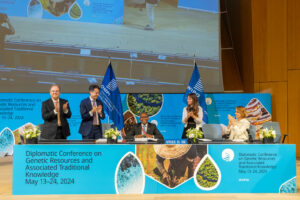

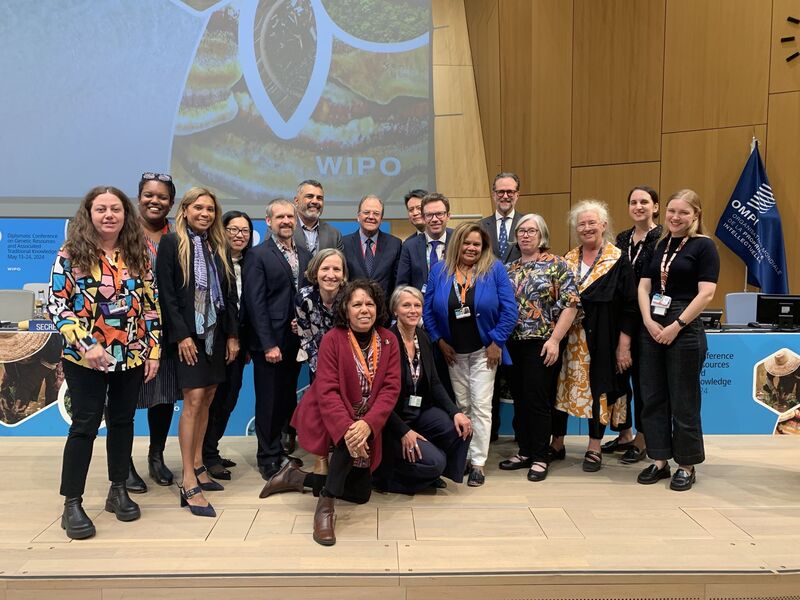
Photo: Australian Delegation, May 2024 Diplomatic Conference, seen here with WIPO DG Daren Tang, Ambassador Patriota and Wend Wendland.
Australia joining the Treaty would show the Treaty benefits all countries, developed and developing alike. If Australia does join, its implementation experience could contribute to the shared knowledge that helps every country put the Treaty into practice.
The recent recommendation by an influential Australian parliamentary committee that Australia become a party to the May 2024 WIPO Genetic Resources and Traditional Knowledge (GRATK) Treaty carries immense practical and symbolic weight – not only for Australia’s First Nations Peoples but for other countries too.
Australia is a megadiverse developed country that is both a provider and user of genetic resources, home to a world-class innovation sector that files patents at home and abroad, and a trading nation subject to a mesh of global trade agreements and WTO commitments.
Australia ratifying the Treaty would upend the myth that the Treaty is a burden imposed by the Global South on the Global North.
The committee’s report provides valuable insights into the factors countries are likely to weigh when considering whether to join the Treaty.
The report makes a second critical recommendation: during implementation of the Treaty, the Australian Government should consult relevant First Nations, the plant science industry and other relevant industry stakeholders.
The report acknowledges that an advantage of Australia joining sooner rather than later is the influence Australia may then have through sharing with other countries its experience in implementing the Treaty.
Lead-up to the Committee’s Decision
Australia’s Joint Standing Committee on Treaties (JSCOT)1 is a parliamentary committee that reviews and reports on treaty actions proposed by the Government before action is taken which binds Australia to the terms of the treaty.
The WIPO Treaty on Intellectual Property, Genetic Resources and Associated Traditional Knowledge (the ‘GRATK Treaty’) was referred to the Committee in May 2026.
Australia had been very active in the 25-year journey to the Treaty’s adoption2, and was one of two developed countries to sign the Treaty (the other being Switzerland).
To join the Treaty and be bound by it, Australia would now need to ratify it.
At the time the Treaty was adopted, The Honourable Penny Wong, Australia’s Foreign Affairs Minister, rightly described the Treaty’s adoption as a ‘remarkable achievement’3 and affirmed that ‘this landmark treaty will recognise Indigenous peoples’ contributions in the international intellectual property system for the first time.’4
The committee received 13 written submissions (including one by this author)5 and held two public hearings in Canberra in June and July 2026. It was also furnished by the Government with a ‘National Interest Analysis’ (NIA).6
The Committee’s Report
The thorough report7 provides a fascinating view into the kinds of factors that a country is likely to assess when considering whether to join the Treaty.
In the case of Australia, these included:
- the perspectives of its First Nations (its Aboriginal and Torres Strait Islander Peoples);
- interactions between the Treaty and other international instruments dealing with Indigenous Peoples’ rights and access and benefit-sharing;
- legislative changes and mechanisms that will be needed for the Treaty’s effective implementation;
- the effects of the Treaty on innovation and legal certainty in the biotechnology, pharmaceutical and plant sciences sectors;
- the Treaty’s prospects of coming into force, and which other countries are likely to join;
- the costs, if any, associated with joining the Treaty;
- how many patent applicants in Australia would likely have to comply with the Treaty’s new patent disclosure requirement;
- that joining the Treaty could provide Australia with an early-mover advantage in demonstrating to other countries how best to implement it; and,
- that parties to the Treaty, as full members of its Assembly of Contracting Parties, would have influence over its governance and evolution.
It seems the Committee was especially swayed by the Treaty’s alignment with the wishes of Australia’s First Nations, the benefits for all countries of predictable, internationally harmonised patent disclosure rules that reduce legal uncertainty and the risks of misappropriation and biopiracy, and improve patent quality, and because joining the Treaty would allow Australia to continue its global leadership role by helping the Treaty come into force and by being among the first countries to implement it.
Its implementation should, the Committee wrote, maintain the safeguards agreed during the negotiations to provide clarity and certainty for innovators, researchers and industry participants. The Committee underlined its view that successful implementation of the Treaty will depend on early, comprehensive and culturally appropriate engagement with Australian First Nations Peoples.
Conclusion
The Australian Government will now consider JSCOT’s report. A recommendation from JSCOT is an important step, but it is not the final decision to ratify the Treaty.
Should Australia proceed to ratify the Treaty, this will no doubt be welcomed by the newly established GRATK Champions Core Group launched in September 2026, under the leadership of Nigeria. This Group is a country-led initiative to promote the entry into force of the Treaty. It is supported technically, upon request, by the Centre on Knowledge Governance at the Geneva Graduate Institute.
As this author has argued elsewhere8, early coordination amongst countries as to how the Treaty is interpreted, operationalised and enforced will contribute to it meeting its explicit and implicit objectives.
It will, therefore, be instructive to see how Australia goes about the Treaty’s implementation.
In cooperation with its Aboriginal and Torres Strait Islander Peoples, Australia could model sensible and pragmatic yet effective implementation, showing that disclosure can be meaningful for the communities concerned while still workable for business.
In so doing, Australia would indeed cement its leadership role in this area.
Notes
- https://www.aph.gov.au/Parliamentary_Business/Committees/Joint/Treaties (accessed October 26, 2026). ↩︎
- See ‘WIPO’s Historic New Treaty Has Important Implications for Patent Applicants’, https://www.iphqnews.com/article/wipos-historic-new-treaty-to-combat-biopiracy-has-important-implications-for-patent-applicants/ (accessed October 26, 2026). ↩︎
- Speech, Parliament House, August 15, 2025, https://www.foreignminister.gov.au/minister/penny-wong/speech/celebration-treaty-intellectual-property-genetic-resources-and-associated-traditional-knowledge, (accessed October 26, 2026). ↩︎
- Press Release, May 27, 2025, https://www.foreignminister.gov.au/minister/penny-wong/media-release/historic-global-agreement-recognising-first-nations-cultural-knowledge (accessed October 26, 2026). ↩︎
- The submissions are available here: https://www.aph.gov.au/Parliamentary_Business/Committees/Joint/Treaties/WIPOTreatyonIP/Submissions (accessed October 26, 2026). ↩︎
- NIAs are required when Australia is considering entering into a new treaty. NIAs consider the treaty, outline the treaty obligations and any regulatory or financial implications, and report the results of consultations undertaken with government agencies, state and territory governments, industry and non-governmental organisations. ↩︎
- JSCOT’s Report No. 234 of August 2026, released in October 2026, available here https://www.aph.gov.au/Parliamentary_Business/Committees/Joint/Treaties/Completed_inquiries (accessed October 26, 2026). ↩︎
- ‘Genetic Resources and Traditional Knowledge: Realising the Promise: Entry into Force, Resilience and Purpose’, https://knowledgegov.org/realizing-the-promise-of-the-wipo-treaty-on-genetic-resources-and-traditional-knowledge/ (accessed October 26, 2026). ↩︎