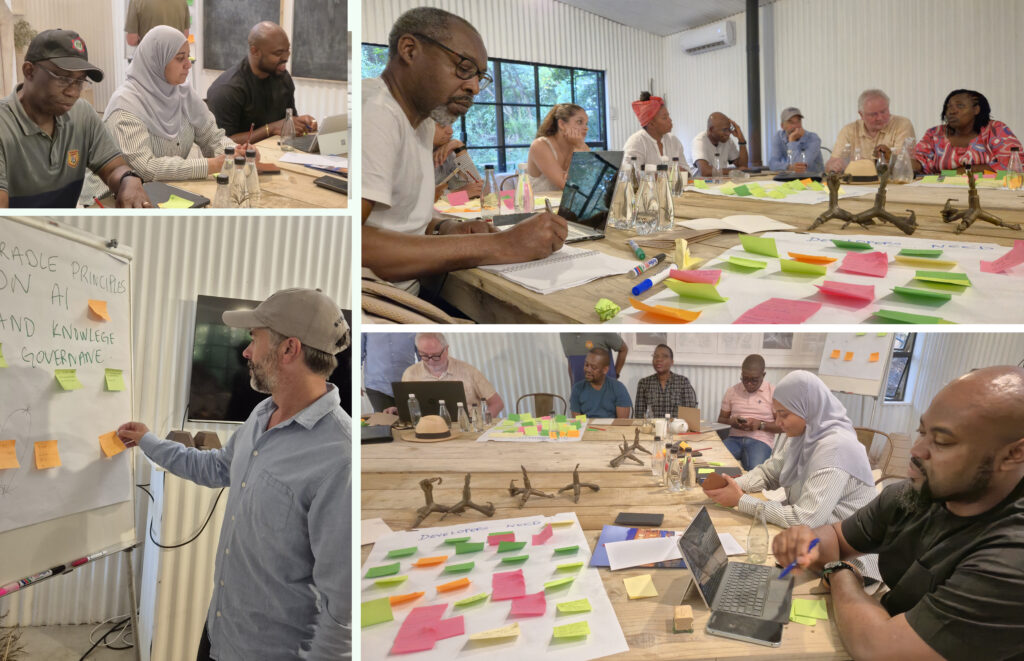
This document was prepared by the Centre on Knowledge Governance (CKG) to summarise discussions on principles of Just AI and Knowledge Governance held in the Cradle of Humankind, South Africa, in February 2026.
The Cradle discussions included representatives of African governments, academics, Artificial Intelligence (AI) model developers, scholars and negotiators of international agreements on traditional knowledge, and creators and performers of copyrighted works and data used in AI training, listed at the bottom of the document. The objective of the discussions was to articulate an African voice and focus on the topic while reflecting principles with potentially global application.
This document records the substance of discussions without attempting to resolve any potential conflicts in views or endorsing any particular norms as reflecting the positions of all or any of the participants. When we use the word “should” we mean it to indicate that at least some members of the discussions proposed that actions should be taken, not necessarily that all in the room consented to the precise framing used here. It is not a suggestion for a legal document. It is the starting point, not an end, of a longer and broader discussion that CKG plans to host, including in consultation with other stakeholders, academics and policy makers.
Table of contents
Needs of African AI Developers
From Knowledge Governance Systems
From Exercise of Agency (code of conduct)
Needs of Creators of Works and Content Used in Training
From Knowledge Governance Systems
Objectives of Copyright and Knowledge Governance
Objectives for Protecting Traditional Knowledge
Just AI
Essence and purpose
The goal of AI models and applications should be to serve as a tool to help humans, not to achieve an intelligence independent of humanity. AI should support human life and the planet. Models and tools should be decentralised and context specific, wherever possible; be as small (e.g. use as little data and compute power) as possible; be adaptable and malleable, be publicly accountable and transparent (whilst respecting privacy); reflect the lived experiences and cultures of the creators, developers and users, and accessible by all people wherever possible.
Definitions of Public AI and Just AI
Public AI models and tools are subject to public policies to ensure that they promote human rights and justice. Public AI policies aim to ensure that AI development is in the public interest, subject to transparent governance and democratic public accountability. Just AI builds on Public AI, aiming to protect the moral and material interests of creators, the stewardship of traditional knowledge, cultural expressions, and genetic resources by communities, and by promoting the developmental priorities of the Global South.
Principles
Just AI systems should not exploit labour, use unsustainable environmental practices, be concentrated in and controlled by large for-profit corporations in one or two countries. Just AI systems require recognition of data providers and data communities who are impacted, have guardrails to prevent abuse (such as deepfakes), and should prevent the misappropriation of traditional knowledge and traditional cultural expressions. African governments should explore strategies to support Public AI, where compute, data, models, and expertise are made available to innovators and stakeholders on the continent.
Needs of African AI Developers
From Knowledge Governance Systems
African AI developers need knowledge governance systems, including balanced copyright and other intellectual property provisions, that promote the ability to fairly use and access data for the development of models and tools. For example, fair use of the JW300 dataset of language translations was required to create African language translation tools by the Masakhane Natural Language Processing (NLP) project for African languages.1 NLP also needs access to other sources that have local language translations, including content from broadcasters (especially public broadcasters). Content and data needed are often held by or created by governments, but not always released through open access policies. There is also a need for access to African data and information held abroad, such as in foreign libraries, museums, archives, and media collections.
African AI developers need the ability to use reverse engineering and knowledge distillation to learn from foundational large language models to create smaller and more specific applications for the African context. Reverse engineering rights are recognised in many systems of the Global North, but often lack expression in the copyright and other laws of the Global South.
African AI developers often wish to ensure protection of their own curated datasets against competing global for-profit institutions. A particular concern is expressed about the rapacious desire for more data by the largest model builders, who rarely share back with African producers of data or model builders. Positive approaches include the use of the Nwulite Obodo Open Data License (Noodl), that includes customised license terms and tiered pricing schemes for the distribution of African language datasets.
From Other Resources
African AI developers need access to a variety of resources to do their work. They need affordable access to a stable Internet and computing infrastructure. Computing power can be accessed through a hybrid of public and private infrastructure. Some examples include African GPU Hub, Sannah AI, MIND institute.
There is a need for access to affordable legal advice and support, for example, from legal networks that understand the law and the needs of AI developers.
Developers need access to various kinds of information and training, including access to performance metrics of public AI, information on data provenance, information on IP and data protection laws, and participation in the development of public policies and strategies.
From Exercise of Agency (code of conduct)
Developers need to establish norms for their own conduct, similar to the Malabo convention and South African NIMA. Organisation should be furthered through support for structures to engage each other and have a strong voice with policy makers (such as through the Deep Learning Indaba).
In their work, developers need to prioritise the African context and cultural sensitivity in their work, prioritise local over global application of ideas for maximum effect, develop high-quality contextualised data to address clearly formulated localised problems, and design for self-correction, recall, and harm-avoidance. Where appropriate developers should be held accountable for their developments, similarly to codes that apply to structural engineers and mining companies that develop potentially dangerous processes and products.
Needs of Creators of Works and Content Used in Training
From Knowledge Governance Systems
Creators of content and data used in AI training should have the right to just remuneration for uses of their works. Just remuneration principles should ensure remuneration and rights to exclude uses when an AI tool can reproduce works in its outputs. Creatives should have the right to better contracts ensuring remuneration when intermediaries license their content for AI uses. Remuneration models could include revenue sharing, contributor funds and pools (see adobe, shutterstock, canva), and through licensing agreements.2
Creators desire transparency in the use of their works in AI training, possibly including watermarking of creative works.
Creators should have the information and training needed if they choose to be part of data communities established to benefit from AI developed from data which they provide, and they should be able to set the terms on which their data is used.
From Other Resources
There is a need for new models of support for creative livelihoods, such as increased grants, public funding (possibly through a tax on profitable AI systems), and possibly reward systems that are correlated to the duration of profitability of their works.
From Exercise of Agency
Creators and those providing training data, such as language recordings, need to be organised and informed to engage in AI policy development and the assertion of their rights. They need to understand the complexity of the value chain of creative work in the age of AI, to rethink the contracting process and limits of IP laws, to proactively engage policy makers to have their needs taken into account, to think of ways to use AI to support their creativity, and to have a basic awareness on IP/Copyright/AI provisions in their contracts.
Objectives of Copyright and Knowledge Governance
Objectives
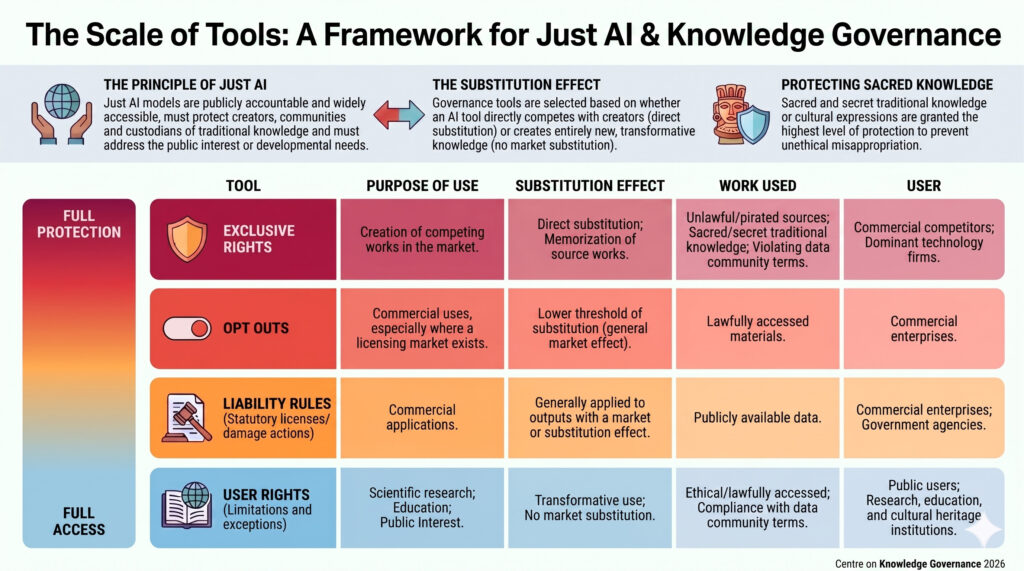
Copyright and other knowledge governance regulations should promote the development of African AI tools and models, not bolster the market power of a small number of dominant technology firms. Copyright rules should strike a balance between enabling some uses of copyrighted works to develop AI tools while taking into account the moral and material interests of creators. In doing so, a spectrum of copyright tools — from rights to exclude and opt out of uses through liability rules (enabling compensation but not exclusion) to user rights allowing free uses — should be tailored according to the purpose and use of the AI tool, the substitution effect on works used in training, the nature of the works used, the nature of the user (see table below).
Copyright tools should include the strongest rights and remedies for uses that substitute for works in the market, including through memorisation and communication of works in AI outputs, or that use unlawfully or unethically accessed materials — including secret or sacred traditional knowledge. Other tools, such as opt-out rights, liability rules, compensatory systems, and limitations and exceptions, may be used to promote various public interests, including the public interest in fostering competition and diversity in AI development. It may be appropriate to ensure compensation for the use of works to train AI tools that produce market competitors, such as in music. Use of works for non-profit research, education, cultural heritage, and other public interest uses that have the goal and effect of knowledge creation and do not create market substitutes should generally be free to use. Commercial applications may also benefit from user rights when they create AI tools and models that are transformative in the sense of producing information for a different purpose and audience than the works used in training — for example in the field of Natural Language Processing. See Makakhane project.
Copyright exceptions for reverse engineering should allow developers to learn from dominant models that operate as essential facilities for the development of smaller and more context-specific and efficient models that are most needed in the African context. There are a handful of dominant foundation and frontier models that African developers need to access and learn from to develop local applications. Knowledge governance systems should include duties to license (refusal-to-deal doctrines) and rights of researchers to access data from dominant AI tools to study systemic risks, such as disinformation, illegal content, and threats to mental health.
Explicit provisions for text and data mining for AI training should be considered at the local and international levels, at least for public interest applications.
Copyright registration and enforcement may require a declaration of the use of AI in the creation of works. Copyright law should set a high bar for copyright protection for AI-assisted outputs.
Scale of Tools
Copyright and other knowledge governance rules can use a scale of tools to address AI uses of content, depending on the purpose and impact of the tools. A table of considerations could include:
Objectives for Protecting Traditional Knowledge
Knowledge governance systems should recognise established rights of indigenous peoples and local communities (IPLCs) relative to AI tools and models which use traditional knowledge, including cultural expressions and genetic resources (referred to collectively at “TK”). Knowledge governance should require disclosure of source and origin of TK used, free prior informed consent, benefit sharing, active involvement and participation of IPLCs in policy formulation, and access to tools and models that involve their interests.
Knowledge governance systems should:
- Recognise the inherent agency of IPLCs, be intentional regarding the active participation and capacitation of IPLCs, address historical injustices and ongoing vulnerabilities through acknowledgement and empowerment, at least question whether dominant IP doctrines and practices and institutions concentrate power away from IPLCs (take an incremental approach to rethinking patents, trademarks and copyright, with IPLC TK holders at the table), identify specific uses of AI with TK which may benefit local communities, eg improving agricultural livelihoods.
- Recognise and uphold the multi-modal nature of traditional knowledges of indigenous peoples as well as local communities, respect the secrecy and sacredness of some TK, recognize the different types of TK and how they should be treated differently, by no means offend TK and TK holders & custodians.
- Prevent unfair exploitation and misappropriation of TK in AI models and applications, including by ensuring that the benefits of uses of TK are shared with indigenous peoples and local communities, ensuring the disclosure of any use of TK in an AI model, after prior informed consent, and ensuring the sharing of access to use tools and models that engage or involve their interests.
What Governments should do
The rise of AI represents more than just a technological shift. It is a pivotal moment for digital sovereignty and socio-economic transformation. Rather than being passive recipients of global AI trends, African governments have a unique opportunity to steer this technology towards national, regional, and continental-specific developmental needs.
The following framework outlines a comprehensive roadmap specifically tailored for African governments. It emphasizes a “Just AI” approach that balances rigorous regulation with the nurturing of local ecosystems, ensuring that AI serves the public interest, protects cultural heritage, and drives sustainable growth across the continent.
In this respect, it is recommended that African Governments:
(i) Articulate strategic, development‑oriented AI governance priorities
Policies should prioritise and invest in research on AI to fully appreciate the scope, risks and benefits of AI in the African context; decide on whether to focus on applying existing AI models, building new ones, or pursuing both in parallel; address AI in all its ramifications and which are tailored to local contexts, including by:
- Agreeing on priority areas for AI development and use, especially key socio‑economic sectors such as IP, health, education, and agriculture;
- Ensuring that human rights, sustainable development, basic access, and the public interest are at the forefront and centre of AI policy;
- Recognising that AI governance transcends risk mitigation and is also a means to advance public value and developmental outcomes;
- Adopting granular, context‑appropriate policies and instruments; and
- Addressing AI in ways that advance developmental and Just AI policy.
(ii) Build and nurture locally relevant AI ecosystems and tools to bolster nationally and/ or regionally-owned AI systems.
Governments should support the development of African AI, especially by local small and medium enterprises (“SMEs”) and startups; introduce AI education in school curricula; invest in AI development that addresses African needs and is relevant in the African context; and prioritise the development and adoption of locally built AI tools, for example, in procurement policies.
(iii) Secure data sovereignty and align AI and IP laws with public values
Governments should consider making government-generated data open, where appropriate, in the public interest; managing African data in ways that encourage AI development, without prejudice to national security, including by creating databases from African‑generated data and protecting them through suitable legal mechanisms; establishing enforceable rules in favour of data sovereignty; building practical and user-friendly pathways to enhance compliance with data sovereignty rules; and imposing appropriate public obligations on the controllers and owners of AI systems in light of their use of natural and social resources.
(iv) Regulate AI, IP, and safeguards to protect rights and the public interest
Governments should consider regulating AI within African territories in order to protect the public interest; taking necessary precautions, including by engaging the relevant stakeholders and taking into account empirical evidence, in adopting foreign notions on AI to ensure that they are adapted to African realities; regulating private AI systems to make them more publicly accountable; ensuring due protection for the work of artists and creators within AI ecosystems; and adopting appropriate limitations and exceptions for research, education and related public‑interest uses.
(v) Invest in AI infrastructure and build strong public‑sector capacity
Governments should consider supporting the development of African AI, especially by local SMEs and startups, through the provision of targeted infrastructure (including connectivity, compute and data infrastructure), funding and incentives; cooperating with other African governments to fund AI development and the implementation of AI‑related policies and strategies; funding AI startups and other local innovators as part of a broader AI ecosystem strategy; building public sector capacity on AI procurement; being independent and context‑sensitive when evaluating all large AI‑related project procurements.
(vi) Pursue regional coordination and inclusive, multi‑stakeholder AI processes
Governments should explore developing cross‑border AI policies and reinforcing collaboration and cooperation across African states; cooperating at regional and continental levels to fund AI development and avoid fragmented efforts; participating actively in global AI agenda‑setting and conversations; presenting a united front as Africa and as part of the Global South in advancing developmental and Just AI policy; advancing the ethical use of AI at international fora, including the World Intellectual Property Organisation (WIPO), the International Telecommunication Union (ITU) and the World Health Organisation (WHO), etc.; establishing frameworks for collaboration and consultation with developers, creators and IPLCs in policy formulation; ensuring the inclusion of technical people in delegations to engage in policy discussions on AI and IP at international fora; and adopting a multi-sectoral and multi-stakeholder approach in the development of national AI strategies and policies.
Workshop Participants
All participants attended the workshop in their personal capacity. Institutions are listed only for identification purposes. Each participant attended a one-day academic conference, a one-day semi-private workshop, and a 2-day workshop, resulting in this report. No participant was asked to endorse this document in any capacity. This report aims to show where there were common ideas and a high degree of consensus amongst workshop participants. However the proposals and concepts in this document do not necessarily represent the views of all workshop participants.
Nyalleng Moorosi, The Distributed AI Research Institute,
Francois Joseph Nnemete Beyen, Ministry of Posts & Telecommunications, Cameroon
Susan Strba, Centre on Knowledge Governance
Andrew Rens, Research ICT Africa
Tobias Schonwetter, University of Cape Town, South Africa
John Asein, Director General Nigerian Copyright Commission
Eman S. Ibrahim, Egyptian Intellectual Property Authority
Chebet Koros, CIPIT, Strathmore University, Kenya
Chidi Oguamanam, University of Ottawa Faculty of Law
Adrian Galley, South African Guild of Actors
Kyla Jade, ReCreate South Africa
Juteau Deadjufo Tousse, Ministre-conseiller, Cameroon Mission to the UN
Sharon Chahale, Kenyan Copyright Board
Donald Ugochukwu Egbufor, First Secretary, Nigeria Mission to UN
Audrey Akweley Yeboawaa Neequay, First Secretary, Ghana Mission to the UN
Ben Cashdan, Centre on Knowledge Governance
Sean Flynn, Centre on Knowledge Governance
Anthony Mathenge, First Counsellor, Kenyan Mission to the United Nations
Notes
Ben Cashdan, Masakhane: Use of the JW300 Dataset for Natural Language Processing (CKG, June 28, 2025), https://knowledgegov.org/masakhane-projects-use-of-the-jw300-dataset-for-natural-language-processing-copyright-issues-contract-overrides-and-cross-border-implications/
↩︎See, e.g., Amy Thomas and Martin Kretschmer, The AI licensing economy (CREATe, 2025), https://www.create.ac.uk/blog/2025/02/24/the-ai-licensing-economy/
↩︎