

GRULAC

Blog

The AI Remuneration Debate: Three Perspectives

The rapid development of generative AI has sparked intense debate over how, or even if, creators should be compensated when their copyrighted works are used to train commercial AI systems. This issue pits the drive for technological innovation against the fundamental rights of authors to benefit from their creations, leading to diverse proposals for legal and economic frameworks that seek to strike a fair balance. The following three presentations from the Global Expert Network on Copyright User Rights Symposium in June 2025 explore this complex landscape from distinct legal, philosophical, and geopolitical perspectives. The Geneva Centre on Knowledge Governance and the Program on Information Justice and Intellectual Property bring you three contributions to the AI Remuneration Debate. PART 1: Christophe Geiger approaches the problem from a human rights perspective, arguing for a balance between the right to develop AI for cultural and scientific progress and the author’s right to benefit from their work. He critiques current systems, noting the “all-or-nothing” nature of the US “fair use” doctrine and the EU’s “bizarre” opt-out rule for text and data mining, which he believes fails to secure fair compensation for authors due to unequal bargaining power with publishers and producers. His central proposal is to replace the EU’s opt-out system with a mandatory statutory remuneration scheme for the commercial use of works in AI training. Drawing on the success of similar “remunerated exceptions” in Europe, which generate significant revenue, Geiger proposes that income from this scheme be distributed directly to creators. Geiger contends this model would uphold authors’ human right to fair remuneration without stifling innovation. PART 2: Zachary Cooper reframes the debate by arguing that traditional copyright concepts are becoming obsolete in an age of infinite digital remixing and AI-driven content creation. He contends that focusing on authorship thresholds is futile because the line between human and machine creation is hopelessly blurred and impossible to audit reliably. Methods like watermarking are technically weak and easily circumvented. For Cooper, the real issue is the massive scale of AI generation, which makes copyright enforcement impractical and weakens creators’ negotiating power. He describes copyright as “a dam in an infinite river,” an outdated barrier against a constant flow of transformation. Instead of rigid ownership rules, Cooper suggests the future lies in collective licensing models and a greater emphasis on attribution and visibility, which would allow creators to capture value as their work spreads across massive platforms. PART 3: Vitor Ido situates the remuneration debate within the political and economic context of Brazil and Latin America, presenting it as a crucial tool for regulating corporate power and protecting national creative industries. He explains that for GRULAC (Group of Latin American and Caribbean Countries), the issue is not just about copyright but about challenging the dominance of large, foreign-based platforms that exploit local content with little to no payment to creators. The discussion also encompasses cultural sovereignty, such as protecting the dubbing industry from AI-generated voices, and safeguarding the traditional knowledge of Indigenous communities from misappropriation. Ido highlights Brazil’s draft AI Bill, which proposes an inverse of the EU’s system: a mandatory remuneration right that includes a reciprocity clause and ties the payment amount to the size of the AI company, directly targeting the market power of major corporations. This approach frames remuneration as a strategic element in a broader agenda of economic justice and cultural preservation in the Global South.

Blog, WIPO-SCCR

The GRULAC proposal on remuneration rights at WIPO SCCR: Understanding the interface with national debates and the issue of corporate power

Vitor Ido of the University of São Paulo (USP) explains the context of the renewed focus on remuneration of creatives in Latin America, especially in Brazil. He focuses on the desire by Brazil’s new government to regulate the power of large corporates, especially those based in the Global North, especially the tendency to exploit Brazil’s creative content at the expense of local authors and creators. This presentation was delivered at the User Rights meeting in Geneva on 17 June 2025. The full text is available below. The political context in Brazil: A renewed commitment to national creative industries It’s a pleasure to be here and thank you so much for the invitation. So I’ll try to feed into this discussion of remuneration rights, but with a different framing and a different entry point in particular: the reasons why GRULAC and Latin America wanted to bring this discussion to WIPO and how there’s kind of a big mismatch between what’s taking place at the national or regional level and what’s taking place more globally. My interpretation is that we need to understand that at least in Brazil, potentially slightly different from what we’re seeing in Europe, there’s two main things: On the one hand, renewed attention to creative industries as strategic to the Brazilian economy and Latin America more broadly. And on the other hand, regulation of huge platforms.  It’s the post-Bolsonaro context. So this is responding to an authoritarian context in which you had severe cutting in culture industries financing, but also deregulation in the platform sector, which also led to direct consequences for democracy, just like we saw in other countries as well. So if we look from that point of view, when we look at how this new government tried to pitch creative industries as one core focus, you see new fiscal policies, you see new legislation and direct and indirect support to not only authors, but movies and all different cultural sectors. That’s where we get to the remuneration issues: low to minimum to absolutely no remuneration at all for authors, in particular by foreign large platforms. And it’s said all the time in Brazil that our Minister of Culture, who’s also an artist, she pretty much gains nothing and she’s well-known, super well-known actually, and she gets basically nothing out of Spotify. On top of that, of course, there are general concerns about a workforce being displaced by artificial intelligence and thinking about the economic potentials of exporting some of our cultural assets to other countries, not just Lusophone countries, but then potentials for conventional streaming platforms like Netflix. So during the pandemic, for instance, when that was the setting, there was no direct support by the government, what we had was just that sort of investment. But also on the other hand, the issue of regulating platforms, what you see, and maybe that’s one of the things that’s being discussed outside of Brazil more, is how the Supreme Court has taken a very active role in regulating platforms, and even this week they’re about to finalise a reframing of a longstanding provision that was basically a safe harbour, not liability, for platforms that is about to be reshaped. And some people in the international literature are even calling it kind of a Brazil model in the making. Remuneration to support and protect journalism and other key sectors But where it fits into remuneration, is that very explicitly the government is saying to counter misinformation, it’s not just about digital literacy, but also about having enough instruments to support journalism, quality journalism, alternative journalism, black-owned journalism, indigenous peoples-owned journalism, women-owned journalism. And because of a fading business model, that also means that potentially new support in the form of remuneration can be part of this agenda.  This is just one example. Another is that, of course, dubbing [of movies and TV] in Brazil is a really huge cultural industry in an economic sense. You see this campaign that is talking not only about the loss of a whole profession, but also how this fits into notions of being Brazilian, what does it mean to speak Brazilian Portuguese, what does it mean to export it all, and the impact of being translated into an AI [voice], which Netflix actually did on a few occasions. It’s not, therefore, just a workforce displacement issue, but also that broader cultural repercussion that needs to be taken into account. The rights of indigenous people to protect traditional knowledge I just wanted to add, as well, a couple of other issues that I think are important for us to understand more broadly. I think the core in Brazil would be there’s more reasons to be concerned about misappropriation, particularly when we’re talking about minorities, than de facto issues with L&Es not existing.  I’m referring, of course, to Alan [Rocha]’s very well-known argument of how courts in Brazil have historically been trying to compensate for the bad legislation that does not really have L&Es, but that de facto end up authorising utilizations, for instance, for both research and educational purposes. In the policy realm, there’s also other reasons to be concerned about what’s going on, with the provisions related to big funders that are licencing some of our preservation and museums and archives policies that often just have that blunt open access provisions that are not really aligned with the way you need to negotiate and ponder things with indigenous peoples. I refer to the launch of the University of Sao Paulo’s new Centre of Documentation of Indigenous Languages and Cultures that took place a couple of weeks ago. It’s a very exciting, huge project, and one of the main issues there is precisely how do you do preservation and archival resources with direct participation of indigenous peoples. One of the main issues is you can’t start with an [open] access provision. It might end with that, but then you need to calibrate issues related to traditional knowledge, so when we bring

Blog

Ensuring Indigenous Participation at WIPO: GRULAC Proposal at PBC/38

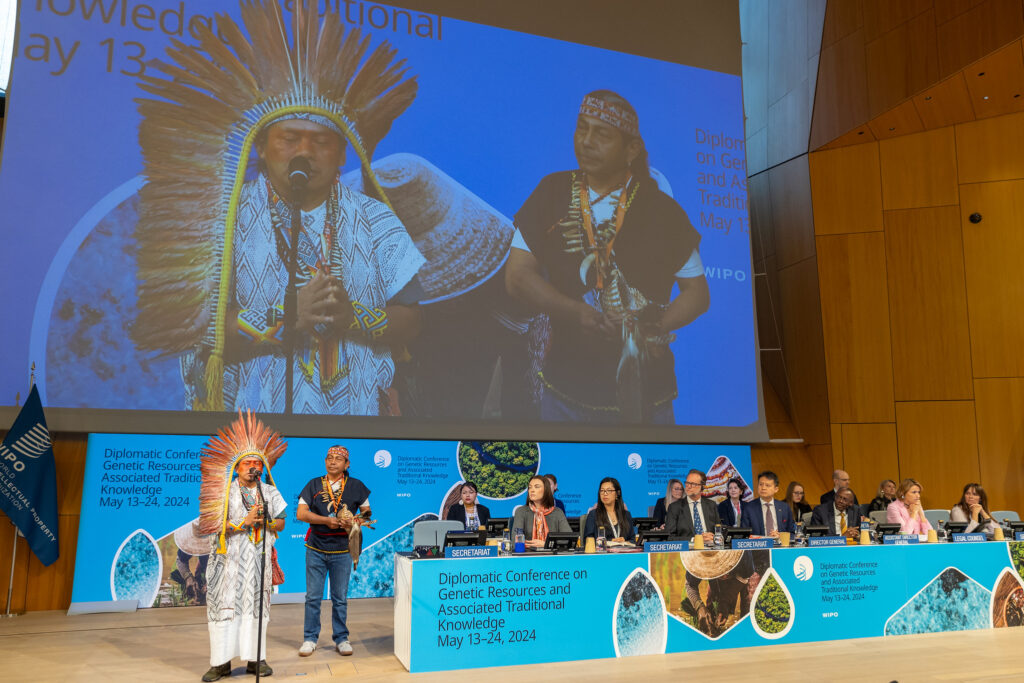
At the 38th session of WIPO’s Program and Budget Committee (PBC), the Delegation of Colombia, speaking on behalf of the Group of Latin American and Caribbean Countries (GRULAC), introduced a proposal to address the ongoing funding crisis that threatens the participation of Indigenous Peoples in WIPO’s norm-setting processes. The proposal calls for the internal reallocation of existing budgetary resources to ensure minimum, stable support for Indigenous and local community representatives at meetings of the Intergovernmental Committee on Intellectual Property and Genetic Resources, Traditional Knowledge and Folklore (IGC). Colombia emphasized that the proposal had the support of most GRULAC members and was developed in consultation with delegations from other regional groups. It was presented in response to the exhaustion of the WIPO Voluntary Fund, a mechanism created in 2005 (WO/GA/32/6) to support Indigenous participation but which has remained underfunded for years. The Delegation warned that the lack of resources—ongoing for more than a year—has already undermined inclusive participation in discussions directly impacting the rights and interests of Indigenous communities. Crucially, the GRULAC proposal does not introduce any new budgetary burdens. Instead, it draws on WIPO’s existing financial rules to allow internal reallocations, enabling at least two Indigenous representatives to attend each IGC session. This approach mirrors a precedent set in 2016 (IGC 31), when Member States—including Switzerland, Australia, New Zealand, Chile, and Peru—pushed for the inclusion of a contingent allocation from WIPO’s regular budget to temporarily support the Fund after its depletion (PBC/24). That 2016 compromise demonstrated that practical solutions can be implemented without amending the program budget or creating new financial obligations. Civil society organizations, including the South Centre, have long argued for the institutionalization of Indigenous participation through predictable, core budget allocations rather than reliance on inconsistent voluntary donations. GRULAC’s proposal responds to those calls and to the broader imperative of inclusive governance in global IP policymaking. No Member State objected to the proposal when it was introduced. However, the Chair deferred the final decision to an informal session to allow further review and discussion. GRULAC expressed its openness to constructive input from all delegations. As WIPO reflects on equity, access, and institutional coherence, this proposal offers a critical opportunity to reaffirm that the voices of Indigenous Peoples must not be sidelined in shaping international legal norms. The forthcoming informal session of the PBC 39th will be a key moment for Member States to move from recognition to action in ensuring meaningful, sustained Indigenous participation at WIPO.

Scroll to Top