Zachary Cooper argues that forcing generative AI tools to filter out copyright infringement removes copyright’s exceptions in practice and hands the owners of old catalogues a cut of new creativity.
Last year at the User Rights conference in Geneva I argued that authorship is fundamentally changing, as all media is becoming interactive. You can be listening to something and change it just by talking to it. I played a song I had made that way. The reason I haven’t brought you a new song this year is that now – if you tried that – you would be greeted with: “I’m sorry, Zac, but we’re not allowed to create that thing for you.”
What’s changed? Well, there has been a huge crackdown from rightsholders towards GenAI tools making copyright-infringing material. Now the US Copyright Office and practically all of the scholarship says that best practice for Generative AI tools is in-app filtering, so that you cannot create infringing material.
This stems from the notion that this level of copyright infringement is unprecedented. However, you have always been able to make copyright-infringing material with every piece of creative software that has ever existed. What is truly unprecedented is creative software that doesn’t allow you to.
Filters remove copyright exceptions
Now you may say – “But Zac, this is different, because these models are trained on copyright-protected works.” The point I want to hammer on is that you do not need to have trained a model on protected works to create infringing materials with that model. For example, all of the leading music models now are exclusively trained with licensed materials and synthetic data. However, you can still feed them protected works to edit into both infringing and non-infringing works – just as you can with much professional creative software.
The first question is – would AI companies even be liable if they did not filter? It depends. Many argue that they would be, both under US and European law. Yet we need to be extremely careful in assuming these companies have actual or constructive knowledge of ensuing copyright infringement. Whether a work infringes is a socially qualitative assessment: a tiny change to something enormously similar might make it a parody, and legal speech. This means that just because the GenAI system can recognise similarity to protected works, this is not the same as recognising infringement.
Indeed, we are reluctant to ascribe liability to popular creative software for allowing you to create infringing material for a good reason. Because we have copyright exceptions. The minute you start expecting the model itself to decide whether something you create is infringing, then you risk losing all of those critical copyright exceptions. The algorithmic policing of illegal speech comes with the policing of legal speech too.
This is currently the case. Every leading generative AI model already refuses to produce all kinds of perfectly legal speech. As Generative AI is now built into Photoshop and Logic, that censorship is now also in-built into these popular creative workstations. In turn, GenAI companies may then need to cut licensing deals for their outputs, even where they have been legally trained, to avoid lawsuits for creating infringing materials.
Once we require licensing for infringing outputs, not inputs, we risk ultimately paying rightsholders for access to public copyright norms and exceptions: purchasing access to the law from private companies.
Walled gardens and poisoned trees
AI companies whose tools don’t filter therefore risk being greeted with lawsuits, including for tools that were not trained on unlicensed protected works. This is most clear in the music industry – where the major record labels are conditioning their licensing on “walled garden” ecosystems . In these walled gardens, you create the song there, distribute it there, and the song cannot leave there. This is their intention for AI-generated music. These partnerships between AI companies and rightsholders – the terms of which are not public – therefore also give legacy rightsholders greater control, at the point of production, of what sort of competing creativity to their own can even be created.
When Suno released a new model trained entirely on licensed works and (ostensibly) copyright-free AI-generated synthetic data, Universal and Sony said that because the synthetic data was created with tools that were once trained on protected works, the new model is the “fruit of the same poisoned tree” . Despite no longer being trained on their catalogue, Universal and Sony still expect Suno to agree to their “walled garden” licensing terms. We are therefore seeing enormous investment in pooling catalogues between separate rightsholders, who are betting that the more pre-existing catalog works they own, the more revenue they will be able to siphon off of the next generation of creative works. As Bob Valentine, CEO of the newly merged BMG and Concord, said on the day of the merger announcement: “AI … has the potential to create a massive amount of incremental income for existing rights—especially for owners of catalogue—that doesn’t exist today.”
Yet, this is a perversion of copyright’s foundational rationale wherein productive creators using GenAI tools must pay a toll to non-productive actors for permission to enter into production – even where their new creativity is not derivative, by public copyright standards, of that pre-existing catalogue.
Warning and Filters
So why automatically block creativity when a warning is sufficient? Any content-matching tool, like YouTube’s Content ID, can tell a creator, “I think that the work that you are creating is infringing,” and let them decide. Any further intervention at the point of production risks removing freedom of expression, concentrating market power and disincentivising productive activity. This is a far greater danger to the coming AI-assisted era of creativity than the garden-variety infringement we are long used to policing.
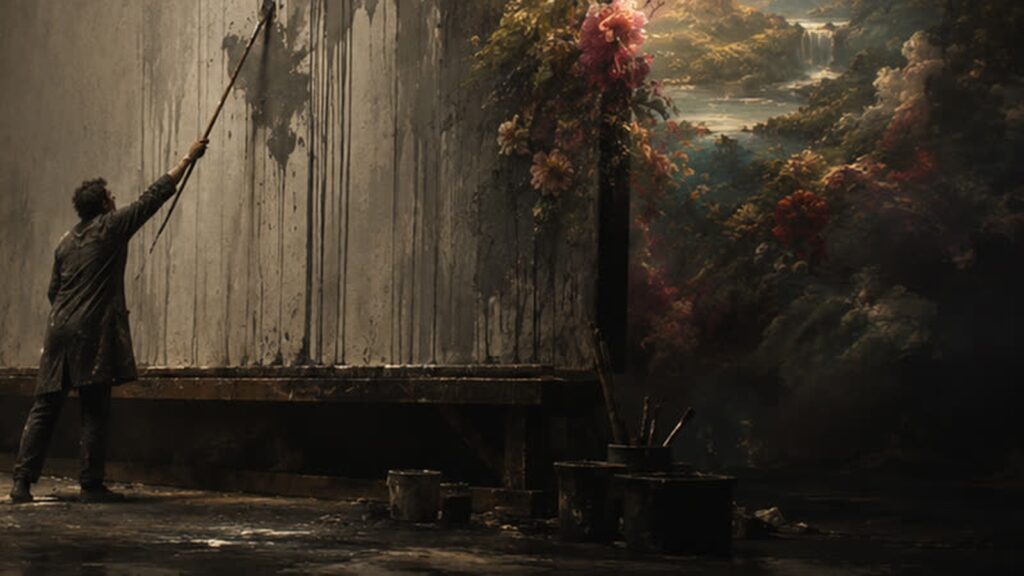
There are old parables about the crooked brush, the paintbrush that takes control of the artist’s hand, choosing what the artist can create against their will. These are classic symbolic nightmares of worlds we do not want, and yet these are the worlds that our current regulatory regime is seemingly bringing into existence. We as lawyers must protect against them.
This is an abridged version of Zachary Cooper’s presentation to USERrights2026. Watch and read the full here: Copyright and AI Outputs.

Zachary Cooper is Research Group Lead at the Weizenbaum Institute and a Lecturer at the Amsterdam Law & Technology Institute, Vrije Universiteit Amsterdam. He is on LinkedIn.