
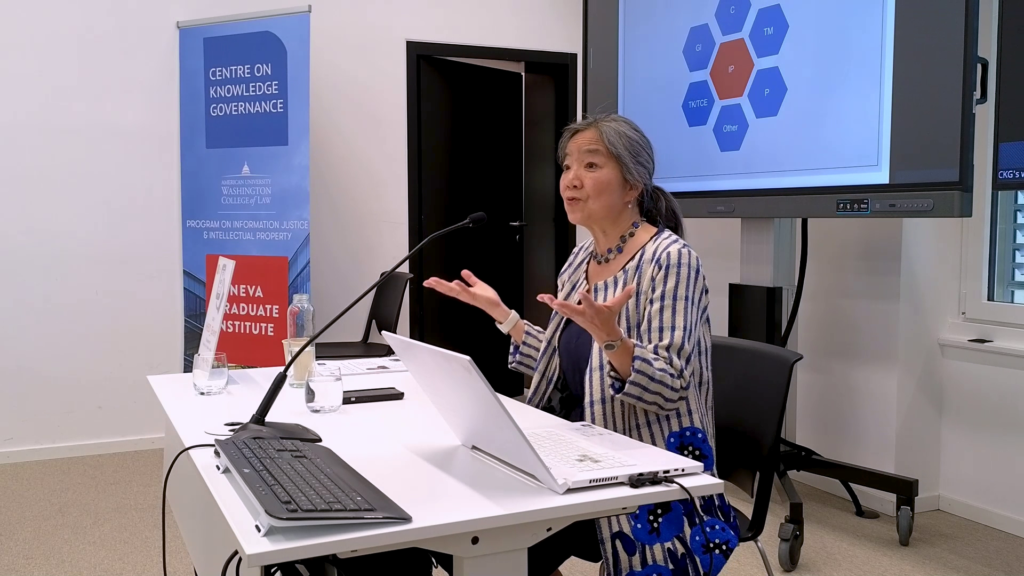
In this video, Maggie Chon explains that 90% of global scientific research is published in English, yet only 25% of the world’s population is proficient in the language. Copyright law frequently acts as a ‘straitjacket’ that restricts the translation and sharing of scientific knowledge. To dismantle these barriers, Chon argues that the scientific community must embrace low-cost machine translation to unlock research trapped behind copyright paywalls.
This is the video and transcript of a presentation at the Centre on Knowledge Governance in Geneva on 18 May 2026.
Professor Sean Flynn: Welcome. We at the Centre on Knowledge Governance are incredibly excited to have Margaret Chon from Seattle University with us tonight. We’ve appointed Maggie as a visiting scholar. She has spent the last six weeks or so at the Rockefeller Bellagio Centre doing some special research on the topic she’s going to be presenting to us today. So with that, please help me welcome Maggie Chon.
Professor Margaret Chon: I am so honoured to be here to share my thoughts with you today. As Sean said, I have been thinking about this topic for the last about a month and a half, very, very intensely, and I welcome your input and feedback because this is actually a work in progress still, although it is enough baked so that I can present it to you here today. I had the privilege of spending about three weeks with three climate change scientists in Bellagio, Italy, through work that was supported by the Rockefeller Foundation, which runs the Bellagio Centre. This work was also supported by the Authors Alliance, which is a nonprofit based in the San Francisco Bay Area. Both of these organisations are very, very much focused on the public interest uses of technology. How does technology, including intellectual property law, foster uses of knowledge to serve the public interest?
The Human Cost of Language Barriers in Science
Two of those climate change scientists were from countries in which English language was not the dominant language. I had the idea that I would interview these two scientists. One of the scientists came from a country in Africa, and English was her fourth language. And it wasn’t until she was 19 years old and pursuing her PhD in France, and really at the pinnacle of her doctoral studies, that she understood for the first time that she had to be fluent in English in order to be a scientist, a top scientist in her field, in order to have impact in her field as a climate change scientist.
So at the age of 19, she started studying English. And it was not easy, because at her university in France, there were no English language classes that were geared towards scientists. So she started using a very early version of Google Translate, which she said was very bad. It was terrible. And she used YouTube videos where she would use captions. She would watch TED Talks going from French to English with captions, and then English to French. And she would basically teach herself. And she said that she really had a very, very difficult time.
At the end of this interview, I asked her a question. I said, if there’s one thing you could do to change the current system to allow you to essentially avoid all of that, what would you do? And she said, can you have the UN create a system where you press on language, and then you have everything being translated into your language? Then you can think. Because it does take time, a lot of time, years, to be able to think in another language. And when you do science, you need to be able to think and to express your thoughts openly.
She started off with Hausa. Her second language was Arabic, because she grew up in a Muslim family. Then she was fluent in French, absolutely perfect French. But English is her fourth language. She is now a climate change scientist working in a government agency in the United States, able to participate in science. There aren’t very many people who can overcome those kinds of challenges to be able to have their ideas come to the rest of the world. Her ideas are amazing, because what she’s trying to do is bring generations, hundreds of years of knowledge of water management systems from the Sahel to the attention of scientists in the West. And that’s translation work on a different level, scientific translation work. So that is why I’m so passionate about this project, because I think that it’s about participation. It’s about impact by people who may not have access because of the dominance of the English language in scientific fields.
Beyond Intellectual Property: Exploring Knowledge Governance
This brings us to Knowledge Governance. Sean runs something called the Centre on Knowledge Governance, and he didn’t call it the Centre for Intellectual Property. All of us here in this room, I’m sure, are here partly because we are interested in copyright law and other forms of intellectual property. And we can spend an entire lifetime studying intellectual property. It is so complex. I’ve spent the last 40 years of my life trying to understand all of these different permutations of IP. And it’s pretty fascinating, right? Just copyright in and of itself.
But that’s not knowledge governance. Knowledge governance is something much more than just IP, and it can mean all sorts of other things. Much of what my work has done is to try to link it to the sustainable development goals? Whether that be the climate change goals that these scientists are working on or other goals, the goals of health care scientists. But also you could think of it in terms of global public goods. And IP is not the only sort of legal system that we need to grapple with.
So especially in copyright, we know that contract law forms of private law are really impactful. And so we need to really grasp and understand how they work in conjunction with copyright. We know public law systems are very important.
So just this morning, I had this interesting conversation with Carolina Botero from Colombia about how FOIA is very important in the cultural heritage space in her country. But also human rights laws are so, so important when we think about what knowledge governance means. And when I have this other category, that is so capacious because when we talk about knowledge, we have to think about the knowledge systems of other sciences.
The Geopolitics of English Dominance in Scientific Publishing
Consider the scientists that IP is supposed to be supporting, including these climate change scientists. We know that scientific knowledge is globally produced. We have people all over the world trying to participate in this scientific knowledge system, but it’s under-inclusive. It’s unevenly accessed. And part of the reason for that is because of English dominance.
English dominance shapes who can participate, and that is because of geopolitics. It’s not a natural outcome of the fact that English is the superior language. This happened because after World War II, the U.S. actually invested a lot in research and development in science. This was an outcome of a deliberate policy choice that happened by the U.S. government. And in fact, after World War II, a lot of scientific publications were published in French, German, Spanish, Italian, and English. It was kind of split across all of these different dominant European languages.
English was just one. But now we’ve come to a point where 90% of science is published in English, and very little of it is translated into other languages, all right? But only 25% of the world’s population is proficient in English, and very little of that scientific publication is translated. So English is efficient. We all in this room understand what I’m saying. It’s lingua franca. It is a platform. It is a standard. You can hear my knowledge, but it excludes those who cannot understand English, who cannot tell me what they know. And so it goes in both directions.
So there’s a thin veneer of cosmopolitanism in science. It’s not truly multicultural. It’s not truly multilingual.
Copyright Paywalls and the Promise of Machine Translation
The education, research, and publishing part of science is basically English-language dominant, which then impacts who can participate. So how does copyright then come into this situation? So we know that much of cutting-edge, the best science, the most cutting-edge science sits behind copyright paywalls. And this is nuanced, so I don’t have time to get into the nuance of paywalls. So in addition to the language barriers, there are paywalls.
And we know that the duration of copyright is long. It’s life of the author plus 70 for human authors. And then for works for hire, 100 years plus from the date of publication. Science has always moved fast, right? Gen AI is making it move faster. The challenges that scientists face now with climate change and pandemics mean that science is forced to move even faster.
And we know that because of the incentives that publishers have, they respond to markets, right? If markets are small, if the languages are tiny, the populations are small, they’re not going to have the financial incentives to translate, all right? If there’s only a small population, let’s say Basque, they’re not going to translate into the Basque language. Even where there’s a larger population like Spanish, and one of my informants was from Colombia, and he told me they don’t have these scientific publications in the Spanish language. They’re basically all published in English. Not only that, these scientists told me that they don’t have a choice. They have to publish in the highest prestige journals in order to show other scientists that they are the best scientists. They don’t have any negotiation. It’s a take-it-or-leave-it contract.
The publishers own all the rights, including all the translation rights. So there’s a lot of market failure here. And what happens is that it’s a vicious circle. All of the publications end up being in English and not translated, all right? So what happens with machine translation? Well, guess what? We have low-cost, rapid translation. All of us use it, all right? We’ve used Google Translate. Whenever you have a web page in a language that you don’t understand, you can press a button and it translates that language into a language you do understand on that web page. We’ve all used it. I’ve used it multiple times since I’ve been in Europe.
And it has the potential to transform scientific knowledge exchange. By scientific knowledge exchange, I don’t want to use the term technology transfer, which sounds so rigid and, you know, formal. It could mean email exchange. It could mean a conference presentation like this. Usually when I do PowerPoint, and I was going to ask, actually, the conveners here to put the Microsoft accessibility subtitles on top, I usually have subtitles, right? It could mean anything. But what I’m really speaking about today are the publications, the texts that sit behind paywalls. So scientists use this already informally to check their emails at work. If they’re non-English speaking scientists, they may send it through, you know, artificial intelligence to make sure their grammar is correct.
I’ve heard that from multiple scientists who come from non-English speaking countries who have to converse with their English language dominant colleagues to make sure their colleagues take them seriously and don’t think they’re stupid because they have some grammatical mistakes. And guess what? We’re right near the UN here, right? The UN uses it all the time to make sure that they are communicating with everyone in the six official UN languages. And so why aren’t we allowing scientists to use it? Because it’s available for WIPO. WIPO uses it for their patent translation documents, for their Madrid documents. I’ve been told that it’s good enough to translate the scientific publications that patent lawyers rely on, right? So part of what I did in Bellagio was I looked at copyright and I spent a lot of time looking at copyright.
Navigating Legal Risks: The Berne Convention and Secondary Liability
Under the Berne Convention, human translations of print works are legally controlled by the author who owns the original work. And in the United States, this is called a derivative work. In other countries, it might be the adaptation right, but it’s basically a translation right. And that was the reason why the Berne Convention came into existence to begin with. Most of you probably know this story. Victor Hugo was not happy that his French language novels, like Les Miserables, were being translated into other languages without his permission and without royalties coming back to him.
So this translation right was put in place by the first 10 Member States of the Berne Convention in order to protect dominant language countries like France against other dominant language countries, basically net exporting countries against net importing countries, right? But even before Berne went into effect, there were discussions and there was agreement that there would be carve-outs, there would be exceptions for scientific publications, educational uses. Because it was recognised at the time that these were important exceptions for people to further the progress of knowledge. Now, the quotation exception was only added explicitly as text, as a provision to the Berne Convention in 1948 as Article 10.1, which is now called the quotation exception. It’s the only mandatory exception in the Berne Convention itself.
And recently, two legal scholars in the UK, Tanya Aplin and Lionel Bentley, published a book where they characterise this as a global mandatory fair use exception. Their thought is that this is actually underutilised, that this is actually mandatory, and that many countries don’t understand the significance of this. It’s a mandatory exception and countries should be using it much more than they do. And not only that, at the same time in 1948, there was an agreed statement that there would be an implied exception for translations, all right? So underneath this umbrella of a quotation exception, translations would be also accepted. Without the three-step test or any of that.
So this is my risk analysis. If I were a lawyer working for a university or a library, this is what I would say. Green light means fine, no legal problem. Yellow means maybe a legal problem, but probably not. And then red means stop, okay?
So we know that the jurisdictions so far that have looked at purely AI authored works have said they are not protected. Anything that is just done by a machine has no human authorship. Therefore, they’re in the public domain. They are not protected by copyright. That’s at the top of the screen. That’s green, okay? Same thing would be true for a pure machine language translated work. Even if it’s a derivative work, there’s no protection, okay? No copyright protection. It’s free for anyone to use. Public domain. That’s green.
The more tricky question is, can that be a basis for infringement?
If you tell a machine, okay, I want you to translate something from English into French, is that machine then infringing the original English language text? That’s a little bit unclear. Maybe some people think, yes, that would be infringing. Other people like me say, I think that there’s a lot of flexibility there and different countries can decide, no, there’s no liability. In fact, that’s being, that’s being litigated right now in some of the big data scraping cases, okay? So the courts have not decided that.
But even if the courts say, yes, there’s liability, the machine has infringed, okay, are you going to sue a machine? No. Somebody has to be like a defendant there and then you’re talking about secondary liability. The person who owns the machine, the platform, right? Well, the Berne Convention and TRIPS, which incorporated Berne, which TRIPS, remember, put in all these enforcement mechanisms, right? That was one of the brilliant strokes of TRIPS. It added enforcement. Neither of those treaties said anything about secondary liability. And so there is absolute 100% flexibility for countries, for member states to say, guess what?
We do not recognise secondary liability for machine language translations, okay? There is no rule, nothing in the treaties that say secondary liability for anything, much less machine language translation. So I actually think that could be a green, but I’m putting it in yellow just to be a little bit careful, okay?
Then, as I just explained with the previous slide, I think there’s a very strong argument to be made that there’s already a quotation exception under Article 10.1. So my bottom line is I don’t think it’s very risky for countries to say, go ahead, use machine language translation for articles that are behind paywalls and there’s no liability. So what’s to stop a library or university from telling a student or a library user, you know, go ahead and, you know, translate that document? I think there are a couple of things and one of them is fear of litigation under all of the different lawsuits that are happening across the country.
And one big case that just got filed, which has nothing to do with what I’m talking about, but is more about the data scraping that’s happening for large language model development, was filed by Elsevier, which owns over 3,000 scientific journals. And it was filed just earlier this month against Meta. And so, of course, in the United States we have statutory damages and so the threat of liability there is very, very high.
But again, I know a lot of you are interested in exceptions and limitations. I think there are a lot here. And I didn’t even talk about the private use, the copying, private use, private copying Berne exception at the very bottom.
Why we don’t have more translation exceptions: the chilling effect of copyright industry lobbies and contractual overrides
The main point, though, that I want to make here is that these are existing exceptions, limitations that exist prior to any additional treaty that is on the table for discussion. But not all countries have enacted translation exceptions, even for science. And the big question is why? I have some theories about why this has not happened. I’d like to focus on the last three. I think that there are obviously some major pressures being exerted by copyright industry lobbies.
And I can talk about the United States since I’m American. I’m also Canadian. I just want to put that out there. But in the United States, I think one thing I want to say is that we have not been successful in pushing back against our copyright industry lobbies, which are very powerful, even though many of these publishers are not even based in the United States. But they’re very, very successful in lobbying. And they have been successful in promoting some very onerous licencing terms on our libraries and our educational institutions to the point where they are impinging on fair use and impinging on some of these flexibilities that I just showed all of you, right?
And I actually think, I’m going to state for the record, that we are in violation of our Berne Convention agreements here, right? We should actually have these mandatory flexibilities for science. But we are in flagrant violation of our obligations under Berne by allowing these contractual overrides.
That’s what we call them. These extreme licencing terms that we allow because of our freedom of contract sort of ideology in the United States. Many other countries have actually put in protections against these contractual overrides, but we don’t in the United States because of these lobbies.
The other thing that I think has happened because of, and this is from more of a developing country perspective, there’s been a focus and maybe perhaps an overfocus on the Berne appendix as kind of the solution to translations, but that has turned out to be unfortunately not the case. And then finally, I think that, I know this is true of my university and I’ve been there for 30 years, they are extraordinarily copyright compliant. They worry about being sued.
And so if there is, you know, a possibility of infringement, they will pay that licence fee instead of thinking about fair use. I’ve had visiting professors come to me and say, why does your university not think about fair use? And I’m just, I just say, I don’t know. I can’t talk to the university council. They don’t understand copyright. Just do what they say, you know. But that’s what happens is that they worry about the legal risk.
Solutions for “Contributive Justice”: Empowering Global Scientific Talent
So what are the solutions here? There are multiple solutions. None of them are mutually exclusive. Okay. I think that we should be creative.
We want to think about all of the different ways to maximise translation for these scientists. One is secondary publication rights. And I know that Faith Majekolagbe is online. This is one of your ideas for pre-publication versions of scientific articles. She thinks that countries should decide that those are exempt from copyright. Scientists retain the rights to those. And those then could be the basis for circulation apart from whatever the publisher decides to do with the final printed version of that particular scientific article. And that could include translation rights. I don’t think that her proposal included that, but I would tack that on.
That would have to be combined with protection against contractual override and open access repositories. So that’s a pretty complicated solution, but I think that’s a very good start. Christophe Geiger has documented along with his co-author Hüte, they’ve documented that countries like Germany have already put in place a one-year embargo on, you know, the printed publication by the publisher. And then after that one year, the publication is out there for the author then to do whatever the author wants to do with it. Again, that’s a very good solution, but it’s a little bit complicated.
Another solution is exceptions and limitations for translations, which is in the African group proposal right now on the table. But even if there’s no multilateral agreement, this can be done on a regional basis. If there’s no WIPO agreement, I think there can be a group of nations that says, hey, let’s just get together and decide this is what we want to do. All right, I have decided that countries should just say no secondary liability. Sorry, the platform is exempt. And, you know, we just had a decision in the United States, the Cox Communications versus Sony decision, which said that the platform was exempt from copyright liability for infringement done by someone who did direct liability. For fuzzy cases, when there’s machine language translation by, let’s say, a for-profit, let’s say, scientific research institution, maybe statutory remuneration, or perhaps in the EU where there’s more of an issue with some of those uses, and then maybe public-private partnerships.
But the main thing I think we need to think about is distinguishing this use case, which I think is really important for scientific progress, from all of the large language model data scraping litigation that is dominating the news and making everyone so scared with this prospect of litigation. And that’s going to be really hard to rise above all of that noise and think about that. But what’s at stake?
What’s at stake? Participation in Science
It’s really important to keep our eye on the prize here, because we need to help these scientists. It’s, you know, I don’t have saviour complex. I just want to make sure that we have a more rapid response for all of us to respond to the next pandemic, to the next global challenge, whatever that might be.
And, you know, we want to think about access in terms of not just giving people more science, but also facilitating participation in science. It’s not just distributive justice, but contributive justice, which I find a very powerful paradigm for thinking about that sort of public interest and human rights-based, public interest-based approach to intellectual property, that everyone has sort of a dignity right to be able to participate. That scientist who I talked to, who her family ended up in Niger by accident, she has uncles who grew up in Nigeria, the English-speaking side of Lake Chad.
Her life would have been totally different if she grew up speaking English rather than French. Her contribution to science is going to be amazing, but she had to overcome incredible hurdles to be able to get to the point where she got. There are other people like her who are very talented, who have so much to give to the rest of the world.
If we could allow them to have the tools that Gen AI can provide us now, and I’m positive that the technology is now where we need it to be to help these scientists give their voices to all the rest of us. That’s where I’m going to end with these ideas that copyright can be a straitjacket, but it can also free us with technology to basically harness all the available talent to foster all available scientific knowledge exchange. I really, really welcome now your questions, your thoughts, and your reactions.
Thank you so much for your attention.