

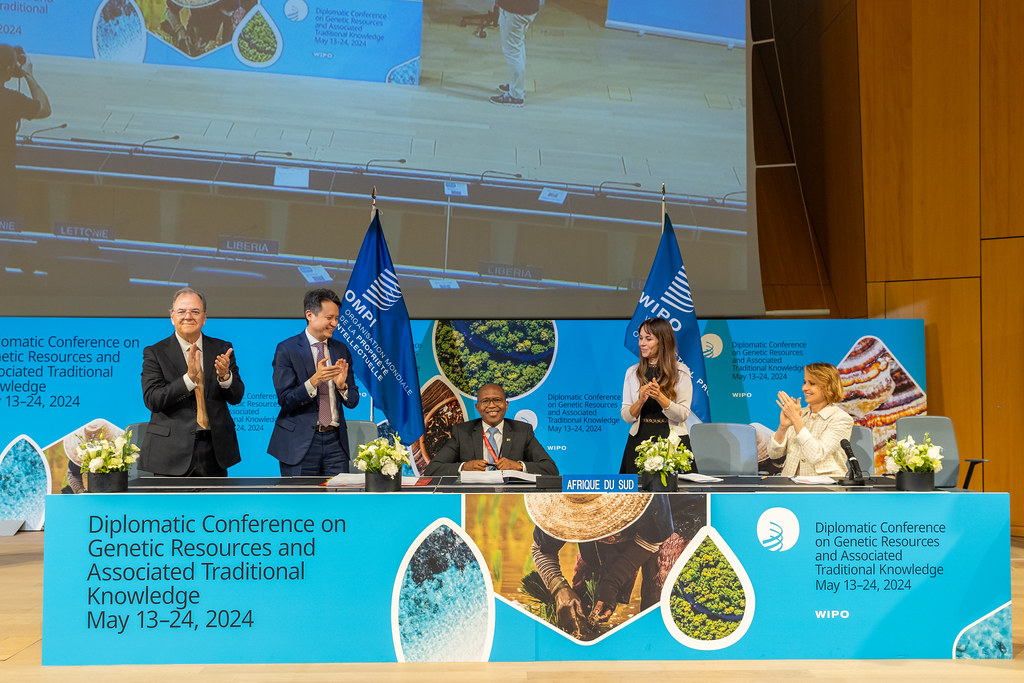
The WIPO Treaty on Intellectual Property, Genetic Resources and Associated Traditional Knowledge (the ‘GRATK Treaty’) was adopted, by consensus, on May 24, 2024. In this blog, Wend Wendland argues that it is time for a core group of countries – he calls them ‘Friends of the GRATK Treaty’ – to rally behind the Treaty and work together to bring the Treaty into force in as many countries as possible, safeguard the Treaty from those trying to undermine it, and ensure the Treaty serves one of its core purposes as an international legal instrument.
This blog is based on a presentation made by the author at the ‘Executive Course for Ambassadors of the African Group: Navigating the Global IP Architecture’, organized by Geneva Centre on Knowledge Governance on July 16 and 17, 2026
The Treaty’s Significance
The significance of the Treaty’s adoption cannot be overstated. For the first time:
- the patent system will provide greater transparency as to which elements of biodiversity are being used, and by whom, and for whose benefit. The Treaty, therefore, helps to curb biopiracy and facilitates equitable access and benefit-sharing;
- an international intellectual property (IP) treaty refers to ‘traditional knowledge’;
- an international IP treaty explicitly includes Indigenous Peoples and local communities in the Treaty and in its future governance; and,
- there is an IP treaty for which countries from the Global South were the proponents. Therefore, for one of the first times in the history of international intellectual property law making, developing countries were not policy-takers but policy-makers, not rule-takers but rule-makers.
Additionally, the adoption of the Treaty shows that the promotion of innovation, respect for the rights of Indigenous Peoples and the conservation of biodiversity are not mutually exclusive.
These are among the reasons that the Treaty has been described by many countries, Indigenous Peoples and scholars alike as ‘historic’, ‘a win for greater balance in intellectual property politics’, a ‘landmark development’, a ‘breakthrough’, a ‘major achievement’, ‘an historic milestone’, and a ‘stark signal of the strength of multilateralism’.[1]
Bringing the Treaty to Life
Africa was often in the lead in the long and winding 25-year journey to the adoption of the Treaty.[2] Africa’s leadership is continuing. Among the 44 countries that signed the Treaty within the one-year period allowed for signing, the majority are African.
But, signing a Treaty is not the same as joining a Treaty. This Treaty will come into force three months after 15 countries have either ratified or acceded to it.
So far, four countries have formally joined the Treaty, two of which are African: Malawi and Uganda. The other two are Albania and Peru.
While the Treaty’s adoption was a milestone, it’s now critical that the Treaty comes into force and begins to realize its promise.
While I have no doubt that the Treaty will come into force in due course, it would be a pity in my view if its membership does not include at least some high-income countries and those with large biotech, pharmaceutical and agro-food companies and in which many patents are filed. I’m pleased to hear that Australia and Switzerland, which both signed the Treaty, seem to be considering joining the Treaty.
There is, however, strong resistance to the Treaty, especially from the United States of America and some other industrialized countries. See, for example, the difficulties being experienced in the Patent Cooperation Treaty (PCT) Working Group at WIPO.
Friends of the GRATK Treaty
Helping the Treaty to come into force in as many countries as possible, and safeguarding the Treaty from attempts to undermine it, are two of the reasons for a core group of friends of the Treaty to rally behind it.
There’s another reason too: it may help ensure that the Treaty serves its core purpose as an international legal instrument.
A core purpose of the Treaty – of any treaty – is to facilitate convergence of standards across domestic jurisdictions. The very reason that countries chose to adopt the Treaty was because there are important differences among the 35 or so existing disclosure regimes at national and regional levels.[3] In today’s globalized economy, issues at the nexus of biotechnology, patents and biodiversity are impractical and/or undesirable to leave to domestic regulation alone. This was why countries agreed to work together to agree on an international legal instrument.
However, as is often the case with a text adopted by consensus, the Treaty is silent, vague or ambiguous on some key elements. This is likely to create uncertainty and lead to important divergences in how the Treaty is interpreted, enacted and operationalized in the Contracting Parties.
If so, the Treaty’s broader purpose of facilitating convergence across domestic legal systems may be undermined. Rather than harmonization, there will be continued fragmentation.
Once it is established, the Treaty’s Assembly of Contracting Parties will play an important role in the maintenance and evolution of the Treaty. Indeed, one of its roles is to promote cooperation among the Contracting Parties.[4] But, it will only meet later, some time after there are at least already 15 parties to the Treaty.
So, with this in mind, a group of ‘Friends of the GRATK Treaty’, from all regions and including some supportive industrialized countries, could also help countries align their interpretation of the Treaty and their legislative preparations and administrative practices related to the Treaty’s implementation. It’s not enough that the Treaty simply comes into force as soon as possible: as important, is that the Treaty is sensibly and similarly implemented in a diverse range of countries. This would also strengthen the Treaty’s Assembly when it starts to meet.
This core group of countries could work with WIPO and other partners to develop a ‘GRATK Treaty Implementation Support Program’.
A program such as this could for, example, develop joint interpretive guidance, checklists, practical guides and toolkits; provide training programs; establish information-sharing platforms; and, facilitate peer-to-peer support and mentorship.
There are precedents for programs like this in other intergovernmental organizations and, in fact, also in the area of Indigenous Peoples’ rights around implementation of the UN Declaration on the Rights of Indigenous Peoples.[5]
In principle, a support program like this could and should be housed in the WIPO Secretariat. The WIPO Secretariat is already responding to requests from Member States for legal-technical assistance. For example, on request, the Secretariat is organizing regional workshops and providing legislative information. But, given WIPO’s wide membership, the Secretariat may need a specific mandate from Member States to be as active and dynamic as needed. The South Centre and the Geneva Centre on Knowledge Governance may also be able to provide support if so asked.
In sum, I leave with you the idea that you, the African Group and other Member States, work together as ‘Friends of the GRATK Treaty’ to champion the Treaty, help bring it to life, safeguard it and align as far as possible how the Treaty is interpreted and implemented.
Wend Wendland is a Senior Fellow, Geneva Centre on Knowledge Governance, Graduate Institute and Adjunct Professor, Faculty of Law, University of Cape Town. He was for many years a Director of the World Intellectual Property Organization (WIPO) until his retirememt from WIPO in June 2025. He is the author of ‘The Journey to the WIPO Treaty on Genetic Resources and Associated Traditional Knowledge: Policy, Process and People’ (Edward Elgar, 2025), now available in paperback.
_____
- Wend Wendland, ‘The Journey to the WIPO Treaty on Genetic Resources and Associated Traditional Knowledge: Policy, Process and People’ (Edward Elgar, 2025), p. 226. ↑
- See Wend Wendland, ‘Africa achieves a landmark outcome: WIPO’s historic new Treaty to combat biopiracy’, Afro-IP, December 11, 2025, < https://afro-ip.blogspot.com/2025/12/africa-achieves-landmark-outcome-wipos.html> accessed July 18, 2026. ↑
- WIPO, Disclosure Requirements Table < https://www.wipo.int/export/sites/www/tk/en/docs/genetic_resources_disclosure.pdf> accessed July 18, 2026. ↑
- Article 10.2 (g), GRATK Treaty. ↑
- See for example The Implementation Project < https://un-declaration.narf.org> accessed July 18, 2026. ↑