It’s time to put people back into the Intellectual Property system. Currently IP tends to reproduce inequality. IP should support public goods such as health and education. We need to address substitution of creators and markets by AI and we should promote solutions like Public AI to protect research and cultural diversity. The profits earned through the monopoly power of IP should be ‘de-linked’ from the incentive to invest in R&D or creativity, especially in health. Most of all, we need accountability back in the system.
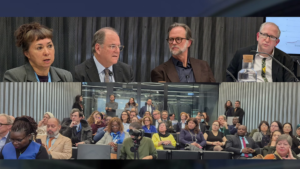
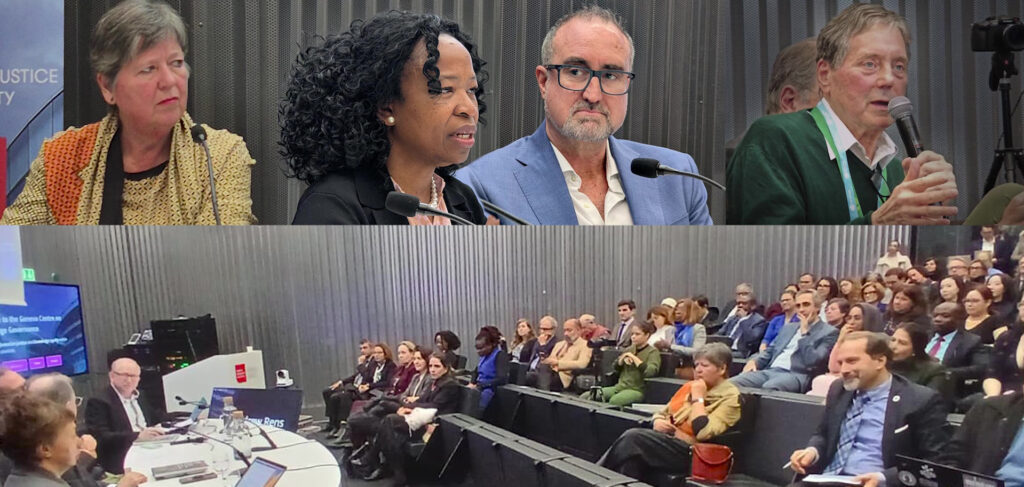
These were a few of the recommendations offered by a high-level panel of international professors, top government representatives and practitioners at the recent launch of the Centre on Knowledge Governance at the Geneva Graduate Institute on 3 Dec 2025. The discussion covered many of the topical issues currently being negotiated at the World Intellectual Property Organization (WIPO) and the World Health Organisation (WHO).
Disclosure of Traditional Knowledge
Former WIPO senior director Wend Wendland talked about his new book which details the long journey to adopt a Treaty on Genetic Resources and Associated Traditional Knowledge (TK), finally passed in 2024 and which requires the disclosure of TK in patent applications, a rare win for marginalised people in the formal IP system.
Valmaine Toki, a Maori rights advocate, praised the treaty but said it will remain an imperfect victory until indigenous people have a full seat at the table in fora like WIPO to ensure full benefit sharing in the exploitation of their knowledge.
Remuneration
Guilherme Patriota, Brazil’s Ambassador to the WTO said that creativity and innovation, especially in the age of AI, should not be a ‘winner takes all’ scenario skewed towards the interests of large corporations.
The creator of Brazil has a huge music industry, very popular, also very valuable in many ways like many other countries of the South. Actually, it’s kind of a wealth of the South. Nigeria has a huge film and music industry as you do in South Africa. What’s going to happen to that? Is that all going to be fed for free into systems for large language models and AI and they will start to replicate similar types of music? I think individuals should have the rights of remuneration for their individual work and contribution. So that’s what we’re looking for. Make it more human, make the system more human.
Harvard Law Professor Ruth Okediji argued that the failure to reward creators is a problem throughout the IP system:
The innovators behind the COVID-19 vaccine are not the ones getting the royalties. The employees in the big intermediaries are not the ones getting the remuneration.
It’s not just indigenous communities. It’s not just women. It’s not just small and medium enterprises. The entire ecosystem is structured around private arrangements that make equitable dissemination [of benefits] difficult… AI is bringing us to this moment of confrontation in more explicit ways. Let’s remember that it’s not just the scraping of music or the scraping of data. There are labourers in developing countries who are painstakingly, for very little money, involved in this [production of AI models]. There are environmental costs of these large language models and those costs will be borne disproportionately. So I think to echo something Ambassador Patriota said, this [inequality] is in the DNA of the system.
Access to Medicines
Participants also talked about the impact of IP monopolies on access, especially to public goods. Leading health advocate Ellen ‘t Hoen expressed disappointment that the IP lessons learnt by the Access to Medicines movement which fought successfully for affordable AIDS medicines in the 1990s were not applied during the Covid19 pandemic.
The vaccines, the COVID-19 vaccines were largely developed with fast, vast amounts of public financing. …That’s exactly what you want. If a crisis hits like that, you want governments to act and spend money in order to solve it. But what they failed to do was attach conditions to that financing. Those conditions could have, for example, been licensing know-how through the Coronavirus Treatment Acceleration Program (CTAP) or the Medicines Patent Pool. That did not happen. So the IP was quite strong, and the companies at the end of the day became the ones who decided where the vaccines would go, and the vaccines went to the highest bidders. There is the famous case of Canada buying three times the size of its population, while about five people were vaccinated in sub-Saharan Africa.
James Love of Knowledge Ecology International added the problem of global scale:
I think we have to really think hard about how you produce works, produce inventions, produce products as public goods in a world where markets are global. They’re not just national. Governments can sort of do public goods at the national level. They have really been bad at doing it at the global level. And I think that proposals like the idea of de-linking the incentive for drug development from the price of the drug, or the idea of a WTO agreement on the supply of public goods, those things are really, really important today.
Limitations and Exceptions
Ruth Okediji described Limitations and Exceptions to Copyright in a similar vein:
There are public goods for which limitations and exceptions are critical. Education would be an example. Every country needs limitations and exceptions that address what happens in the classroom. So I’d say limitations and exceptions for education are super important.
We have limitations, for example, for innovation purposes, reverse engineering, decompilations, when it comes to software. This is important in order to both promote interoperability but also to understand what’s behind the hood when you’re looking at a particular technical invention. So I think identifying the category of limitations and exceptions is important and then discerning whether that is a category that at the multilateral level can facilitate consensus because it is the kind of knowledge good for which all countries have a common concern. Archivists are another example. The role of libraries, another example.
Okediji went on to characterise L&Es as a form of delinkage
How do we separate the incentives for creativity from the tax we all must bear in order to make sure that writing goes on, that education goes on, that music goes on?
Public AI
Centre on Knowledge Governance Director, Sean Flynn talked about interventions that could help protect the public interest when it comes to AI:
The AI field is now reproducing a power balance that’s been in copyright for 20 years or more, which is policy is made basically at the intersection of big tech and big content. All of these guys have plenty of money, plenty of lobbyists… So who’s left out of that? Researchers are left out of that. Consumers are left out of that. Small individual creators, scientists, etc.. So, in the AI space you can see this kind of thinking emerging… Some people call it ‘Public Interest AI’ or ‘AI for Good’ or, and there’s a new term called ‘Public AI’. And essentially, they’re talking about AI systems that are publicly accountable.
Flynn cited public AI projects under way in Spain, Switzerland and Nigeria, partly to enhance cultural diversity:
We’re now understanding that large language models are themselves a language. And languages represent and display a culture. And so, large language models, when you train them on the whole internet, represent the culture of the internet… It’s predominantly English, it’s predominantly United States, it has all kinds of racism built into it. And one of the ways to combat that is build small language models, is train not on the whole internet, but actually on local sets of materials.
Research Agenda for the Centre
Participants agreed that the Centre on Knowledge Governance should play a role in researching and promoting positive approaches which support IP reform. According to Wend Wendland, “There’s a real crying need for safe spaces outside of WIPO for delegates to have informal and frank conversations and dialogues supported by experts with a balance of perspectives” Wendland proposed that the Centre do some work on Traditional Cultural Expressions, including “think pieces, options papers, issues papers and strategy option papers for policy makers and even the IGC chair and vice-chairs to use if they wish to.”
Other issues were raised which might form part of a research agenda for the Centre and/or its partners, including:
- Developing proposals for new institutional arrangements to ensure more inclusive participation in multilateral policy making fora by marginalised groups such as Indigenous People (Valmaine Toki)
- Studying the type of actions which may accelerate the ratification of the Traditional Knowledge Treaty by countries to hasten its coming into effect. Such actions may focus on ways to increase the voice of the affected parties in policy making at national level. (Ambassador Patriota)
- Investigating the proposition that AI technologies may reduce drug development costs, and this may assist in advancing the propostion that patent monopolies which push up prices unreasonably are no longer justified (Ellen ‘t Hoen)
- Elaborating a range of “distinguishing factors” which might be used for evaluation of AI tools from various perspectives, such as evaluating whether access to training data should be subject to copyright exceptions. (Ben Cashdan, from the chair)
- Identifying and comparing Public AI initiatives such as those in different stages of development in Switzerland, Spain (Barcelona) and Nigeria, possibly to come up with a useful typology of Public AI (Sean Flynn)
- Investigation of the European Data Space model (currently covering the health sector) through which data holders are required to make health data available within the EU, for the purposes of research, product development etc (James Love)
- Examining expanded formulations of the ‘substitution factor’ (as found in the Fair Use doctrine in the US) to mitigate the negative impact of generative AI on artists and their livelihoods, which go beyond copying a single creative work (Sean Flynn)
- Delving deeper into the role of competition law alongside IP in knowledge governance, both in AI and in medicine. (Ruth Okediji)
- Focusing on accountability from major firms who both produce technologies that we want, but also produce them in ways that we find less desirable. That could be a new instrument on digital collections of royalties, or bringing artists back into the conversation about remuneration, or funding incentives in a different way. At the moment, we do not have a functioning multilateral framework for accountability by governments outside of the human rights framework. (Ruth Okediji)
Below is the full transcript of the launch. You can watch the full video of the launch online. You can also register an interest in our upcoming course on Artificial Intelligence and Intellectual Property.