
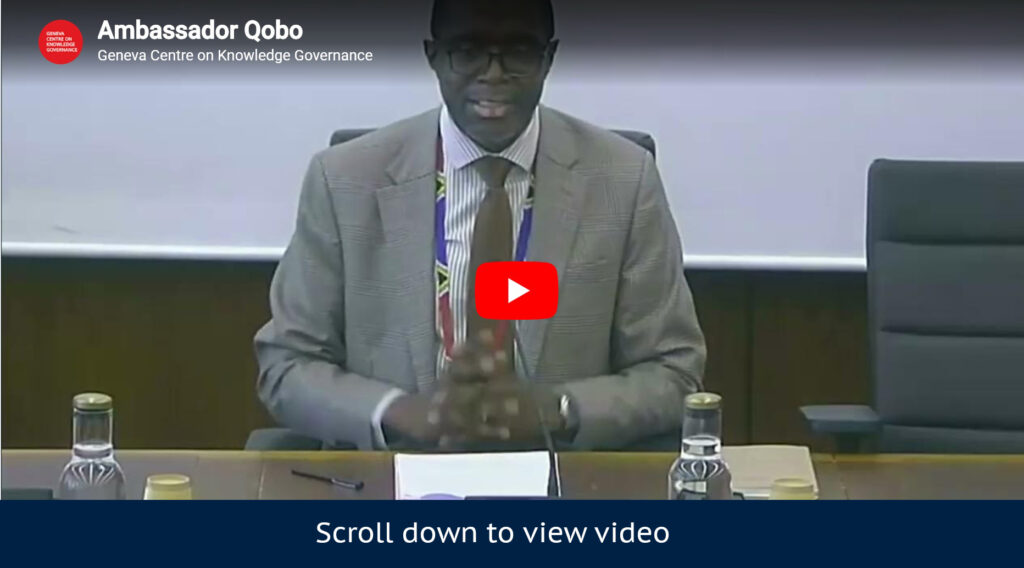
Global copyright frameworks must evolve to ensure a fair balance between rewarding creators and protecting the public’s right to knowledge. This is the main message delivered by Mzukisi Qobo, South Africa’s Ambassador and Permanent Representative to the World Trade Organisation, during his address to members of the Access to Knowledge Coalition of education and research organisations at WIPO in Geneva on 21 May 2026. In his presentation, Qobo emphasises that while early copyright laws like the Statute of Anne inherently prioritised public access and affordability, today’s globalised intellectual property rules frequently result in knowledge scarcity for developing nations. He explains that academics and students in the Global South are often priced out of essential materials, and restrictive domestic laws severely lack the necessary exceptions for libraries, research, and cross-border sharing.
Watch the video to hear Qobo detail the devastating real-world impacts of these imbalances, such as the permanent loss of roughly 3,500 rare films in a University of Cape Town fire because copyright laws prevented the archive’s digitisation. He also highlights how these outdated frameworks threaten the future of innovation by restricting African developers from accessing the datasets needed to train Artificial Intelligence. Ultimately, Qobo issues a powerful call to support the African Group’s proposal for a new international instrument that clarifies and expands copyright inclusivity, ensuring that the global system serves the broader public interest.
For the full transcript, visit this blogpost.