Centre News

Artificial Intelligence, Blog, Centre News

Centre Announces Short Course on Intellectual Property and Artificial Intelligence

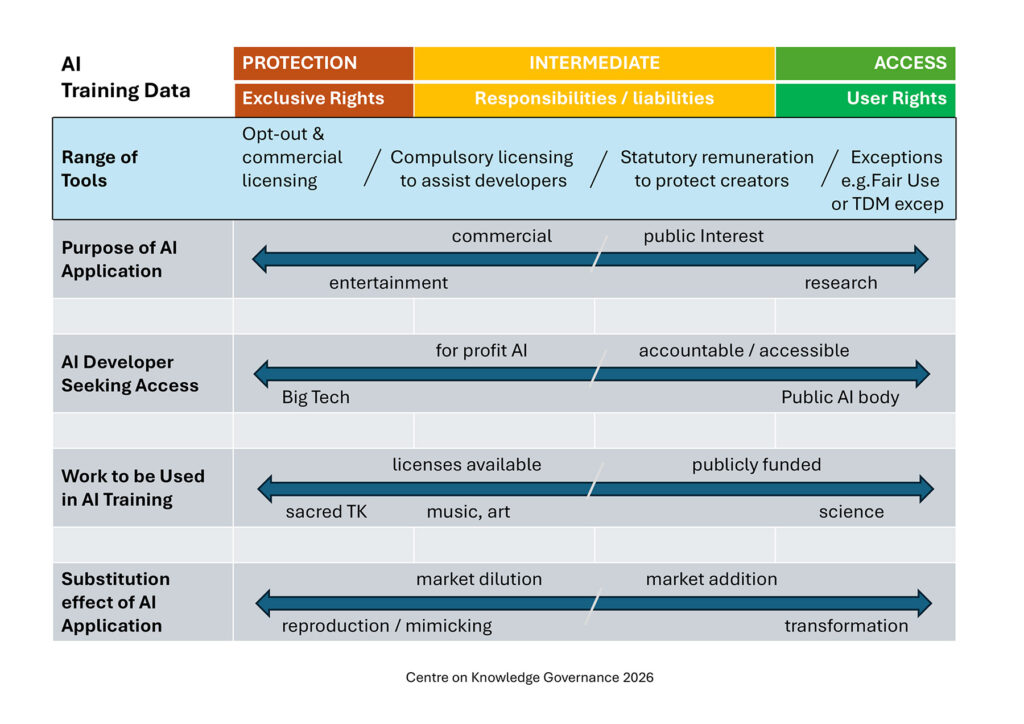
The Centre on Knowledge Governance is please to announce a new short course on AI and IP to take place in Geneva from September 7-8, 2026. COURSE DESCRIPTION  This intensive two-day course provides a comprehensive, comparative analysis of the evolving legal and policy landscape at the intersection of Intellectual Property (IP) and Artificial Intelligence (AI). Participants will explore pressing legal challenges, including the copyright protection for AI training data, the patentability and copyright of AI-generated outputs, and the balance between proprietary interests and the public interest in research (Text and Data Mining and computational research) and the development of “Public AI.”  The course will feature in-depth comparative analysis of legal frameworks and policy proposals across the European Union (EU), United States (USA), India, Brazil, Singapore, Japan, and in international forums, such as the World Intellectual Property Organization, World Trade Organization and other agencies.  The learning experience will culminate in a practical role-play exercise in which students will draft a model international legal instrument aimed at ensuring fair remuneration for creators while safeguarding the rights of researchers and public interest organizations developing AI infrastructure. This legal instrument will focus on  a range of factors to be used in distinguishing research and public interest uses of AI from commercial competitive uses. LEARNING OBJECTIVES Upon completion of this course, participants will be able to: WHO IS THIS PROGRAMME FOR? This programme is particularly relevant for mid- to senior level practitioners from various organisations working at the intersection of intellectual property and AI policy or scholarship, such as: LECTURERS The Course will be directed by Sean Flynn and Ben Cashdan of the Centre on Knowledge Governance, Geneva Graduate Institute. Guest lecturers will participate in person or online to bring comparative expertise from jurisdictions such as India, Brazil and China and the African continent, in addition to the US and EU. SCHOLARSHIPS 10 scholarships will be available for highly motivated government delegates from developing countries or representatives of public interest organizations who participate in multilateral policy processes on copyright, AI and the rights of researchers. EXPRESSION OF INTEREST (INITIAL APPLICATION) If you are interested in being considered as a student on the course, and/or if you would like to apply for one of our scholarships, please kindly complete the following form:

Blog, Broadcast Treaty, Centre News, WIPO GA, WIPO-SCCR

Centre publishes new analysis on broadcast, limitations and exceptions

This week our research team published a series of new reports. These relate to the work streams in the upcoming Standing Committee on Copyright and Related Rights (SCCR) at the World Intellectual Property Organization (WIPO). Analysis of Agenda Items for WIPO SCCR 47by Sean Flynn This note, which will be presented at the November 25, CKG Workshop on SCCR 47, provides background information, links to recently published research and analysis, and descriptions of the issues that may be addressed in the 47th meeting of the World Intellectual Property Organization’s Standing Committee on Copyright and Related Rights, December 1-5, 2025. It is published as part of the mission of the Centre on Knowledge Governance to produce information and analysis to promote the public interest in multilateral knowledge governance negotiations. The analysis is presented in the order that the items occur on the SCCR 47 Agenda.  Tracing a Century of Broadcasting Rights Debates: 1928–2025Luca Schirru and Sean Flynn This report provides a detailed view of developments concerning broadcasting rights within international copyright law, beginning with the 1928 Rome Revision of the Berne Convention and continuing through the latest SCCR discussions. These SCCR sessions illustrate the ongoing effort to create a new international treaty to update protection for traditional broadcasting and cablecasting against signal piracy, while grappling with complex issues like protection over computer networks and the definition of object and scope. Copyright Limitations and Exceptions in the SCCR: A TimelineLuca Schirru, Ben Cashdan and Sean Flynn The timeline details the progression of discussions within the WIPO SCCR regarding Limitations and Exceptions (L&Es) to copyright. This detailed chronology, spanning from 1996 to 2025, highlights the main proposals, studies, and key milestones concerning L&Es for various sectors, including visually impaired persons, libraries, archives, and educational institutions. It documents the formal inclusion of L&Es on the SCCR agenda, the development of numerous draft treaties and working documents, and the ongoing efforts to reach consensus and implement work programs. Comparison of Proposed Texts on Limitations and Exceptions in SCCR 47Jonathan Band Two new documents have been introduced for the Limitations and Exceptions agenda item: the African Group’s “Proposal on Limitations and Exceptions” (SCCR/47/5) and the Chair’s “Text Proposed” (SCCR/47/8), alongside the earlier U.S. proposal “Limitations for Libraries and Archives” (SCCR/44/5). The tables identify common elements among the three documents and additional areas shared by the Chair and African Group texts, suggesting significant areas of commonality and that further text-based work towards an international legal instrument can start with these documents. Justifications for an Instrument on Copyright Limitations and ExceptionsAditya Gupta and Sean Flynn The authors summarise justifications for an international instrument on limitations and exceptions (L&Es) to copyright, and for expanded limitations and exceptions more generally. The justifications are taken from a review of academic literature. Researchers have posited that such an instrument is necessary to counteract the existing “minimum protection approach” of international treaties, which often prioritizes copyright holders over the public interest, access to knowledge, and competition and development concerns. Is the draft Broadcast Treaty consistent with the General Assembly mandate?Sean Flynn WIPO published a new draft of the proposed Broadcasting Organizations Treaty as SCCR/47/3, which does not differ in its main provisions from previous drafts and raises questions about whether it fulfils the mandate of earlier WIPO General Assemblies. The analysis focuses on substantive changes and controversial provisions, addressing whether there is sufficient “agreement on objectives, specific scope and object of protection”. Four new proposals for SCCR 47Ben Cashdan WIPO has published four new proposals on ways forward for key work streams in the SCCR, scheduled for 1–5 December 2025. The proposals concern exclusive rights for broadcasting organisations, disparities in the remuneration of performers, limitations and exceptions to promote education, research and access to knowledge, and ensuring fair copyright royalties for creators in the digital environment.

Blog, Centre News, WIPO GA, WIPO-SCCR

Comparison of Proposed Texts on Limitations and Exceptions in SCCR 47 

Two documents have been introduced in connection to the Limitations and Exceptions agenda item for SCCR 47 Previously we already had a third document Below are two tables. The first identifies common elements among the African Group Proposal, the Chair’s Text, and the US proposal. The second table identifies common elements addressed by the African Group Proposal and the Chair’s text, but not included in the U.S. document. (It should be noted that the African Group’s Proposal also includes provisions not in the U.S. document or the Chair’s text.) As the attached tables demonstrate, there are significant areas of commonality among all three documents; and even more between the Chair’s text and the African Group Proposal. This suggests that further text-based work in the Committee towards an international legal instrument or instruments concerning exceptions and limitations can start with these documents.  PDF version below Table 1: Common Elements in United States Objectives and Principles for Exceptions and Limitations for Libraries and Archives, African Group Proposal, and Chair’s Proposed Text U.S. Objectives and Principles African Group Proposal Chair’s Text National Exceptions Encourage Member States to adopt well-focused exceptions and limitations in their national laws that are consistent with their international obligations, including the three-step test, and facilitate the public service role of libraries and archives, and maintain the balance between the rights of authors, artists and publishers, and the public interest, particularly in research, education, preservation, and access to information. (p. 2) Encourage Member States, when adopting or revising exceptions and limitations for libraries and archives, to consider adding museums and other non-profit institutions that function as a library, archives, or museum as eligible entities. (p. 2) Contracting Parties shall take all appropriate measures to respect, protect and fulfill the right to receive education and conduct research through appropriate exceptions and limitations in their national laws, consistent with their international obligations, maintaining the balance between the rights of authors and the larger public interest. (p. 15) Member States shall provide an appropriate balance in their copyright and related rights system through limitations and exceptions for the public interest, including for education; research; freedom of expression uses such as for quotation, comment, criticism, review, caricature, parody and pastiche; access to information and news reporting; preservation of cultural heritage; and to facilitate access for persons with disabilities. (p. 15) Contracting Parties shall update, carry forward and appropriately extend into the digital environment limitations and exceptions in their national laws which have been considered acceptable under the Berne Convention, especially under article 10(1) and 10(2), and devise new exceptions and limitations that are appropriate in the digital environment to protect educational and research activities. (p. 15) Limitations and exceptions are an integral part of a balanced copyright system and should contribute to quality preservation, access, education and research, as well as to expand opportunities for all persons with disabilities to fully participate in the cultural life of the community, to enjoy the arts, and to benefit from scientific progress. (p. 6) Promote cooperation among institutions at national, regional and international levels. (p. 6) Research and Education Encourage Member States to enable libraries and archives to carry out their public service role of advancing research and knowledge by adopting exceptions and limitations for purposes of research and scholarship, and to consider adding museums and other non-profit institutions that function as a library, archives, or museum as eligible entities. (p. 3) It shall be permissible to use a work or other subject matter for educational or research purposes to the extent justified by the purpose and provided such utilization is compatible with fair practice. (p. 19) Facilitate access to works for cultural, educational and research purposes, including through digital and online tools, and across borders. (p. 5) Enable cultural heritage institutions as well as educational and research institutions to provide copies and enable access to works to researchers, teachers, students and the public, under appropriate conditions. (p. 5) Preservation Encourage Member States to enable libraries and archives to carry out their public service role of preserving works by adopting exceptions and limitations for their preservation activities, and to consider adding museums and other non-profit institutions that function as a library, archives, or museum as eligible entities. (p. 3) Exceptions and limitations can and should enable libraries, archives, and museums to carry out their public service role of preserving works that comprise the cumulative knowledge, heritage, and culture of the world’s nations and peoples. (p. 3)[E]xceptions and limitations can and should enable libraries, archives, and museums to make copies of published and unpublished works, including highly ephemeral materials, for purposes of preservation and replacement, under certain appropriate circumstances. Those circumstances may include preservation and replacement in both analog and digital formats, or migration of content from obsolete storage formats to more stable formats on an ongoing basis, as reasonably necessary and as incidental to technology for a specific, limited preservation purpose. (p. 3) Contracting Parties shall provide for a limitation or exception to the right ofreproduction in order to allow cultural heritage institutions to make copies of any works or other subject matter that are permanently in their collections, in any format or medium, for the purposes of preservation of such works or other subject matter and to the extent necessary for such preservation. (p. 29) For purposes of this Instrument, “cultural heritage institution” means a publicly accessible library or museum, an archive, or a film or audio heritage institution. (p. 31) Support the preservation of cultural heritage by libraries, archives and museums and other not-for-profit entities performing equivalent functions. (p. 4) Enable cultural heritage institutions to make copies of works, whether published or unpublished, for the purposes of preservation or replacement, including highly ephemeral materials. Such copies may be made in analog or digital formats, and during technological migration, provided they are necessary and incidental to a specific preservation purpose. (p. 4) Enable the preservation of and remote digital access to works, including cross-border, under secure conditions and promote the respect of adequate and effective

Blog, Centre News, WIPO-SCCR

Four new proposals for SCCR 47

The World Intellectual property Organization (WIPO) has published four new proposals on ways forward for some of its key work streams in the Standing Committee on Copyright and related Rights (SCCR), to take place from 1st to 5th December 2025. The proposals concern:(i) Exclusive rights for Broadcasting Organisations to protect their content(ii) Addressing Disparities in the Remuneration of Performers(iii) Limitations and Exceptions to Copyright to promote Education, Research and Access to Knowledge, and(iv) Ensuring Fair Copyright Royalties for Creators in the digital environment across the world. Here are the proposals in more details, with links to the source documents and to our analysis. Document Number Title Description Submitted by SCCR/47/3 A new draft of the WIPO Broadcasting Organizations Treaty. This aims to reflect the views of member states expressed at the previous SCCR and also at the WIPO General Assembly in July 2025. It addresses the issue of enhanced and updated protection for broadcasting organizations concerning their programme-carrying signals, which has been on the WIPO agenda since 1998. But does it give broadcasters and streamers too many exclusive rights? See our analysis of the latest draft. SCCR Chair, Vice-Chair, and facilitators SCCR/47/4 A proposal for a Study on the Rights of Audiovisual Performers and their Payment Mechanisms for the Exploitation of their Performances. This requests WIPO to commission a study on the situation of audiovisual performers, examining the legal and economic frameworks governing performers’ rights worldwide, and how these influence payments received for the use of audiovisual performances, especially on digital and on-demand platforms. It aims to assess the impact of the Beijing Treaty on Audiovisual Performances and identify best practices in ensuring performers receive fair payment. African Group SCCR/47/5 A draft Instrument on Limitations and Exceptions for Libraries, Archives, Museums, Education and Research Institutions and People with Disabilities. The draft instrument recognizes the need to maintain a balance between the rights of authors and the larger public interest, such as education, research, and access to information. It specifies permitted uses for education and research, cultural heritage, and for people with any disability that requires accessible formats.See our summary of justifications for L&Es. African Group SCCR/47/6 A proposal for a Legally Binding Instrument on the Governance of Copyright Royalty in Digital Environment: Promoting a Fair Chance in a Globalized World. This working paper proposes a legally binding international instrument to govern copyright royalties in the digital environment. It addresses the disparity between developed and developing countries regarding royalty collection and distribution mechanisms. It identifies four key challenges: the governance of royalty collection and distribution, mechanisms for royalty allocation, the centralization of a global copyright database, and disparities in copyright royalty valuation.Watch our contributions to the remuneration debate Indonesia

Blog, Centre News

Italy updates its copyright law to address AI

On September 18, 2025, the Italian Senate definitively approved the country’s first comprehensive framework law on artificial intelligence (AI). The new law also reflects Italy’s commitment to aligning its domestic legal system with the EU Artificial Intelligence Act (Regulation (EU) 2024/1689), ensuring coherence between national rules and the emerging European regulatory framework. Law no. 132 of September 23, 2025 (Provisions and delegations to the Government regarding artificial intelligence), has been published in the Official Gazette no. 223 of September 25, 2025, and it will enter into force on October 10, 2025. It consists of 6 chapters and 28 articles, not only establishing ethical and regulatory frameworks for AI across various sectors but also bringing several changes to the field of copyright law. In particular, Chapter IV, titled “Provisions for the Protection of Users and Copyright,” modifies Article 1 of Law No. 633/1941 (Italy’s Copyright Act) and introduces a new Article 70-septies, adapting the legal framework to the evolving challenges posed by AI-generated content and data mining. Emphasising human authorship The first major change introduced by Article 25,  a), of the new AI law is a revision to Article 1 of the Italian Copyright Act. The phrase “human” has been explicitly added, clarifying that only works of human creativity are eligible for protection under Italian copyright law. The amended text now reads: This law protects works of human creativity in the fields of literature, music, figurative arts, architecture, theatre, and cinematography, whatever the mode or form of expression, even when created with the assistance of artificial intelligence tools, provided they are the result of the author’s intellectual effort. This addition is not merely semantic. It codifies a crucial principle: while AI can be a tool in the creative process, copyright protection remains reserved for human-generated intellectual effort. This positions Italian law in alignment with the broader international trend, seen in the EU, U.S., and UK, of rejecting full legal authorship rights for non-human agents such as AI systems. In practice, this means that works solely generated by AI without significant human input will likely fall outside the scope of copyright protection. Regulating text and data mining for AI The second key innovation is provided by Article 25,  b), of the new AI law, which introduces Article 70-septies in the Italian Copyright Act, providing clarity on the legality of text and data mining (TDM) activities used in the training of AI models. The provision states: 1. Without prejudice to the provisions of the Berne Convention for the Protection of Literary and Artistic Works, reproductions and extractions from works or other materials available online or in databases to which one has lawful access, for the purposes of text and data mining by AI systems, including generative AI, are permitted in accordance with Articles 70-ter and 70-quater. This provision essentially reaffirms that text and data mining (TDM) is permitted under certain conditions, namely where access to the source materials is lawful and the activity complies with the existing TDM exceptions under EU copyright law, as already implemented in Articles 70-ter and 70-quater of the Italian Copyright Act. It mirrors the spirit of the EU Directive 2019/790 on Copyright in the Digital Single Market, which created specific exceptions for TDM, notably distinguishing between scientific and general uses. By formally reiterating the TDM exceptions for the use of AI, Italy seeks to balance the promotion of AI development with the protection of content creators’ rights. However, challenges remain regarding the definition of ‘lawful access’ and the ability of rightsholders to effectively exercise their opt-out rights in relation to TDM activities. Conclusion The recent amendments to Italy’s Copyright Act mark an important step toward harmonising traditional legal frameworks with the realities of emerging technologies, such as AI. By emphasising human authorship and providing clearer legal pathways for text and data mining, the new provisions aim to foster both innovation and respect for intellectual property. The law shall enter into force on the fifteenth day following its publication in the Official Gazette of the Italian Republic. This article was reposted from the original at https://communia-association.org/2025/10/01/italy-updates-its-copyright-law-to-address-ai/

Blog, Centre News, Traditional Knowledge

A Paradigm Shift with an Uncertain Future: Prof Wend Wendland on the WIPO Treaty on Genetic Resources and Associated Traditional Knowledge

On 25 September 2025, Professor Wend Wendland, delivered the 14th Peter Jaszi Distinguished Lecture at American University in Washington D.C.. The event was hosted by the Program on Information Justice and Intellectual Property. For over 25 years at WIPO, Prof. Wendland played a critical role in the area of traditional knowledge, including as the Director of the Traditional Knowledge Division and Secretary of the Intergovernmental Committee (IGC). His lecture, titled “Beyond Adoption: Why it Matters and What’s Next for the WIPO Treaty on IP, Genetic Resources and Associated Traditional Knowledge?”, celebrated the recent adoption of this landmark agreement. In his lecture, Professor Wendland described the Treaty as a ‘historic’ event and a ‘paradigm shift’ in intellectual property. He highlighted that it is the first international IP treaty championed by developing countries and Indigenous Peoples, making them policy-makers rather than policy-takers. The Treaty’s core feature is a new mandatory requirement for patent applicants to disclose the origin of genetic resources and associated traditional knowledge. This aims to combat biopiracy and reconcile innovation with biodiversity conservation and equitable benefit-sharing. This transparency is expected to improve the patent system’s quality and efficacy, while also contributing to environmental, economic, and social justice by acknowledging the role of Indigenous Peoples as stewards of biodiversity. Despite his enthusiasm, Wendland acknowledged the Treaty’s limitations, noting that it does not create new rights in traditional knowledge, and does not directly ensure compensation for provider countries and Indigenous Peoples. It represents what could be agreed upon by consensus after a 25-year struggle, demonstrating strategic pragmatism. The adoption itself is significant, marking a step forward in the evolution of the IP system and providing a platform for a more inclusive conversation about the future of IP. However, Wendland cautioned that the treaty’s adoption alone is not enough; its true significance will depend on its practical implementation and effectiveness. Finally, Wendland discussed the path forward, stressing the immediate need for the Treaty to come into force, which requires ratification by 15 countries. He expressed concern that this process might be slower than hoped, with some major countries like the USA, Japan, and the Republic of Korea opposing the treaty, and others like India and China not yet signing it. Potential hurdles for ratification include political reluctance to recognise Indigenous Peoples, conflicts with existing national laws, and pressure from trading partners. Wendland concluded by urging policymakers, patent offices, and the international community to work towards bringing the Treaty to life, ensuring its paradigm-shifting potential is realised in practice. Watch the full presentation here.

Centre News

Tracking AI for Good in the Global South: Our TDM Case Studies are Online

The Geneva Centre on Knowledge Governance has been researching cases of Computational Research (or Text and Data Mining) aimed at public interest outcomes in Africa, Latin America and elsewhere. From a health chatbot in South Africa to a culturally-sensitive LLM for Chile and Latin America, we document the work of AI developers, especially in the Global South. This is part of our work to analyse whether and how copyright and AI policies need to contain provisions which consider the social impact of AI. See our Case Studies on Text and Data Mining.

Centre News

How will Gen-AI lawsuits Impact Copyright? We Help You Keep Track.

Are you trying to keep track of all the litigation by rights holders and creators against Generative AI companies? Litigation is under way covering a range of works, from musical compositions to books and journalism. In some cases the arguments presented and judgements handed down in these cases may begin to define the likely policy direction for copyright in the age of AI. In the first of a series of articles and papers on this topic, Geneva Centre counsel Andrés Izquierdo wrote an Infojustice blog entitled AI, Copyright, and the Future of Creativity: Notes from the Panama International Book Fair. Watch this space for more.

Centre News

It is Official: The Centre will Launch between September and November 2025

It is official – the Centre on Knowledge Governance will be launching in the coming months. In September and October 2025 we expect to publish some of our new research, including our case studies of Computational Research and AI for Good in the Global South. In November and December we will be present at the upcoming WIPO meetings, including the CDIP and SCCR47. Watch this space for announcements and for special events in Geneva and online. See our calendar for all upcoming events: https://knowledgegov.org/events/

Scroll to Top