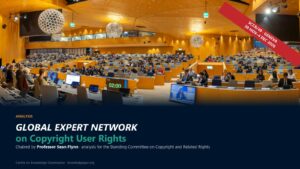
WIPO-SCCR

New Analysis of Agenda Items for WIPO SCCR 49
The Centre on Knowledge Governance (CKG) has published Analysis of Agenda Items for WIPO SCCR 49, a briefing by Sean Flynn and Susan Strba on behalf of the Global Expert Network

The Centre on Knowledge Governance (CKG) has published Analysis of Agenda Items for WIPO SCCR 49, a briefing by Sean Flynn and Susan Strba on behalf of the Global Expert Network


Copyright scholars from South Africa, Canada, Brazil and the United States say the Constitutional Court has cleared the way, and urge lawmakers to pass the Copyright Amendment Bill.


Two opinions of international legal experts are missing from the record of the South African Constitutional Court. The Centre on Knowledge Governance is making them available in this post.


Zachary Cooper argues that forcing generative AI tools to filter out copyright infringement removes copyright’s exceptions in practice and hands the owners of old catalogues a cut of new creativity.


Nancy E. Weiss argues that voice, agency and authority offer a way to think about Indigenous knowledge in the age of AI, and that the real question is on whose terms knowledge will flow.


Aman Gebru argues that open platforms which close up once they mature are breaking a promise, and that contract theory can hold them to it.
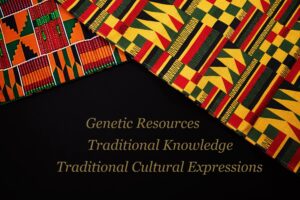

The 53rd session of the World Intellectual Property Organization’s Intergovernmental Committee on Intellectual Property and Genetic Resources, Traditional Knowledge and Folklore (IGC 53) concluded in Geneva on 25 September 2026 with incremental progress on the negotiating texts. But differences persist over the substance, scope and methodology of the negotiations, including whether traditional knowledge (TK) and traditional cultural expressions (TCEs) should be brought together in a single negotiating text.

Australia joining the Treaty would show the Treaty benefits all countries, developed and developing alike. If Australia does join, its implementation experience could contribute to the shared knowledge that helps every country put the Treaty into practice.

Ben Cashdan, Director of Communications for the Centre on Knowledge Governance, attended MozFest 2026 (28–30 October), the Mozilla Festival, in Barcelona on behalf of the Centre. and held talks with Public AI specialists.
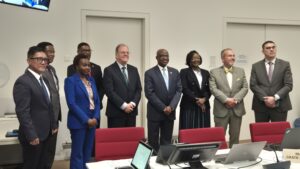
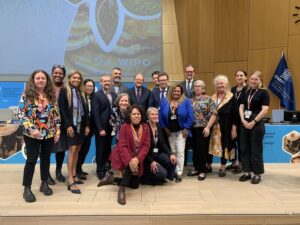
WIPO Member States establish a cross-regional coalition to accelerate ratification of the Treaty on Intellectual Property, Genetic Resources and Associated Traditional Knowledge, with support from the Centre on Knowledge Governance (CKG).

Introduction The Global Expert Network on Copyright User Rights drafted this set of objectives and principles for an instrument on limitations and exceptions at its annual meeting on June 16-18,


At the recent User Rights conference convened in Geneva by the Centre on Knowledge Governance, one panel addressed the topic of the Globalization of Fair Use. As the moderator of

The tenth U.S. rulemaking under section 1201 of the Digital Millennium Copyright Act (DMCA) shows how burdensome the U.S. model is for gaining exceptions to the digital locks that protect much content these days. Countries implementing their WIPO obligations should instead tie liability to infringement, and those bound by U.S. trade deals should keep their process for exceptions as simple as possible.
A thirty-year pattern of U.S. flip-flopping on whether fair use should travel abroad — and why the AI industry’s needs may now be tipping the balance back in its favor.
The 68th series of meetings of the Assemblies of the Member States of the World Intellectual Property Organization (WIPO) convened in Geneva from July 7 to 15, 2026. Following the
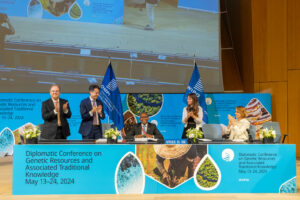
The WIPO Treaty on Intellectual Property, Genetic Resources and Associated Traditional Knowledge (the ‘GRATK Treaty’) was adopted, by consensus, on May 24, 2024. In this blog, Wend Wendland argues that
Introduction The strongest message emerging from the AI for Good Global Summit 2026 was clear: the future of artificial intelligence (AI) will depend less on creating new international laws and

Artificial intelligence has become one of the principal issues facing the international intellectual property system. Over the past several years, the World Intellectual Property Organization (WIPO) has approached AI primarily
On the first day of the 68th series of meetings of the World Intellectual Property Organization (WIPO) Assemblies, seemingly divergent priorities emerged on the floor. On one side, developing nations

The Director-General of the World Intellectual Property Organization (WIPO) Mr Daren Tang, has unveiled his proposed appointments for Deputy Directors General (DDGs) and his appointments for Assistant Directors General (ADGs)

This article first appeared on the blog of the NORRAG Global Education Centre here, as part of NORRAG’s blog series AI and the Digitalisation of Education: Challenges and Opportunities. Sustainable Development
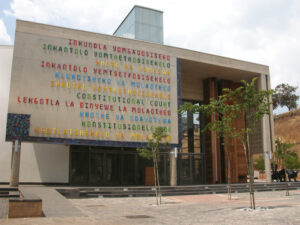
On 26 June 2026 the Constitutional Court in South Africa handed down its judgement on the constitutionality of the Copyright Amendment Bill. It found that the majority of provisions are
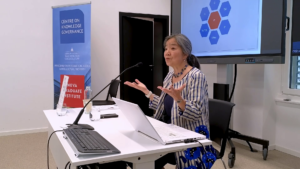

In this video, Maggie Chon explains that 90% of global scientific research is published in English, yet only 25% of the world’s population is proficient in the language. Copyright law
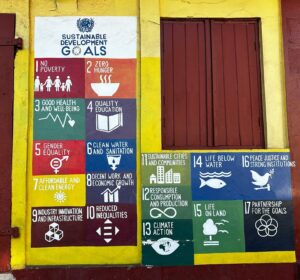
The adoption of the WIPO Development Agenda (DA) at the 34th session of the WIPO General Assembly in Geneva in 2007 marked a turning point in the organization’s approach to
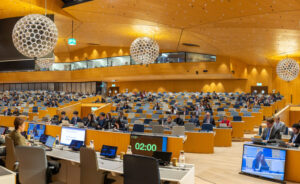
The 48th session of the World Intellectual Property Organization’s Standing Committee on Copyright and Related Rights (SCCR) reached a breakthrough in its main agenda items. Cutting through decades of gridlock,


This article is also available as a PDF here. The Medicines Patent Pool, a UN-backed health organisation, and pharmaceutical company Roche on 18 May signed an agreement to expand access


1. LA PROPUESTA DEL GRUPO AFRICANO ES UN INSTRUMENTO FLEXIBLE El documento del Grupo Africano (GA) sobre excepciones y limitaciones (SCCR/47/5) es un proyecto de instrumento que da curso al


This post first appeared on Medicines Law & Policy. World Health Organization member states will propose to continue negotiations on a critical annex to the Pandemic Agreement, after being unable

News sites – including major papers such as the Financial Times, the New York Times and the Guardian and social media sites such as Reddit — have made archivists the
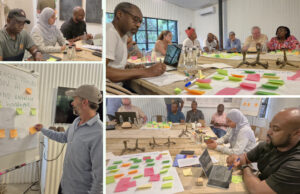
This document was prepared by the Centre on Knowledge Governance (CKG) to summarise discussions on principles of Just AI and Knowledge Governance held in the Cradle of Humankind, South Africa,


Luca has a PhD from the UFRJ Graduation Program on Public Policy, Development and Strategies (PPED/UFRJ) with a thesis on ‘Copyright and AI Generated Works’ and is a Director of the Brazilian Copyright Institute. He is a research fellow at the Centre for IT & IP Law (KU Leuven) and a post-doctoral researcher at the National Institute of Citizen Science in Brazil. He is a guest professor at the Graduation Program on Public Policy, Development and Strategies (PPED/UFRJ) and professor at the Specialization Program on Intellectual Property Law at PUC-RJ.

Dr. Susan Isiko Štrba combines teaching and research with providing policy and legislative advice and technical training to governments, intergovernmental organizations and civil society. She focuses mainly on human rights, intellectual property (IP), trade and development. Dr Isiko Štrba is the author of International Copyright Law and Access to Education in Developing Countries: Exploring Multilateral Legal and Quasi-Legal Solutions, a leading guide to the functioning of international copyright law for the public interest in developing countries. She has also published numerous journal articles in the field of human rights, trade, IP and development.
She currently researches the interface of technology, intellectual property and the African Continental Free Trade Area. She is a member of the International Association for the Advancement of Teaching and Research in Intellectual Property (ATRIP) and a member of the Executive Council of the Society of International Economic Law (SIEL). Dr Isiko Štrba has taught Intellectual property, competition law and human rights in various institutions including: the Boston University (Geneva International Campus), The Graduate Institute, Trade Policy Training Centre in Africa (TRAPCA), the International University in Geneva, University of the Witwatersrand, South Africa and the WIPO Academy.
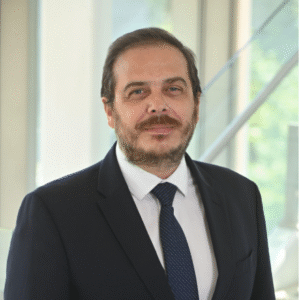
Andrés Izquierdo is Senior Research Analyst for our project on the Right to Research in International Copyright. He conducts high-impact research, provides training to a global network of change-makers, and connects a global academic network to the work of global and domestic organizations that represent researchers, libraries, museums, archives, educational and research institutions.
Before joining PIJIP, Andrés Izquierdo practiced law through his award-winning intellectual property and cyber law practice in Colombia. He has been named one of the best entertainment law attorneys in Colombia by the publications Best Lawyers (2020), and top Intellectual Property practitioner by Chambers and Partners (2014-2020), and is author of the book Cyberlaw by Wolters Kluwer. Izquierdo was previously Business and Legal Director for Sony Music Entertainment in the Andean Region, and litigation partner in Palacio, Izquierdo & Ballesteros, an intellectual property law firm in Colombia. He has LLM degrees in Intellectual Property from American University Washington College of Law and from the University of Turin – WIPO, and a law degree from Universidad de Los Andes.

Ben Cashdan is a economist and television producer in South Africa. He was an economic advisor in the South African Presidency under President Nelson Mandela, focusing on capacity building and local economic development. Since 2000 Ben has served as executive producer of a number of television series on democracy and development for global broadcasters. In 2015 Ben co-founded ReCreate South Africa, a coalition of creators and users of copyrighted material in South Africa, working together for fair and balanced copyright reform and access to knowledge.
Ben has a masters degree in Social and Political Sciences from Kings College Cambridge and a Postgraduate Certificate in Economics from the London School of Economics. Ben also continued his postgraduate studies at Johns Hopkins University in Baltimore, Maryland in the Department of Economic Geography. He was South African producer for Harry Belafonte’s biographical documentary Sing Your Song. Ben has also produced 4 episodes of The World Debate on BBC World News. He developed and produced the first season of South2North on Al Jazeera English, the first global talk show to be produced in Africa for a major global broadcaster. In December 2013 Cashdan produced an episode of BBC Question Time on South Africa after Mandela.
Ben has directed a number of broadcast media projects on democracy and development in partnership with agencies including the World Economic Forum, the United Nations Development Programme and the African Leadership Academy.

Professor Flynn researches and teaches on the intersection of intellectual property, international law, and human rights. Professor Flynn designs and manages a wide variety of research and advocacy projects that promote the public interest in intellectual property and information law. Professor Flynn Chairs the Global Expert Network on Copyright User Rights and is a founding member of the Global Congress on Intellectual Property and the Public Interest.
He is Editor in Chief of Infojustice.org, a leading public interest law and policy blog. He is a special faculty appointment at American University Washington College of Law, visiting Scholar at the University of Amsterdam’s Institute for Information Law (IViR), and Senior Research Associate at the University of Cape Town’s Intellectual Property Unit. Prior to joining WCL, Professor Flynn completed a Fulbright Fellowship, was clerk to Chief Justice Arthur Chaskalson, South African Constitutional Court and Judge Raymond Fisher, U.S. Court of Appeals for the Ninth Circuit, practiced law at Spiegel & McDiarmid and the Consumer Project on Technology, and served on the policy team advising then Assistant Attorney General for Civil Rights Deval Patrick.